Students work hard. Many are doing the wrong mental labor.
These free tools from The LearnWell Projects make thinking visible, so students, tutors and faculty can see what a task demands, aim their effort at the right level, and know when learning is enough. Six free tools, downloaded by more than 1,500 educators.
Watch: why smart students do well in class but poorly on exams (2:29)
Find your tool in 30 seconds
Tell us who you are and what you’re seeing. We’ll point you to the free interactive tool that fits, plus one move you can make this week.
A dime isn’t a dollar. Remembering isn’t analyzing.
Children learn to tell a dime from a dollar long before they have money to spend. College asks students to tell remembering from understanding, and applying from analyzing, every day. Yet that skill is rarely taught.
So students study for hours at the wrong level, ace the quiz, then miss it on the exam. They aren’t lazy. They have a cognitive gap.
Hard work can’t close that gap. Effective thinking can. When students learn to differentiate thinking skills, they can read what a task demands, match their mental labor to it, and check that what they learned matches what will be assessed.

Six tools. One path to effective thinking.
Each tool answers the question the one before it raises. Start with the ThinkWell-LearnWell™ Diagram and follow the steps in order, or start with the one your students need most.
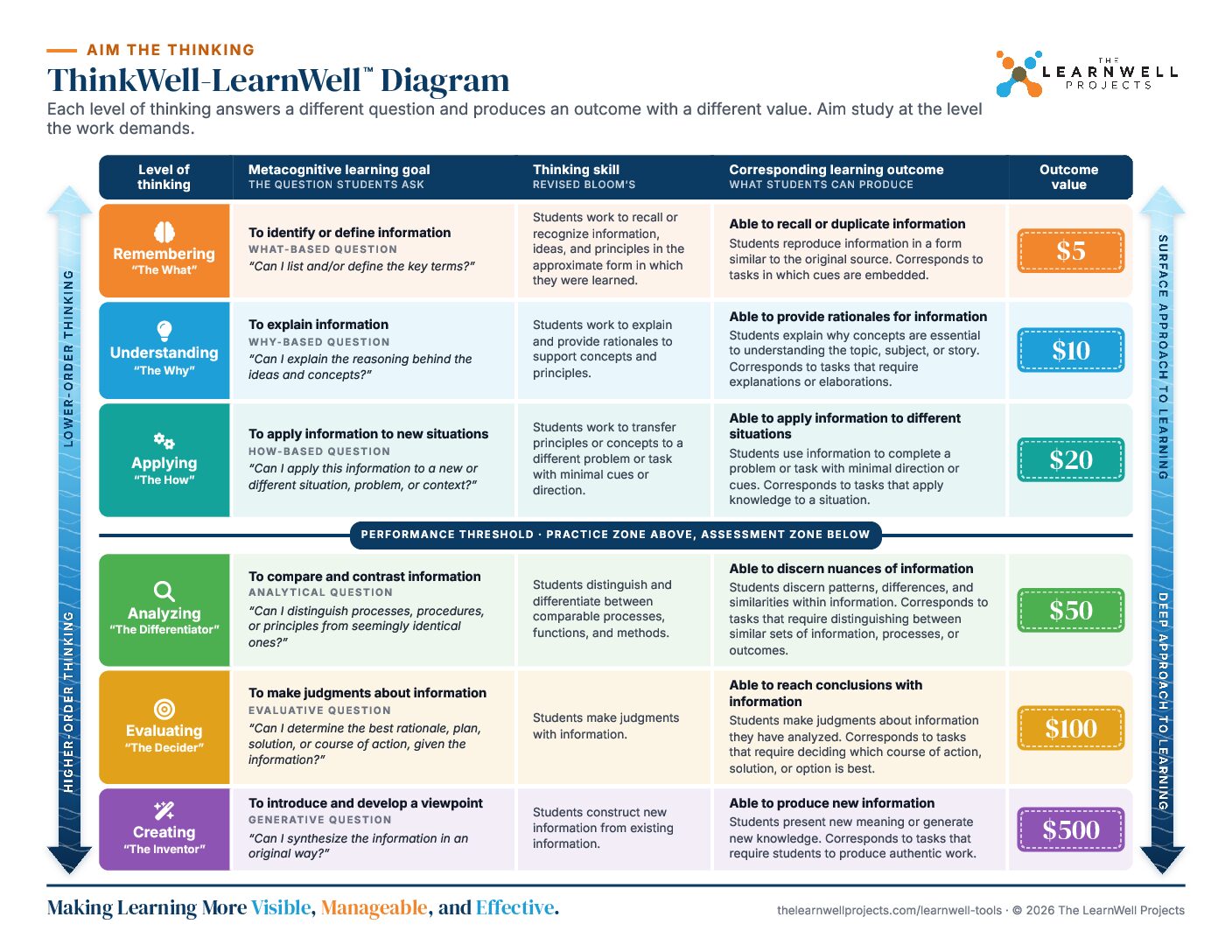
ThinkWell-LearnWell™ Diagram
Six levels of thinking, from remembering to creating, each paired with the question it answers, the outcome it produces and its value, from $5 to $500. Students see at a glance which kind of thinking a task demands and what it’s worth.
Use it when: a student says “I knew it” but missed it on the exam, or work comes back below your standard.
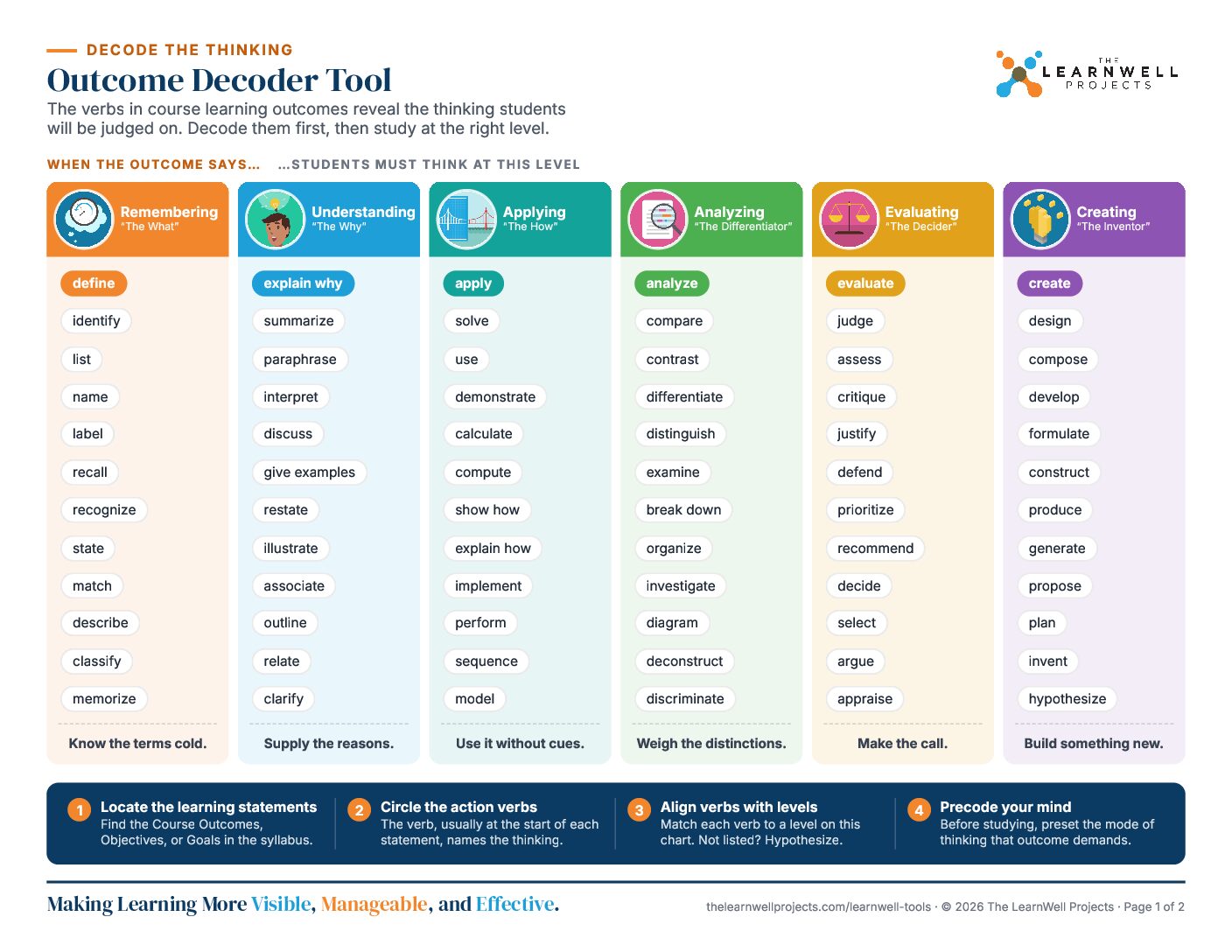
Outcome Decoder Tool
The verbs in a course’s learning outcomes reveal the thinking students will be judged on. The Decoder matches each verb to a level of thinking, so students study at the level the course demands. Works for academic courses and the trades.
Use it when: a new course, unit, or syllabus begins, or a student is working hard at the wrong level.
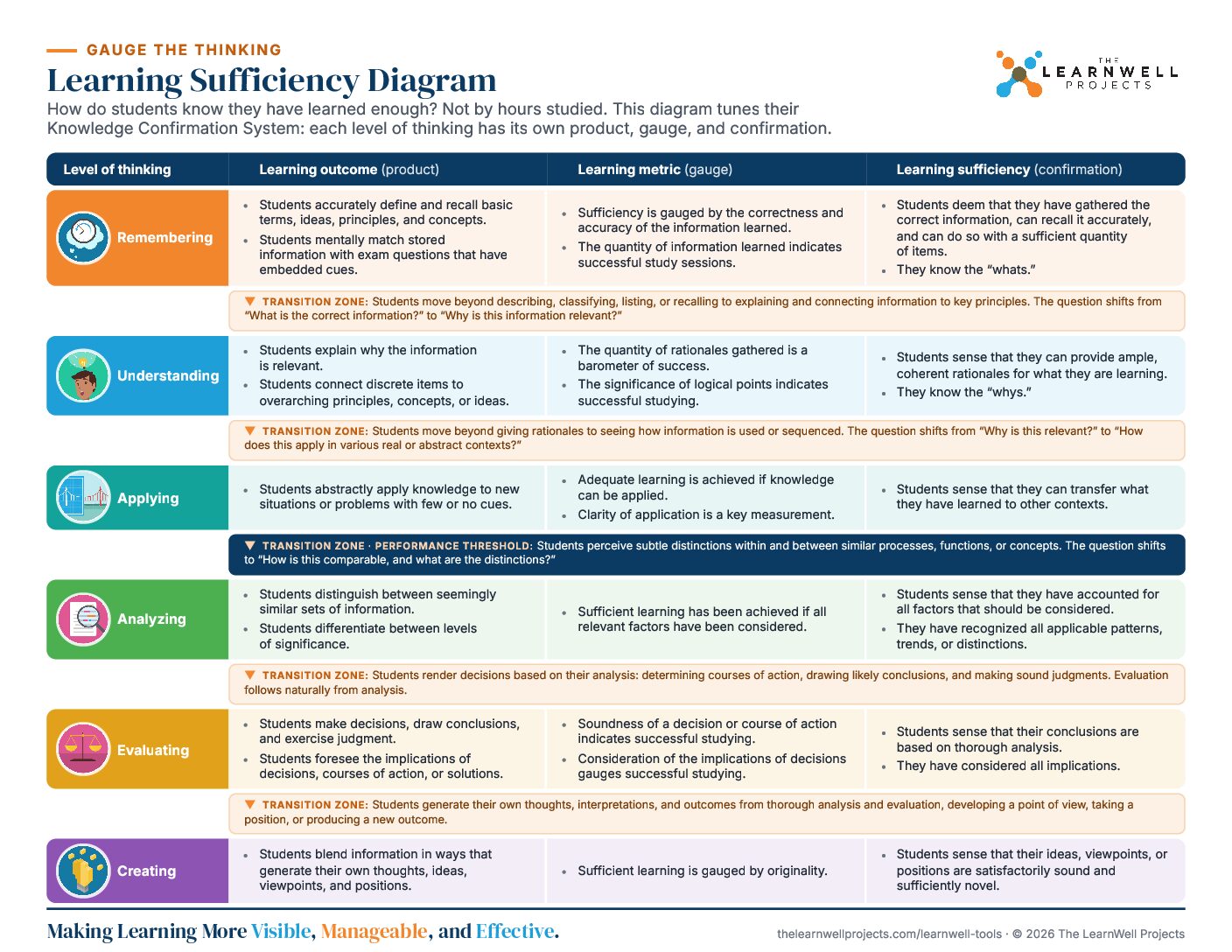
Learning Sufficiency Diagram
How do students know they’ve learned enough? This tool replaces hours studied with better gauges: the outcome each level of thinking should produce, the metric that measures it, and the signal that confirms it. Students learn to judge preparation by the quality of their thinking.
Use it when: students say, “You don’t know how long I studied for this test.”
Go deeper
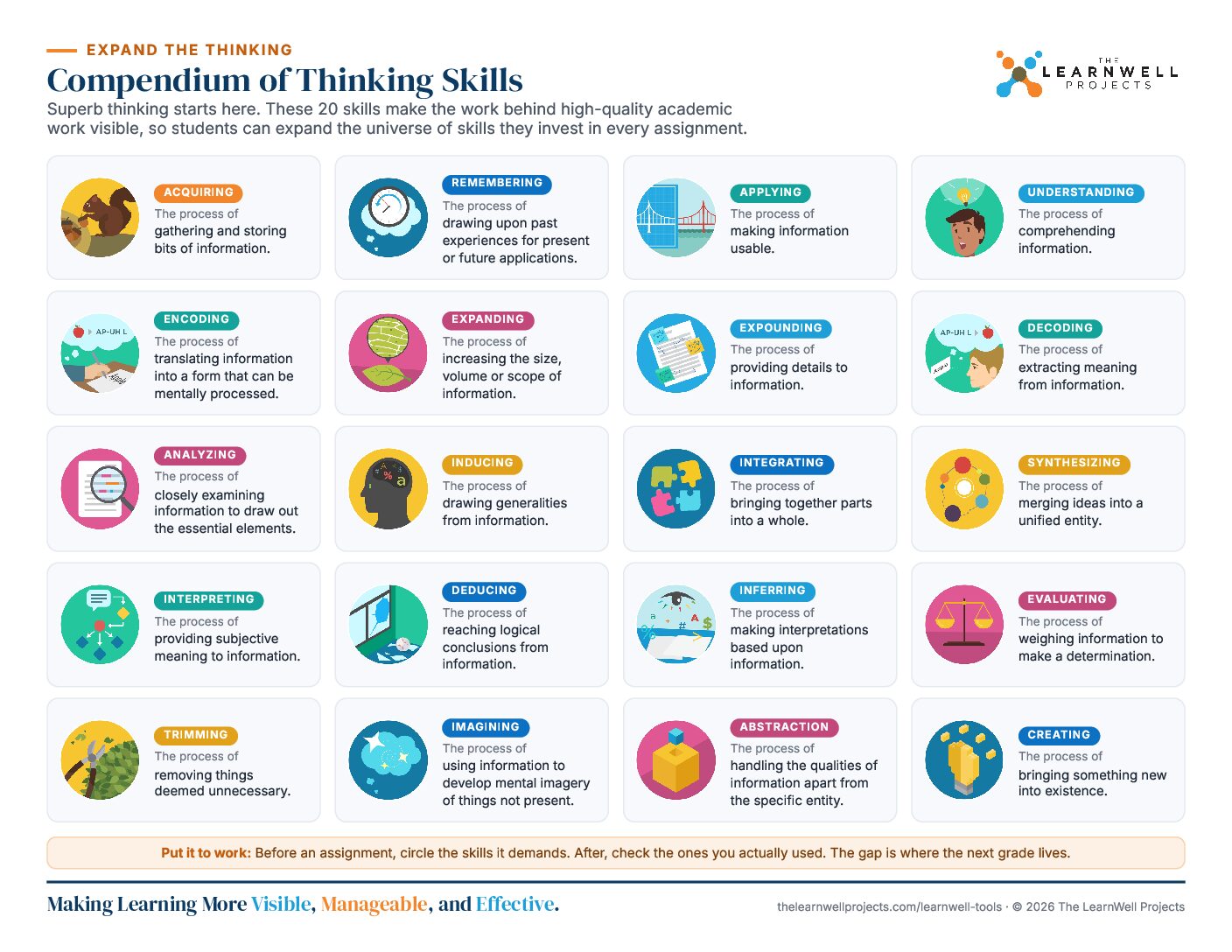
Compendium of Thinking Skills
Twenty thinking skills, from acquiring and encoding to synthesizing and creating, each with a plain-language definition and a visual cue. It gives students, tutors and faculty a shared vocabulary for the mental labor behind academic work.
Use it when: training tutors, launching a first-year seminar, or opening a faculty workshop.
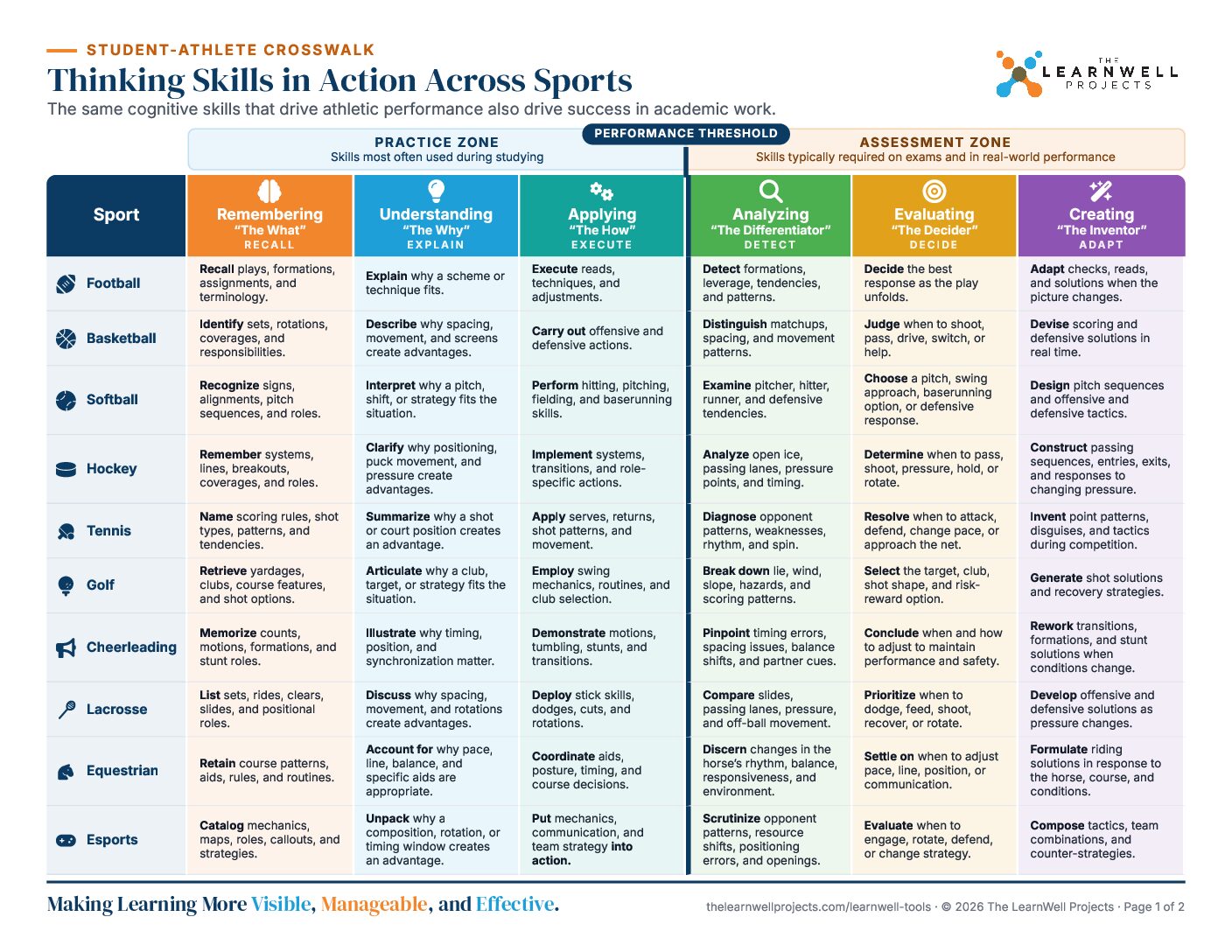
Student-Athlete Crosswalk
Athletes already read patterns, choose responses and adapt plays under pressure. The Crosswalk maps that thinking across 10 sports and esports to the same six levels, then helps students carry it into the classroom. It builds cognitive dexterity: using what they know in a new setting.
Use it when: working with student-athletes, or any student who doesn’t yet see themselves as academic.
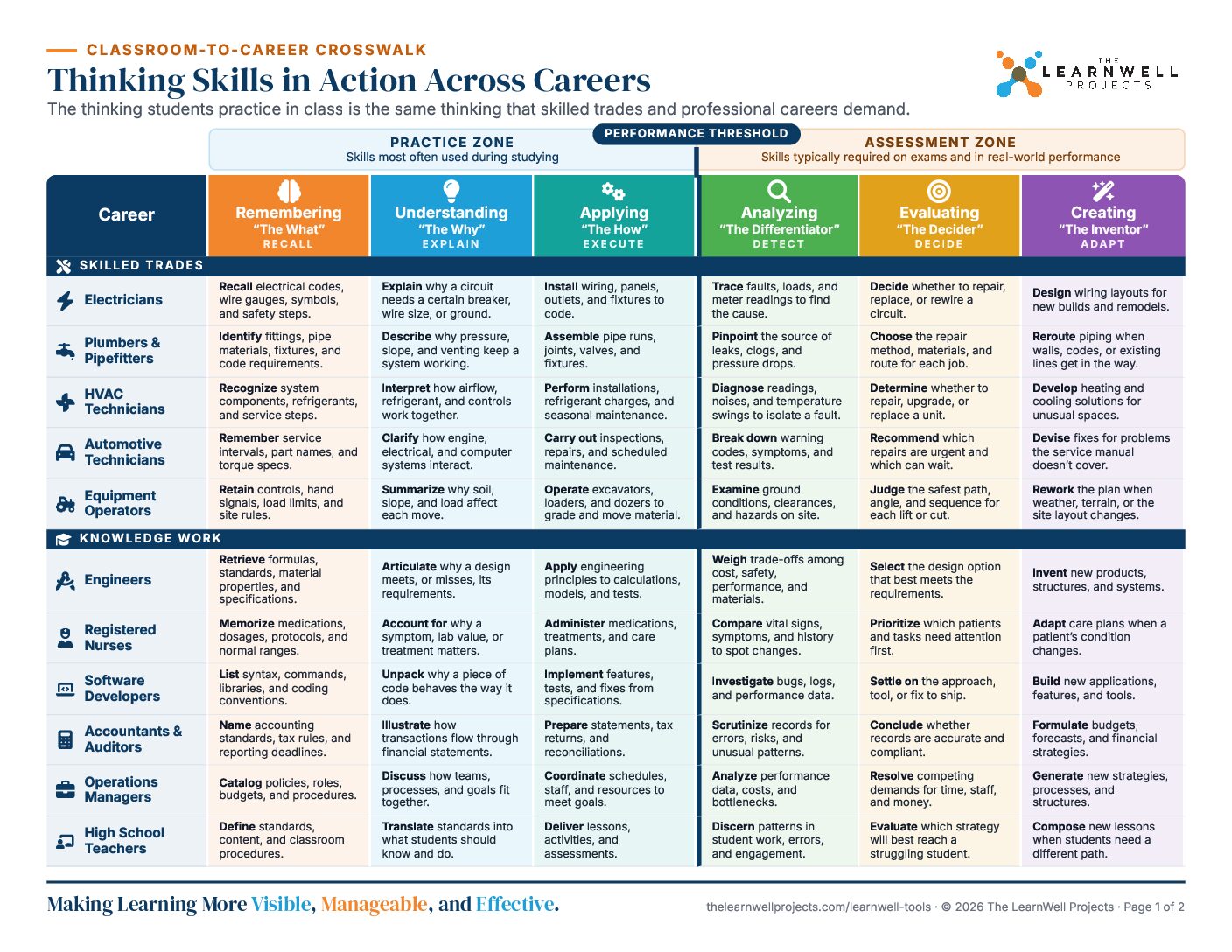
Classroom-to-Career Crosswalk
Every career runs on the same six levels of thinking. The Crosswalk maps them across 11 careers, from electricians, HVAC technicians and equipment operators to nurses, engineers and teachers, so students can see that their coursework builds the thinking their future work demands.
Use it when: a student asks, “When will I ever use this?”, or in advising, career services, and first-year seminars.
See the tools at work
Real students and real campuses, where making thinking visible changed the outcome.

From Ds to deeper thinking
Molly, a DJ, was earning Ds in Music Through the Ages. She had memorized every artist, but the course wanted analysis. The Learning Sufficiency Diagram showed her why, and she went on to graduate near the top of her class.

A study hall that changed practice
At the University of the Cumberlands, we unpacked the complex thinking football players already used and connected it to class. The head coach then rebuilt the practice schedule around the same bridging methods.

A shared language for thinking
WashU’s Eric Fournier on what lasts after a QEP ends: when faculty and academic support share one language for thinking, they build a complementary learning environment instead of working in silos.
What students and educators say
“I never realized how much control I could have over my thinking and performance until I learned this skill.”
Santana, University of California San Diego
“I wish I had learned this skill earlier. I am now completing my dissertation, and my work has been much smoother since using the ThinkWell-LearnWell™ Diagram.”
Participant, 2021 SACSCOC QEP Annual Meeting
Get all six tools free
What you’ll get:
- All six tools as print-ready PDFs
- A start-here guide for using them in order
- Short videos and stories that show each tool at work
"*" indicates required fields
Want your team trained on these tools?

I train tutors, faculty, advisors and coaches to use these tools together, so your campus becomes a complementary learning environment where students and faculty work in step, not in silos. Tell me about your campus and I’ll follow up by email.