Denison University: Making the Hidden Work of Learning Visible
Relationships weren’t enough. Making the hidden work of learning visible.
Denison’s natural sciences had everything a campus could want: committed faculty, hardworking students, a culture of mentorship. The data still said some students weren’t thriving. The answer was not more support. It was making academic work visible.
What began as a request for a traditional mentorship program became an opportunity to fundamentally reimagine how people learn from one another. Recognizing the limitations of a conventional approach, I introduced a Peer Learning Strategist model that shifted the focus from one-to-one mentorship to collaborative learning and shared expertise. Together, we created a dynamic learning ecosystem that strengthened connections, unlocked collective knowledge, and cultivated a culture of continuous learning and growth.
A campus that did everything right, and data that pushed back
Denison’s sciences did not come looking for a miracle. Students passed introductory courses, moved through rigorous curricula, and went on to top graduate programs. Faculty believed in their students. Office hours were full. High-performing students hired tutors as a precaution. Relationships were part of the academic infrastructure.
By 2018 the division also knew that not everyone was thriving. First-generation students were far less likely than their peers to feel they belonged in science classes, 41% compared with 76%, with similar gaps across demographic groups. Many underrepresented students passed introductory courses yet persisted into advanced coursework at lower rates and with lower grades.
The paradox deepened on campus. Struggling students were highly engaged: reworking problem sets, lining up for office hours, studying late. The problem was not effort. It was what effort had become. Students equated working hard with rereading, highlighting, and memorizing, while assessments quietly asked them to analyze, evaluate, and synthesize. When effort did not pay off and classmates seemed fine, students concluded, “Maybe this isn’t for me.”
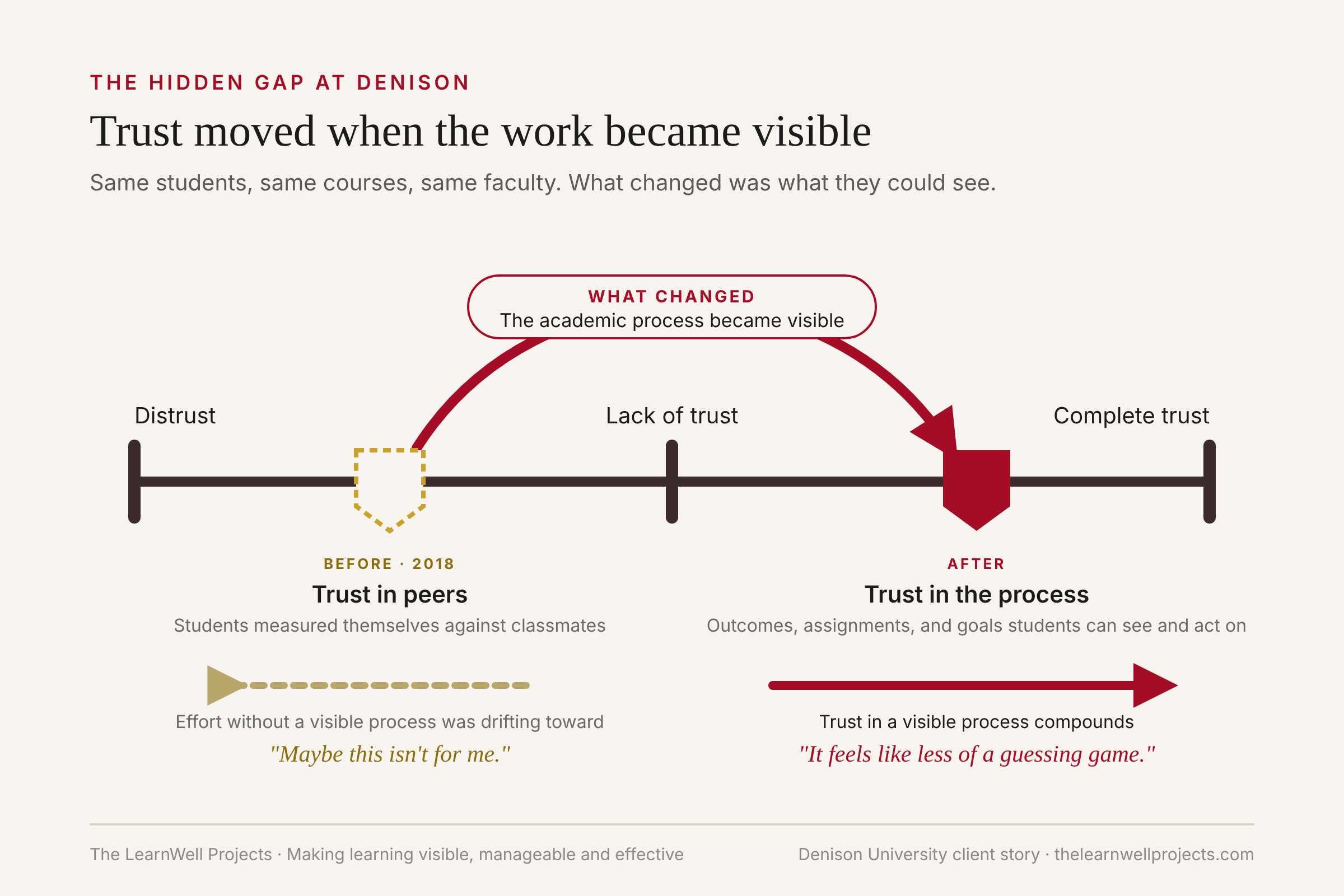
Keep the relationships. Reorganize them around academic work.
The sciences had asked for a mentoring program. The more I listened, watched, and analyzed student work, the clearer it became that this was a process problem, not a people problem. A process problem calls for a process solution, and the learning center, which sees both what faculty teach and how students act on it, became the engine.
Denison already had peer tutors. The division needed peers who could make the invisible work of learning visible. Peer Learning Strategists were recruited not for being the highest performers but because the training would raise their own performance, which made them ideal metacognitive guides. The role had three responsibilities: clarify the contributions students must make outside class, amplify students’ cognitive skills through metacognitive enrichment sessions rather than “come with your questions” tutoring, and document how students relate to academic work through Trench Data™, then feed that back to faculty.
The moment PLSs were trained to talk about thinking rather than topics, the learning center shifted from an auxiliary service to a strategic partner. It became one of the few places on campus where faculty expectations and student practices were visible at the same time.
| Part | Cognitive demand | Where students go wrong |
|---|---|---|
| “What is evolution?” | Remember accurate disciplinary knowledge | Treating recall as understanding |
| “How is it different?” | Analyze relationships between concepts | Treating the terms as interchangeable |
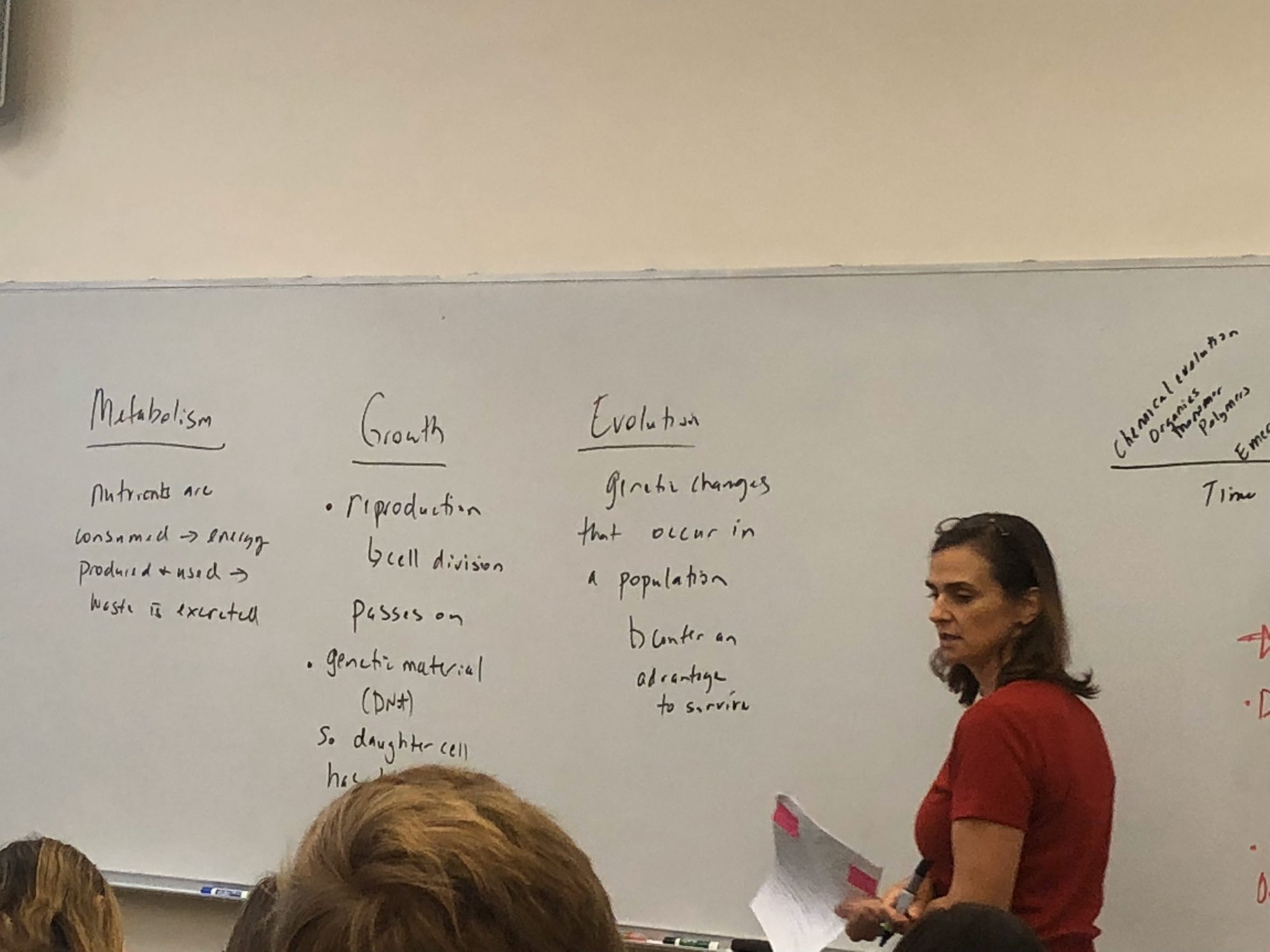
A student who prepares by memorizing definitions walks into the exam confident. The confidence evaporates when the question demands analysis. Making the dual demand explicit gave PLSs a new script: “Can you explain the difference without your notes, and show how they relate?”
Metacognitive Learning Outcomes
Faculty had written outcomes “upward,” for deans and accreditors. Using the MLO Rubric, they rewrote them “forward” into students’ daily work: “Decode the fundamental laws of physical chemistry by describing how an example illustrates a specific law in concept checks and conceptual test problems.” Better lenses, not just better verbs.
Homework Analysis
Decoding the cognitive work embedded in assignments exposed the effort paradox across biology, chemistry, physics, and math: daily questions tested discrete topics, while exams quietly tested the implicit concept that knitted them together.
Academic SMART Goals
Students replaced activity goals (“study biology”) with goals that name a cognitive action, content, scope, and time: “Analyze three differences between natural selection and evolution before tomorrow’s class.” The hardest part of self-regulation, defining the task, done before the study session starts.
Interrupted by a pandemic, and validated by the invitation back
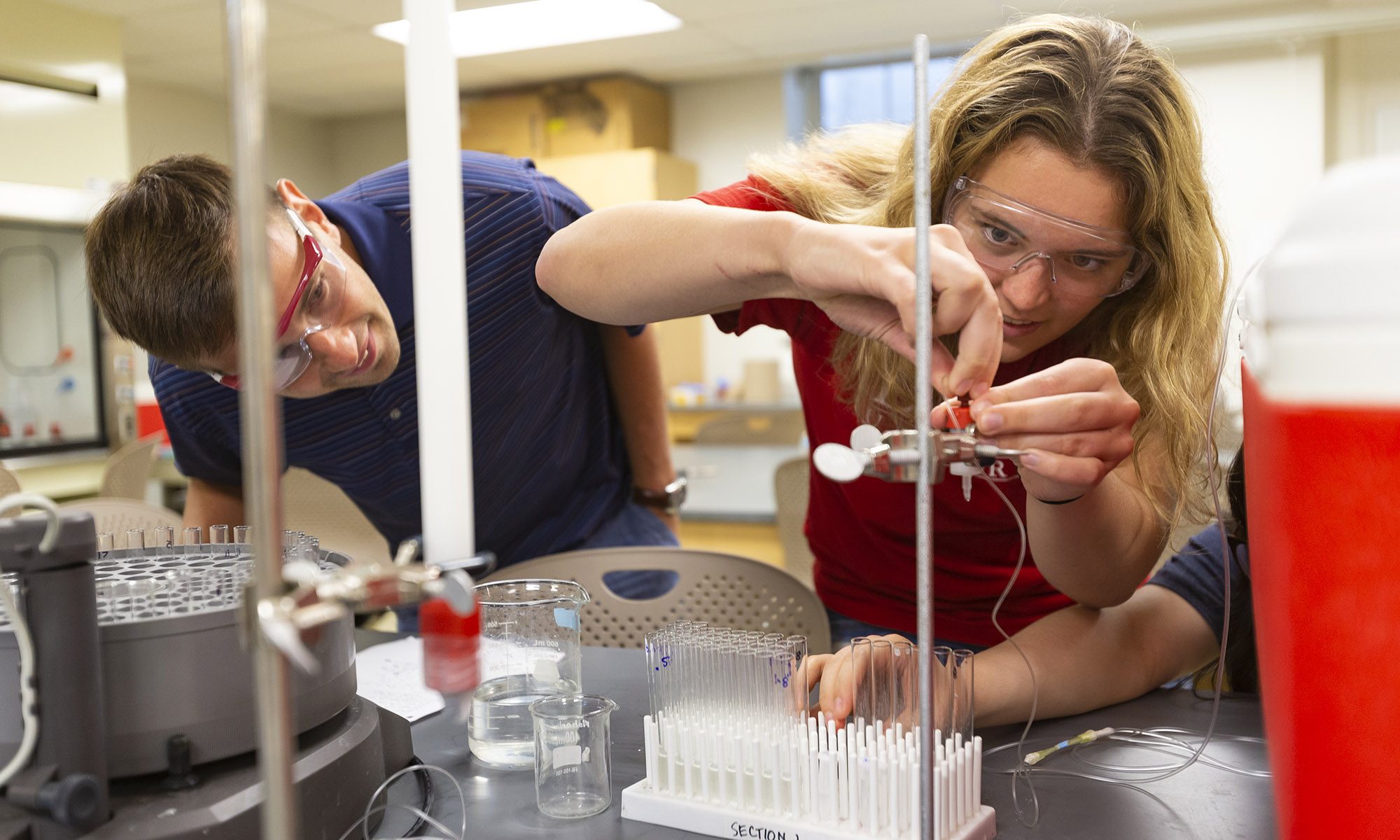
Within the first semester a student-driven academic culture began to take shape. Faculty reported students buying into metacognitive work, tackling more complex questions, and raising quiz grades. Students described feeling “more control over what to study” and that courses felt like “less of a guessing game.” Peer Learning Strategists reported that the training changed their own learning first.
The institutional shift was the deeper result. Faculty began to see academic helpers as partners in designing and evaluating coursework, not just supporting students who struggled with it. PLS documentation and homework analyses gave faculty something they rarely have: a clear picture of what students were actually doing between class sessions. The sciences developed a shared language for academic work.
In March 2020, COVID moved the consultancy online and the in-person rhythm faded. The division kept implementing and iterating. For several years the story went quiet. Then, in 2025, Denison reached out: the Peer Learning Strategist model and the metacognitive framework had become a significant success in the natural sciences, the division wanted to expand the work across the sciences and ultimately the institution, and they wanted the original architect to help lead it.
First-generation students’ sense of belonging in science classes versus their peers, the gap the work set out to close
The model held through COVID and beyond without the consultant on campus
Denison invited the work back to scale across the sciences and the institution
Faculty and Peer Learning Strategists
“The metacognition tools students have been introduced to have helped them feel more control over what to study and their learning process. The learning objectives have helped as well because it feels like less of a guessing game to them.”Dr. Ayana HintonFaculty, Natural Sciences
“The response from my class was very positive. All the students bought into the value of metacognitive work. I saw a gradual increase in the class’s ability to tackle more complex questions over the term, accompanied by increases in quiz grades.”Dr. Andy McCallFaculty, Natural Sciences
“By revising my course learning outcomes, I was able to connect learning processes throughout the semester. A succinct metacognitive-based outcome made it easier for everyone to link this course objective to practice problems and lab calculations throughout every unit.”Annabel EdwardsProfessor of Chemistry
“Prior to this experience, it would have never occurred to me that the way in which I was thinking and processing information may not be aligned with my professors’ expectations, and therefore could be making a course more difficult for me than it needs to be.”Kristina DiezPeer Learning Strategist
“Copious memorizing and shallow level thinking are rarely useful. PLSs are trained to force students to think on a deeper level, and to develop their thinking skills, so that this type of thinking becomes second nature.”Nicole WetoskaPeer Learning Strategist
Published and related
Fall 2026
“From Relationships to Results: Making the Hidden Work of Learning Visible at Denison University.” Leonard Geddes, guest editorial, The Learning Assistance Review 31(1), Fall 2026, the peer-reviewed journal of the International College Learning Center Association.
The article tells the learning center side of this story for learning center professionals. Link to follow on publication.
Is your student success problem a people problem, or a process problem?
A free consultation with Leonard Geddes starts with what your students and faculty can’t see yet, and ends with a plan to make it visible.