
What athletic preparation reveals about helping students recognize and use what they know
Part III of the Metacognition Is Academic Athleticism series
By Leonard Geddes
When we watch sports, whether in person or on television, the outcomes can drive us into states of emotional madness. “That defense can’t hold water!” we shout at the TV. “That quarterback can’t throw a rock into a river!” Or, depending on the sport and our frustration, “That goalie can’t stop a nosebleed!”
The mistakes seem simple from our comfortable vantage point. But I’ve sat down with teams to watch how they interrogate a game during film sessions, and the conversation looks different from the one happening in our living rooms. What looks like a physical failure may begin with something a player misunderstood, overlooked, or recognized too late. Athletics gives us a visible window into learning—and into what happens when learning doesn’t travel.
In Part II, we looked at how players and students connect individual pieces of information to concepts they can use. But a player who sees those connections on the field may still walk into biology or chemistry and treat every detail as something separate to memorize. That learning capacity hasn’t necessarily disappeared. The student may not yet recognize where—or how—to use it in the new setting.
I was a college linebacker, so let’s start there.
The Eye in the Sky Doesn’t Lie
Imagine a linebacker who knows the defensive playbook well. He explains his assignments during meetings, lines up correctly during practice, and consistently defends his area. All signals suggest that he knows what to do. Then, at a critical moment late in Saturday’s game, the picture in front of him changes.
The stadium is loud, the offense shifts, and a receiver darts in motion faster than he experienced during practice. The play unfolding in front of him no longer looks quite like what he rehearsed, so he hesitates. By the time he recognizes what is happening, the ball carrier is moving through the space he was supposed to protect.
Damn, touchdown!
During the subsequent Monday film review, the coach pauses the film. “You know this,” he says. “We worked on it all week.” The player nods disappointedly because the coach is right, but that doesn’t explain why his preparation failed to hold up on Saturday.
Now imagine a student leaving a chemistry exam, frustrated. “I knew this,” she tells her academic helper. “We worked on it all week.” She understood the explanations and completed similar problems previously, but the exam presented familiar information in new contexts. No one was there to help her identify the key concept.
The following animated clip recreates a conversation from a focus group I conducted in a learning center. The other male voice belongs to a student I trained as a Peer Learning Strategist.
The exchange highlights a familiar post-mortem experience many academic helpers face: the student shows solid subject knowledge but cannot pinpoint what kept her from applying it on the assessment. Since learning is abstract, her underlying challenge remains hidden, making her likely to repeat the same error in this course and others. Though the issue appeared during the exam, it originated in how she studied—much like the linebacker’s mistake on game day stemmed from his practice. Ultimately, their practice and preparation didn’t sustain them on game day, when it mattered. This isn’t a failure of practice; it’s a failure of transfer.
Learning Is Supposed to Travel
What happened between preparation and performance? That’s the question transfer asks us to investigate. Transfer involves how learning in one context influences performance in another. It determines whether knowledge and skills travel from the meeting room to the practice field, from practice to the game, and from yesterday’s mistake to tomorrow’s adjustment.
I illustrate transfer of learning with visuals and in greater depth in The Transfer Matrix. However, for this article, note that transfer can travel Near or Far. Near transfer involves using knowledge or skills in a situation similar to where you learned them, while far transfer involves using those elements in a substantially different context. As a practical shorthand, near transfer is easier and far transfer is harder.
A near-transfer experience could be when our linebacker recognizes a familiar defensive alignment on game day from practice, or when a student solves an algebra equation structured like class examples or writes a recitation of a short story they recently read. On the other hand, a far-transfer experience occurs when the linebacker recognizes a formation in a game that differs slightly from the one he saw in practice and then checks the defensive front into a different alignment, or when a student applies literary critique methods to evaluate historical documents.
Difference, Distance, and Difficulty
Here is a useful way to think about what makes a learning experience near or far: Differences create distance, and that distance creates difficulty. Susan Barnett and Stephen Ceci helped clarify this in their taxonomy of transfer. Differences can involve subject matter, setting, timing, purpose, social conditions, and how a task is presented. A situation can be close to the original learning experience in one respect and distant in another.
The distance is not measured in miles. It concerns what changes between the situation in which someone learns and the situation in which that learning must be used. Differences between the original learning context and the later context add complexity, increasing the distance knowledge and skills must travel. For both the linebacker and the chemistry student, the mismatch between how they prepared and what they encountered on game day created a gap too wide — or too far — for their initial preparation to bridge.
Bring Practice Closer—and Make the Connection
Perkins and Salomon describe two complementary approaches to promoting transfer: hugging and bridging. Hugging brings preparation closer to the conditions of eventual use. Bridging helps learners identify underlying principles and deliberately connect them to other situations.
Coaches tend to use hugging to promote transfer. The basketball coach can’t transport the team into next week’s arena, but can introduce some of its distractions. The football staff can’t reproduce every feature of an away game, but can rehearse communication when ordinary verbal cues become difficult to hear. These adjustments attempt to reduce the distance between preparation and performance.
The parts of college assessments that students miss most often involve far transfer. These questions, projects, papers, etc., try to determine whether students can transfer content that may have been explicitly and directly delivered in class or presented in text to unfamiliar contexts. This is why I encourage academic helpers to use a bridging approach with students. Students must be empowered to traverse academic complexity by recognizing and applying cognitive skills they already possess in familiar domains.
Helping Students See Thinking They Already Use
In 2022, I used bridging with a group of middle-school-aged boys labeled low performers and troublemakers. Rather than starting with what they struggled to do in class, I began with something they knew well: playing video games. We used that experience to help them differentiate the thinking skills they were already using. In my work, I regard that differentiation as an essential academic skill that is too often left implicit.
The crosswalk below illustrates the kinds of distinctions we can make visible. Notice how remembering information differs from comparing options, diagnosing a problem, or evaluating a response. These actions may work together during play, but separating them helps students recognize what a particular learning task requires.
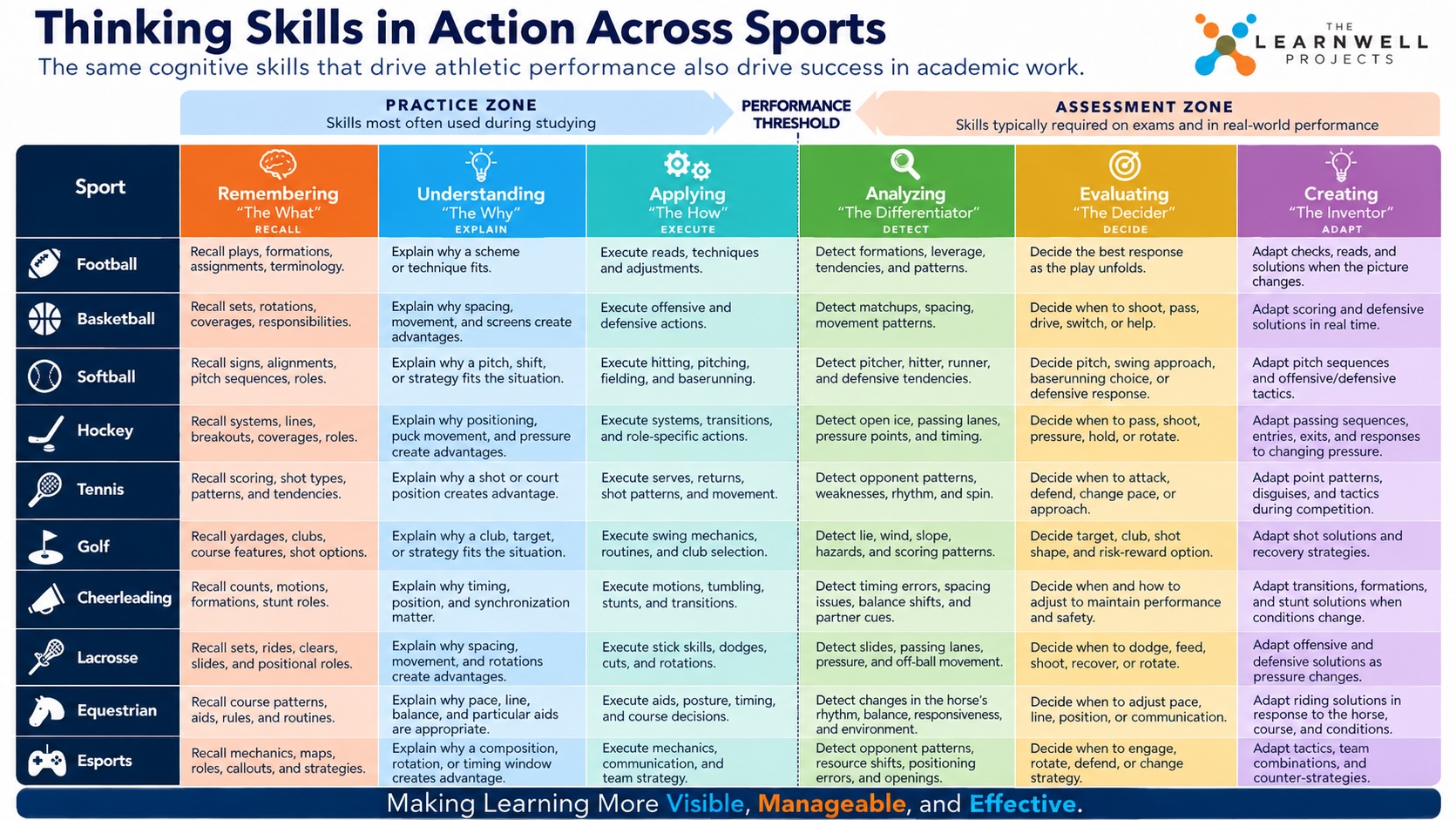
Within a few weeks, I saw those boys begin excelling in class. Students previously known for behavioral difficulties became top performers in their respective classrooms. I share that experience not as proof that one intervention explains every change, but because it challenged the picture with which we began. Their familiar activity gave us a way to make learning resources visible and available elsewhere.
I used a related approach with the football team at the University of the Cumberlands in Kentucky. We unpacked the complex learning players routinely accomplished in their sport and implemented a program connecting that work to how they learned in class and practice. Afterward, the head coach changed the practice schedule to incorporate the bridging methods I used in study hall. The connection moved beyond metaphor and into how they organized their preparation.
During that period, the team also had its most successful season in recent history at that time. Perhaps that was a coincidence; I wouldn’t attribute the season to the program alone. What matters for this discussion is the change in preparation: a coaching staff saw value in making learning processes more explicit and incorporated that work into practice. Academic helpers can examine their own preparation structures in the same spirit.
Who Is Making the Conceptual Choices?
Start with one upcoming assessment and look closely at what the student must do independently. Then examine the studying. Who interprets the situation, identifies the underlying concept, selects a principle, and explains why it applies?
If the helper supplies those decisions, the student may practice using a method without practicing choosing it. On the exam, the student makes the choice. That difference can remain hidden even when the study session seems to be going well.

The goal isn’t to withhold instruction. It is to help students practice looking beneath surface features, choosing among approaches, explaining their reasoning, and adjusting when the evidence calls for it. Practicing the method isn’t the same as practicing the choice; the former requires application thinking, while the latter requires analysis and evaluation. Preparation should match the intellectual demands of the assessment, not merely its appearance.
Our linebacker needs to recognize the assignment when the picture changes, not only execute it after the coach identifies it. Our chemistry student needs the same independence, along with the disciplinary knowledge the task requires. Athletics helps us see that relationship; academic support can help students practice it.
Mid-term season provides a great opportunity to try this with one student, one task, or one upcoming assessment at your institution. Make preparation resemble the required performance where that helps, and make the underlying connections explicit where resemblance isn’t enough. Then change the example and see what the student can recognize without your cue. That’s how transfer becomes something we prepare for rather than something we merely hope will happen.

Start the Conversation
- With a student: What thinking do you use in your sport or another familiar activity that we might unpack to explore this academic task?
- With an academic helper: Which conceptual choices does the student practice, and which do you supply?
- With your center’s team: Where could we deliberately introduce hugging and bridging into an existing support session? How can we introduce these approaches to athletic coaches?
Please leave a thoughtful comment below. We’d love to hear your perspective.
Bibliography
Barnett, S. M., & Ceci, S. J. (2002). When and where do we apply what we learn? A taxonomy for far transfer. Psychological Bulletin, 128(4), 612–637. DOI: 10.1037/0033-2909.128.4.612.
Perkins, D. N., & Salomon, G. (1988). Teaching for transfer. Educational Leadership, 46(1), 22–32.
Perkins, D. & Salomon, G. (1992). Transfer of Learning. Oxford: Pergamon Press.
Snowman, J. (2006). Psychology Applied to Teaching. New York: Houghton Mifflin Company.
Veenman, M. V. J., Van Hout-Wolters, B. H. A. M., & Afflerbach, P. (2006). Metacognition and learning: Conceptual and methodological considerations. Metacognition and Learning, 1, 3–14. DOI: 10.1007/s11409-006-6893-0.