
Be sure to get the PDF version before you leave.
Some of you remember these ole’ days.
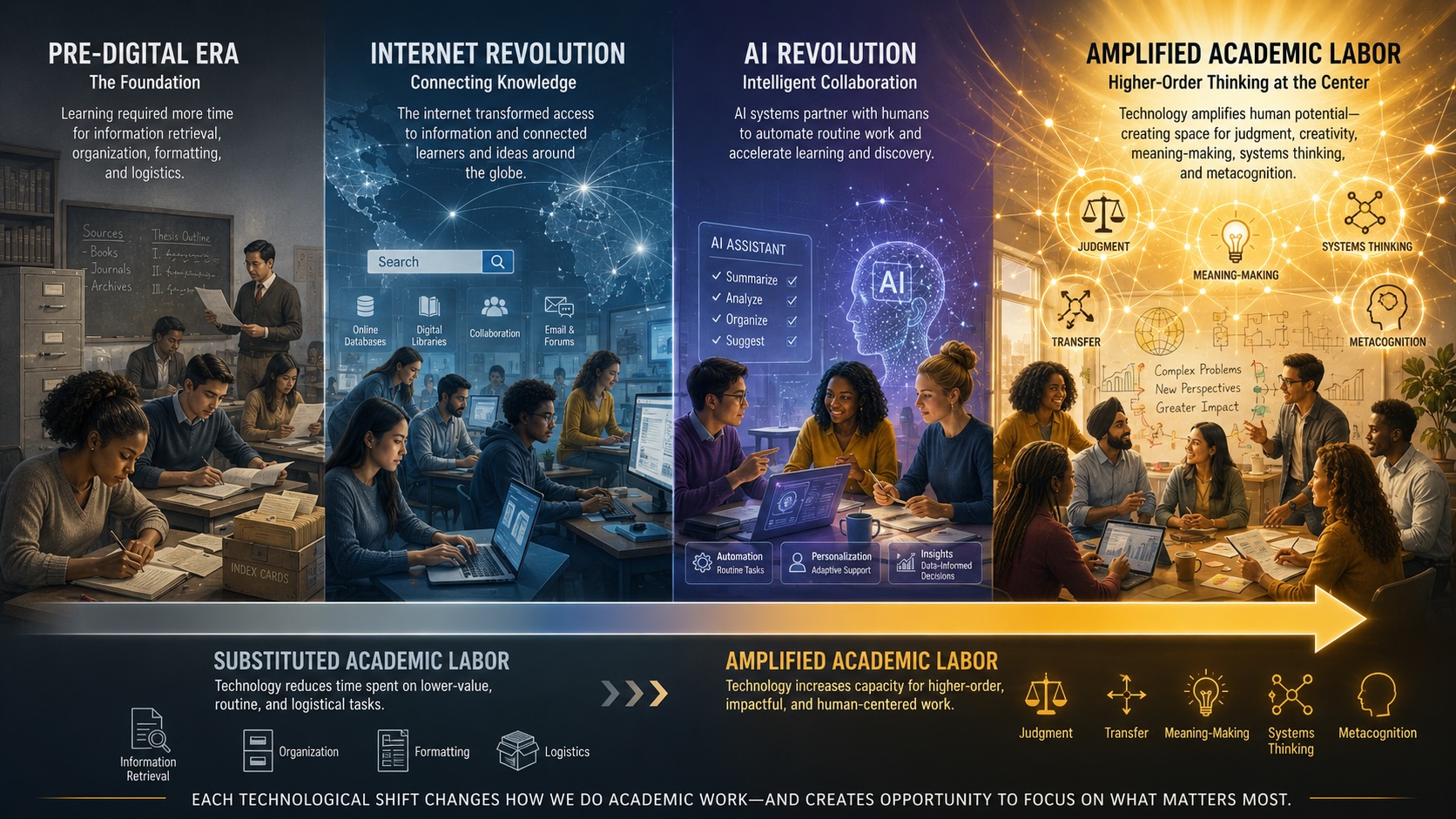
A student walks into the library carrying a notebook, a stack of index cards, and a list of sources scribbled on a sheet of paper. She flips through a card catalog drawer, writes down call numbers, wanders the stacks looking for books that may or may not be available, photocopies journal articles, and manually records citations for later use. She may even ask a librarian for help using the microfiche machine to view archived documents.
Hours pass before she begins the more valuable intellectual work her professor intended: understanding, interpreting, evaluating, and synthesizing ideas.
I’m a month shy of my fiftieth birthday, and I remember these days vividly. For many seasoned faculty, this scene isn’t nostalgia; it’s their orientation to academic work. It was how everyone worked.
Then the Internet arrived.
I was an undergraduate student in the mid-1990s, just as this new and poorly understood technology, the World Wide Web, began reshaping academic work. I lived through that rapid transition. I remember the shared reluctance and initial rejection of the Internet by professors and students. Despite this, we all tried to adapt to the burgeoning new world of the Internet.
Soon, tools we learned as first-year students were obsolete by senior year. Faculty were teaching — or more like experimenting with — their students to use this new tool they did not fully understand or yet trust themselves. We didn’t simply adopt new technologies; we had to rethink what “doing the work” meant.
There was justified concern that easier access to information would weaken learning. The past frictions were necessary for academic growth. Besides, what would students lose if these frictions disappeared?
The outcome was unforeseeable to many, and that uncertain future was scary.
In the midst of that rapid transition, we struggled to see then what we struggle to see now: the unexpected benefits from a new technology.
The Internet didn’t eliminate academic work. It redistributed it. It consolidated it. Ultimately, it enhanced it.
Once time-intensive and procedural tasks like locating sources, compiling bibliographies, and accessing materials were compressed into minutes. The result was not less rigor, but a relocation of rigor.
Students could spend less time finding information and more time deciding what it meant. Group work became less about logistics and more about problem-solving. Research became more equitable as students attending smaller colleges gained access to nearly unlimited resources, and their work became more dependent on higher-level cognitive skills, such as analysis, judgment and synthesis.
The quality of learning moved upward.
That pattern is worth holding onto as we confront the current shift to AI.
Today, higher education stands at a similar moment. Generative AI (and increasingly agentic AI) is redistributing academic labor. Some forms of the work are being substituted. Others are being amplified.
The challenge facing institutions is not determining whether AI belongs in higher education; it is understanding which forms of academic work are being, can be, and perhaps should be substituted, which are being, can be, and should be amplified, and how learning experiences should evolve in response. Leading in the age of AI requires learning centers and teaching and learning centers to develop new levels of collaboration. Together, they must quickly deconstruct academic work both inside and outside of the classroom and articulate new paths for complementary learning environments.
I’ve seen how an empathic design approach and a metacognitive perspective can make academic work visible and provide a unifying language for in-class and out-of-class educators. The increased visibility into the mechanisms of academic labor empowers students to do more meaningful and rewarding work.
Higher education must quickly shed its general reluctance to AI and shape how it affects learning before external markets dictate its usage for us. The business community is already heading down this path, deconstructing workforce skills and tasks to determine how AI will affect how people work.
Recent research from Boston Consulting Group argues that AI will reshape far more jobs than it replaces. Rather than focusing on occupations, the researchers examined the underlying tasks that constitute work. Their conclusion was striking: AI’s primary impact will not be elimination but transformation. Many routine, structured, and repeatable tasks will be substituted, while human effort increasingly concentrates on judgment, interpretation, oversight, collaboration, and decision-making.
The same logic applies to academic work.
For academic leaders, the question is not whether AI will replace rigorous academic work. The question is which forms of student academic labor are likely to be substituted, and which forms can be amplified because AI exists.
The routine, repeatable tasks that BCG predicts will be substituted in the workforce are equivalent to low-cognition tasks in education. The tasks involving judgment, interpretation, collaboration, regulation and decision-making are equivalent to high-cognition tasks in academic work.
The categories below apply Boston Consulting Group’s workforce disruption framework to academic work. Rather than classifying jobs, the framework classifies forms of student academic labor according to how technological advances change their value and execution.
The Evolution of Academic Work
The history of educational technology reveals a consistent pattern. New technologies rarely eliminate learning. Instead, they substitute certain forms of academic labor while amplifying others. The Internet shifted students away from information retrieval and toward information analysis. Generative and Agentic AI appear poised to create a similar shift that will move students away from routine information processing and toward abstract thinking, judgment, interpretation, transfer, and meaning-making.
| Academic Work Transformation | Pre-Internet | Post-Internet | Pre-Generative AI / Agentic AI | Post-Generative AI / Agentic AI |
| Substituted Academic Labor Tasks that become easier, faster, or largely automated because they are structured, repeatable, and governed by established procedures. | Searching card catalogs, locating books and journals, manually compiling bibliographies, physically accessing research collections | Search engines, online databases, digital libraries, citation management tools | Summarizing readings, creating flashcards, generating study guides, formatting citations, producing first drafts, organizing notes | AI-generated summaries, flashcards, study guides, citation formatting, first-pass essays, concept maps, practice questions, note organization |
| Amplified Academic Labor Forms of intellectual work that increase in value because technology frees time and cognitive resources for deeper thinking. | Analysis, interpretation, synthesis, evaluation, original thinking, scholarly discussion | Greater emphasis on evaluating sources, connecting ideas, interdisciplinary inquiry, collaborative problem solving | Faculty seek deeper learning but often struggle against students’ focus on task completion and information reproduction | Judgment, transfer, meaning-making, ethical reasoning, systems thinking, metacognitive awareness, intellectual self-authorship, critique, complex collaboration, and disciplinary decision-making |
When comparing the second row to the first row of this chart, it’s clear why higher education has been historically siloed. Before the Internet, significant time and resources were devoted to locating and organizing resources. However, the Internet provided new infrastructure that allowed students to learn more deeply.
Perhaps the AI era will follow a similar trajectory. Since completing the task will consume less of students’ time and attention, academic work can be designed for deeper interactions, and leveraging AI, students may have the bandwidth to do it.
The important question for higher education is not whether students will use AI. The more important question is whether institutions will intentionally redesign academic work around the forms of thinking that technology amplifies. Every major technological shift in education has moved the center of gravity of learning upward. The Internet reduced the labor required to find information. AI reduces the labor required to organize and process information. What remains—and becomes increasingly valuable—is the work of deciding what information means.
Grow, lead, and achieve with tools, tips, and insights delivered straight to your inbox by The LearnWell Projects.
By submitting this form, you are consenting to receive marketing emails from: . You can revoke your consent to receive emails at any time by using the SafeUnsubscribe® link, found at the bottom of every email. Emails are serviced by Constant Contact
The most important implication is that AI does not simply change what students produce. It changes the distribution of academic labor. As lower-order academic work becomes increasingly substituted, the value of higher-order academic work rises — along with students’ opportunities to engage in it. This mirrors what occurred during the Internet revolution. Students did not stop researching when search engines arrived. They simply spent less time locating information and more time interpreting, evaluating, and applying information.
This distinction matters because many current discussions about AI focus almost exclusively on academic products. Can students use AI to write papers? Can AI answer exam questions? Can assignments still measure learning?
These questions are understandable, but they risk overlooking a more important shift.
Academic products have always been proxies for academic work.
Faculty assign papers not because the paper itself is the goal. The paper is evidence of analysis, synthesis, interpretation, and judgment. Professors assign projects not because they need more projects in the world. Projects provide opportunities for students to engage in disciplinary thinking.
Similarly, mathematics professors do not assign problem sets because they need more answers; they assign them because students must learn math concepts, recognize patterns, select appropriate methods, and evaluate the reasonableness of solutions. Nursing faculty do not assign patient case studies because they need more care plans; they assign them because students must learn to interpret clinical evidence, prioritize competing concerns, and make sound judgments under conditions of uncertainty.
The danger is not that AI can produce academic products.
The danger is assuming that academic products and academic work are the same thing.
They are not.
Summary
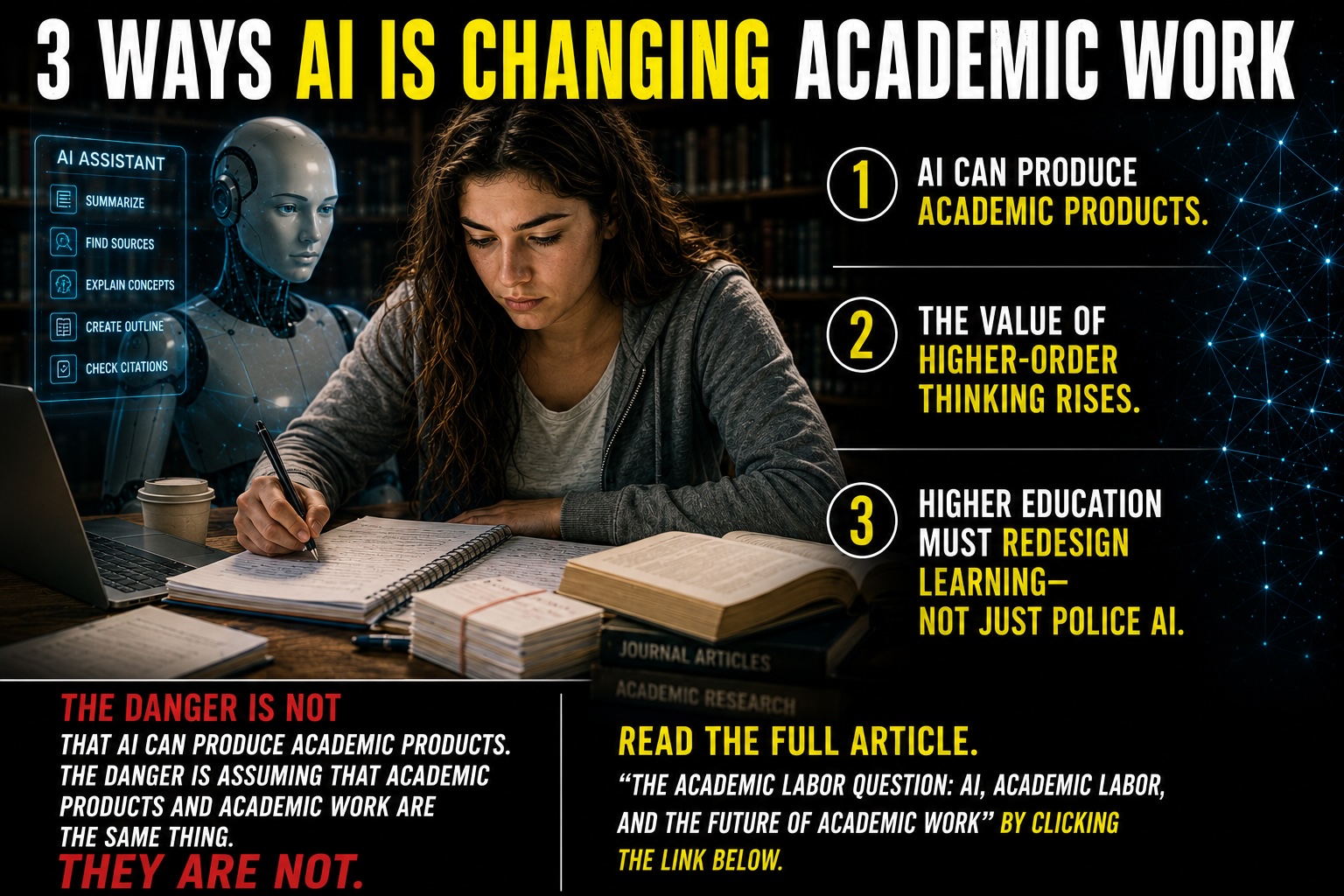
There are three ways AI is changing academic work, and why learning centers, teaching-and-learning centers, faculty, and academic leaders must respond strategically and collectively.
1. AI Is Not Eliminating Academic Work. It Is Redistributing It.
The central mistake in many AI conversations is assuming that if technology completes part of a task, the learning has disappeared.
That is not what happened with the Internet.
Search engines did not eliminate research. They reduced the time required to find information. Online databases did not eliminate scholarship. They expanded access to it. Citation-management tools did not eliminate academic rigor. They reduced procedural friction.
AI is doing something similar.
It can summarize readings, organize notes, generate practice questions, create flashcards, format citations, produce first drafts, and help students begin tasks that once consumed significant time and energy.
Some of that work is being substituted.
But substituted labor does not have to mean diminished learning. It can create more room for students to engage in the forms of work that matter most: interpretation, judgment, critique, decision-making, transfer, ethical reasoning, and meaning-making.
The issue is whether institutions will design for that possibility.
2. The Academic Product Is Not the Academic Work
A paper is not the goal of a writing assignment.
A project is not the goal of a project.
A completed problem set is not the goal of a mathematics course.
These products are evidence—or at least intended evidence—of something more important. Faculty assign essays because students need to analyze, synthesize, interpret, and make judgments. They assign projects because students need opportunities to think and work within the disciplines they are learning.
Mathematics faculty do not assign problem sets because the world needs more completed answers. They assign them because students must learn concepts, recognize patterns, choose appropriate methods, and judge whether their solutions make sense.
Nursing faculty do not assign patient case studies because they need more care plans. They assign them because students need to interpret clinical evidence, prioritize competing concerns, and make sound decisions under conditions of uncertainty.
AI makes this distinction impossible to ignore.
If an AI tool can produce an academic product, institutions must become much clearer about the intellectual work that product was meant to represent in the first place.
The danger is not that AI can generate papers, summaries, or answers.
The danger is assuming that academic products and academic work are the same thing.
They are not.
3. AI Will Substitute Some Forms of Academic Labor
Some tasks are structured, repeatable, procedural, and governed by established rules. These tasks can often be completed faster—or partially automated—through technology.
Before the Internet, substituted academic labor included:
- Searching card catalogs.
- Locating books and journal articles.
- Compiling bibliographies by hand.
- Physically accessing research collections.
After the Internet, students used search engines, digital libraries, online databases, and citation-management systems to complete many of those tasks more efficiently.
AI is now substituting another set of routine academic tasks:
- Summarizing readings.
- Generating flashcards and practice questions.
- Creating study guides.
- Organizing notes.
- Formatting citations.
- Producing first drafts.
- Building concept maps.
Institutions should not pretend these tools do not exist or assume that prohibiting them will preserve a previous version of academic work.
Instead, we need to ask a more useful question:
Which tasks are students spending time on because those tasks build essential intellectual capacity—and which tasks are simply procedural barriers to the deeper work we actually value?
That is a curriculum-design question, an assessment question, and an academic-support question.
What’s Next
In Part 2: The Academic Labor Question – Redesigning Academic Work in the Age of AI, we’ll look at what AI actually does well, what it still struggles to do, and how institutions can redesign academic work so students spend more time in the kinds of thinking that matter most.
All thoughtful comments will receive the full, clean PDF version of the articles.
Candelon, F., Manyika, J., & colleagues. (2026). AI will reshape more jobs than it replaces. Boston Consulting Group. bcghendersoninstitute
Geddes, L. (2023). How to successfully transition students into college: From traps to triumph (1st ed.). Routledge.
Martin, R. L. (2007). The opposable mind: How successful leaders win through integrative thinking. Harvard Business Review Press
How AI Contributed to This Article
I chronicled how I used generative AI as an assistant to write this article.
Substituted academic labor
I normally spend far too much time editing and rephrasing as I write. I can fixate on a single word for several minutes, only to delete the entire sentence later. It is not a great use of time. AI stepped in to handle much of the editing and rephrasing that I usually get stuck on.
I estimate that researching and writing this article would previously have taken 40 or more hours. With AI helping, the process took about 12 hours spread over four days. Much of that time was spent on higher-value thinking because AI handled much of the routine clean-up, such as smoothing sentences, tightening wording, and fixing minor inconsistencies.
Amplified academic labor
I had already written extensively about the deeper levels of academic work. Because AI reduced the time I spent on wording, editing, and second-guessing, I had more focus available for the core intellectual work. That included the overall judgment, the conceptual framework, the historical comparisons, the interpretation of the BCG model, and the application to academic work.
For me, those are the most cognitively engaging and personally rewarding parts of writing. In past projects, especially when I wrote my book in the pre-AI era, I sometimes lost motivation because I would fixate on details and lose my mental flow. AI helped me maintain that flow this time, and I genuinely enjoyed the process more.
In practice, AI did for my writing process what I argue it can do for students. It reduced lower-level drafting and organizing, so I could spend more energy on abstraction, transferring concepts, judgment, synthesis, meaning-making, and application. It also gave me insight into personal things that may make writing more cumbersome than it needs to be.
Metacognitive benefit
Reflecting on my use of AI has helped me better understand the specific roadblocks I run into when I write. I have started to name and track the time‑wasting habits that eat into my writing time. AI has also suggested small adjustments I can make to avoid these patterns in the future. This combination of awareness and concrete fixes should strengthen my writing over time and help me write both better and faster.
I have some concern that I could lose certain skills over time as I increasingly use AI, but I also believe that I will gain greater capacity for deeper work. Just as important, it helped me notice the personal habits that make writing harder than it needs to be and prompted the kind of metacognitive reflection that will improve how I work going forward. (This last part is not automatic; it takes a lifelong learning disposition. But I think we can all benefit by using the technology in this way.)
Looking ahead
I did not use agentic AI for this piece. Still, I can already imagine a near future in which those tools help me bring a much larger catalog of existing material into publishable form more quickly.
Ethical note
I am fully aware that AI relies on significant amounts of water and energy, and that many people are rightly concerned about its impact on future jobs and incomes. Those questions matter, but they are beyond my expertise and outside the scope of this piece. My focus here is much narrower: how education can use this technology to help students, faculty, and institutions thrive.


6 comments
Deborah Walker
Thank you for these articles. I plan to use them in a workshop for new faculty as we discuss Bloom’s Taxonomy and alignment between what we are doing as faculty and what we are expecting of our students. It is interesting to see how the level of thinking is raised as technology has advanced into AI. The charts are very useful to see how the focus of learning/thinking has changed with advancing technology. It is a good question for faculty to see where they are (I am) versus where the students are.
Leonard Geddes
Hi Deborah.
Thanks for your thoughtful response. Believe it or not, but technology has enabled us to focus more on deep thinking than ever before. We would love to know how things go with your faculty.
Saundra McGuire
Thanks, Leonard. I definitely understood the difference between academic labor and academic products from your article. But I didn’t fully understand or have the ability to articulate the difference when I was an undergraduate student. I don’t think most of our students do either. I think this distinction would be very helpful for them.
What I’m less convinced of is that we can get the faculty to engage in the deep work and time that will be required for them to switch from grading based on academic products and instead develop a system for evaluating academic labor. But I’m hopeful there is a way. Now on to part 2.
Saundra McGuire
I found this piece fascinating, Leonard. As a self-described “techno dinosaur” I am one who has a high level of disdain for AI. In my experience it has been used by students to circumvent academic work and to produce academic products that will earn them high grades. I agree with you that “Higher education must quickly shed its general reluctance to AI and shape how it affects learning before external markets dictate its usage for us.” I’m struggling with how to personally shed that reluctance when it’s hard for me to imagine how to get students to use AI for the higher order skills that it should be used for.
One way might be to help them understand that there is a difference between academic work and academic products. I didn’t understand this when I was an undergraduate. I’ve found that when I ask students the difference between studying and learning they are thoughtful in their reflection and finally understand that memorizing for a test is not the same as mastering the concepts. The understanding effects a paradigm shift in their approach to learning. I think a similar paradigm shift might occur if we helped them understand the difference between academic work and academic products.
Thanks for such a thought-provoking article. I especially enjoyed your discussion of the benefits of using AI to assist with writing it. I’m looking forward to reading the next installment!
Leonard Geddes
Saundra, thanks for your contribution. Zeroing in on your interest in the difference between academic products and academic work (or academic labor), academic products are the artifacts students submit: papers, exams, projects, presentations, solved problems, and other deliverables. These are the visible outputs of learning.
Academic work, by contrast, is the intellectual labor that produces those outputs. It includes analyzing information, evaluating evidence, making judgments, solving problems, synthesizing ideas, and revising one’s thinking.
Traditionally, we grade the product because it is observable. The work itself is much harder to see directly. Instead, we infer the quality of the student’s intellectual labor from the quality of the artifact they produce. A well executed lab assignment is an expression of students’ conceptual understanding, organized thinking, sequential execution, and so forth. As you may know, if a professor is providing students intentional metacognitive feedback, they would highlight these evidences of intellectual labor. But most faculty don’t do that. They just give them a grade for the finished product.
One way I think about this is the difference between a house and the labor that built it. An inspector can evaluate the finished structure, but the house itself is not the carpentry, engineering, decision-making, problem-solving, and craftsmanship that went into its construction. The framing of a custom home will be qualitatively better than the framing of a spec home. The finished product provides evidence of that labor, but it is not the labor itself.
This distinction matters because a product is not the same thing as the work that created it. For much of higher education’s history, academic products and academic labor were tightly connected. AI is forcing us to reconsider that relationship because students can now produce increasingly sophisticated products with less direct involvement in some of the labor that those products once reliably reflected. I think we have an opportunity to clarify the labor and amplify the types of workmanship we value most.
Leonard Geddes
Article #2 will be available on Monday, June 15, at 7 am or after the first ten thoughtful responses, whichever comes first.