
Be sure to get the free PDF at the end of this post.
The first part of this series argued that AI is less a threat to academic work than a force that shifts where rigor lives, moving student effort away from routine tasks and toward higher‑order thinking. In Part II, I map how that shift is already changing student mental labor across research, problem solving, writing, and math, and show how reimagined assignments can help students do more of the work that actually counts as learning.
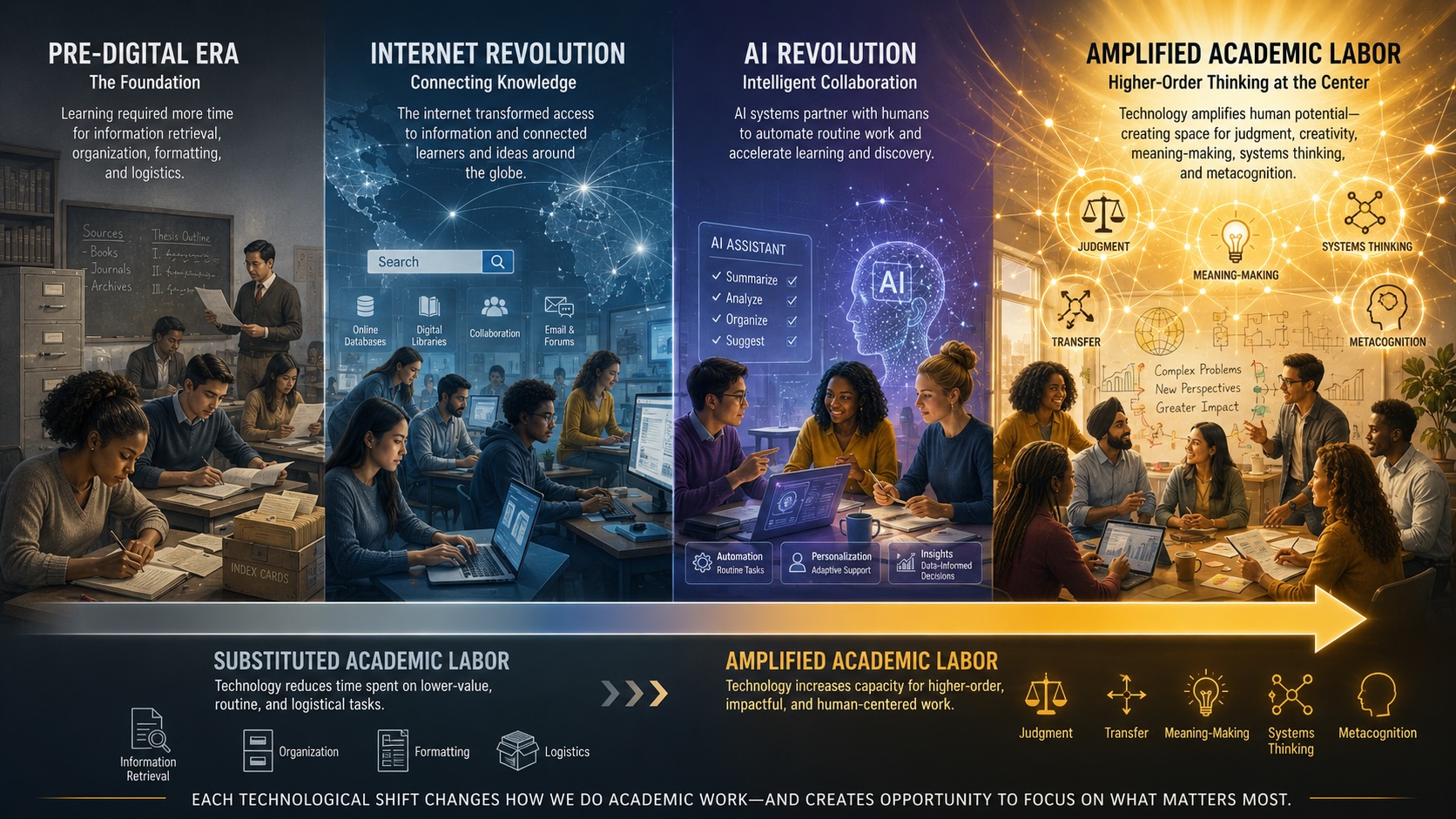
As I continue to reflect on the dawning of the Internet era in the mid‑1990s, it is clear that the technology democratized academia. Students were no longer limited to their local campus libraries; they suddenly had “the world at their fingertips.” Even though information became abundant, the Internet did not write research papers for students. Instead, it provided more information to use in their research and exposed them to myriad ways of learning material from different instructors. As a result, the energy and focus that once went into simply finding information could shift to a new skill that became increasingly valuable: judging the quality of information. Higher education, rightly, responded to this shift by evolving academic work products to emphasize this skill.
That earlier transition gives us insight into what we can expect with generative AI. A useful sequence of questions to consider is: What is this technology democratizing? What is it making more readily available to students? And which skills will emerge as more valuable in this new landscape?
I certainly do not claim to have all the answers. I simply have some observations.
This distinction becomes particularly important when considering what types of work AI performs well. Generative AI excels at structured tasks. It can summarize information, generate outlines, draft preliminary responses, identify themes, organize ideas, and produce initial outputs. These activities are valuable, but they largely operate within existing patterns.
What AI struggles to do reliably is the work that higher education purportedly values most, according to their mission statements.
- Conducting research to produce empirical evidence.
- Determining whether evidence is convincing.
- Generating interpretations of events.
- Reconciling competing interpretations.
- Making sound arguments.
- Recognizing flaws in an argument.
- Making judgments under uncertainty.
- Integrating lived experience with disciplinary knowledge.
- Constructing meaning.
- Abstracting ideas across time, space and circumstances.
These activities sit much closer to the core purposes of higher education.
When we put these observations together, a pattern emerges. Each technological era changes where student effort is spent and which forms of academic labor rise in value. The table below uses four common academic products to trace that evolution. It shows how the Internet, pre‑generative AI practices, generative AI tools, and a post‑generative AI baseline each reshape the kind of mental work students must do to learn well.
The Evolution of Student Mental Labor
| Academic product | Internet era | Pre‑Generative AI student labor | Generative AI capabilities | Post‑Generative AI student labor |
| Research | Provides fast access to abundant sources and search tools. | Students must read, select, organize, and cite sources; discern relevance and credibility. | Can locate, summarize, organize, and format citations for students. | Students must frame meaningful questions, contextualize sources, personalize lines of inquiry, and construct original interpretations and arguments. |
| Problem solving | Provides access to information, examples, and solution frameworks. | Students must interpret problems, select appropriate methods, and apply the information and frameworks to reach solutions. | Can generate step‑by‑step solutions, apply standard frameworks, and explain procedures. | Students must diagnose which problems are worth solving, evaluate and adapt AI‑generated approaches, justify choices, interpret meanings and limitations of solutions, and transfer methods to novel contexts. |
| Writing assignments | Provides words, examples, and grammatical guidance through online resources. | Students must generate ideas, organize material, and make choices about structure, wording, and grammar. | Can produce organized, grammatically correct drafts; suggest structures, vocabulary, and examples. | Students must develop an authentic voice, craft purpose‑driven arguments, integrate lived experience with disciplinary knowledge, and ensure that writing reflects genuine understanding rather than generic, machine‑generated prose. |
| Math | Provides access to many problems, examples, and solution templates. | Students must use their own reasoning to solve problems and check their work. | Can solve problems, show steps, and offer alternative solution methods. | Students must judge when solutions are reasonable, choose among competing methods, interpret what results mean in context, and model real situations rather than merely reproducing procedures. |
A key point is that the post–generative AI labor in column five is not new; it has always been part of serious academic work. What is new is the expectation that such higher-order thinking will become the baseline rather than the exception. In a pre‑AI environment, students often spent so much cognitive energy on lower‑order tasks—locating information, organizing content, performing routine procedures—that only a small fraction of their work reached this level of abstraction, interpretation, and judgment.
Post‑generative AI tools now automate much of that earlier labor, making it possible, and arguably necessary, for institutions to recalibrate what “normal” student work looks like. If we were scoring a rubric, these post‑AI forms of labor would occupy the highest levels of performance; the challenge before us is to design learning experiences so that this kind of contextualizing, personalizing, voice‑developing, and meaning‑making is no longer reserved for a few exceptional students, but becomes the expected starting point for everyone.
Requiring all students to produce such labor-rich academic products was unimaginable and perhaps cruel before generative AI could take on some of the work. But now, with this new technology, can you see how students may have the capacity to engage in deeper thinking and learning.
I also recognize the concern many people have: Won’t this technology just make students lazier? Can’t they simply plug in a prompt and get an academic product? Those are legitimate questions, but they point us back to our own responsibilities. If tools can generate products on command, then faculty must change how they assign work, and academic support professionals must change how they assist students, so that the focus shifts from producing answers to doing the intellectual labor that answers are supposed to represent.
If the table shows what is changing in student mental labor, assignments are course infrastructure we use to act on that insight. The real test is what happens on Tuesday afternoons when students sit down to do their work. Below are two very ordinary assignments, shown in their traditional form and then reimagined through the lens of academic labor rather than academic products alone.
Grow, lead, and achieve with tools, tips, and insights delivered straight to your inbox by The LearnWell Projects.
Putting it into Practice
Writing assignment
Traditional (product-focused)
Write a 4–6 page essay explaining how one course concept (metacognition, motivation, or mindset) influences student success. Summarize relevant theories, provide examples, and use clear organization and grammar.
New (labor + product + voice)
Explore how one course concept affects student success in a specific context.
- Write a short memo that defines your context and poses a focused question.
- Create an “evidence and experience” list with course sources and lived examples.
- Draft a 4–6 page essay that answers your question and intentionally develops your own academic voice.
- Add a brief reflection naming one revision for clarity and one revision to better reflect your perspective.
Math assignment
Traditional (product-focused)
Complete 15 optimization problems from Chapter 4. Show all work and label graphs. Grading is based on correct answers and procedures.
New (labor + product + interpretation)
Work the same set of problems, but also:
- For each scenario, identify what concept is most relevant, state your assumptions, and write the function you are optimizing.
- Show your solutions and note which method you used and why.
- For two problems, interpret the meaning of your solution in plain language and describe one limitation of your model or where the result would not make sense in real life.
In these examples, the traditional versions come from actual college courses, while the new versions are imagined using the criteria in the “Evolution of Student Mental Labor” table. My hope is that they nudge you to reconsider how assignments are structured, so students spend less time figuring out how to get through tasks and more time genuinely engaging with them.
Less time generating first drafts and more time refining arguments.
Less time organizing content and more time constructing meaning.
Less time reproducing knowledge and more time transferring it across contexts.
This shift mirrors what occurred after the Internet transformed research. Information access ceased to be the primary challenge. The challenge became knowing what to do with the information once it was available.
Generative AI extends this progression. The challenge is no longer simply finding information or even organizing information. The challenge increasingly becomes exercising judgment about information and using it responsibly to create insight.
This is why AI should not be viewed primarily as a technology initiative. It is a learning strategy issue.
The institutions most likely to thrive will be those that systematically identify which forms of academic work are becoming substitutable and which forms are becoming more valuable. They will recognize that AI does not diminish the importance of learning. Rather, it changes where learning resides.
For Learning Centers, Teaching and Learning Centers, and Program Chairs, this creates a clear strategic imperative. The task is not to determine whether AI should be allowed. The task is to map the academic work students perform, identify which activities AI can reasonably substitute or augment, and redesign learning experiences around the forms of thinking that remain uniquely human (at this stage) and aligned with the most indispensable qualities of higher education’s universal mission.
This is precisely the lesson emerging from workforce transformation research. Organizations that thrive do not simply automate existing processes. They redesign work around the new capabilities technology creates.
Higher education now faces the same opportunity.
I am not advocating for AI usage; rather, I’m acknowledging that AI usage will spread. I believe higher education should help control how it spreads, since AI impacts our domain — the world of thinking — perhaps more than any other.
The future belongs not to institutions that preserve every traditional academic task, nor to those that outsource thinking to machines. It belongs to institutions that understand the difference between academic labor and learning, and that intentionally use AI to shift students toward deeper forms of abstract thinking, judgment, synthesis, reflection, collaboration, and meaning-making.
This approach empowers institutions to avoid developing a technology strategy separate from their educational strategy— or even worse, above it. Instead, it presents an educational strategy that brings AI usage into harmony and in service of the institution’s mission.
It’s time that higher education stops running away from transformation. Stop reacting to change and start leading the way. The first step is envisioning academic work, academic labor, and the distribution of labor.
If you have been pondering how higher education can shape the future using AI, then I’d love to hear your reaction to this article and perhaps be a part of your conversation.
Candelon, F., Manyika, J., & colleagues. (2026). AI will reshape more jobs than it replaces. Boston Consulting Group. bcghendersoninstitute
Geddes, L. (2023). How to successfully transition students into college: From traps to triumph (1st ed.). Routledge.
Martin, R. L. (2007). The opposable mind: How successful leaders win through integrative thinking. Harvard Business Review Press
Summary
3 Ways AI Should Change Student Work
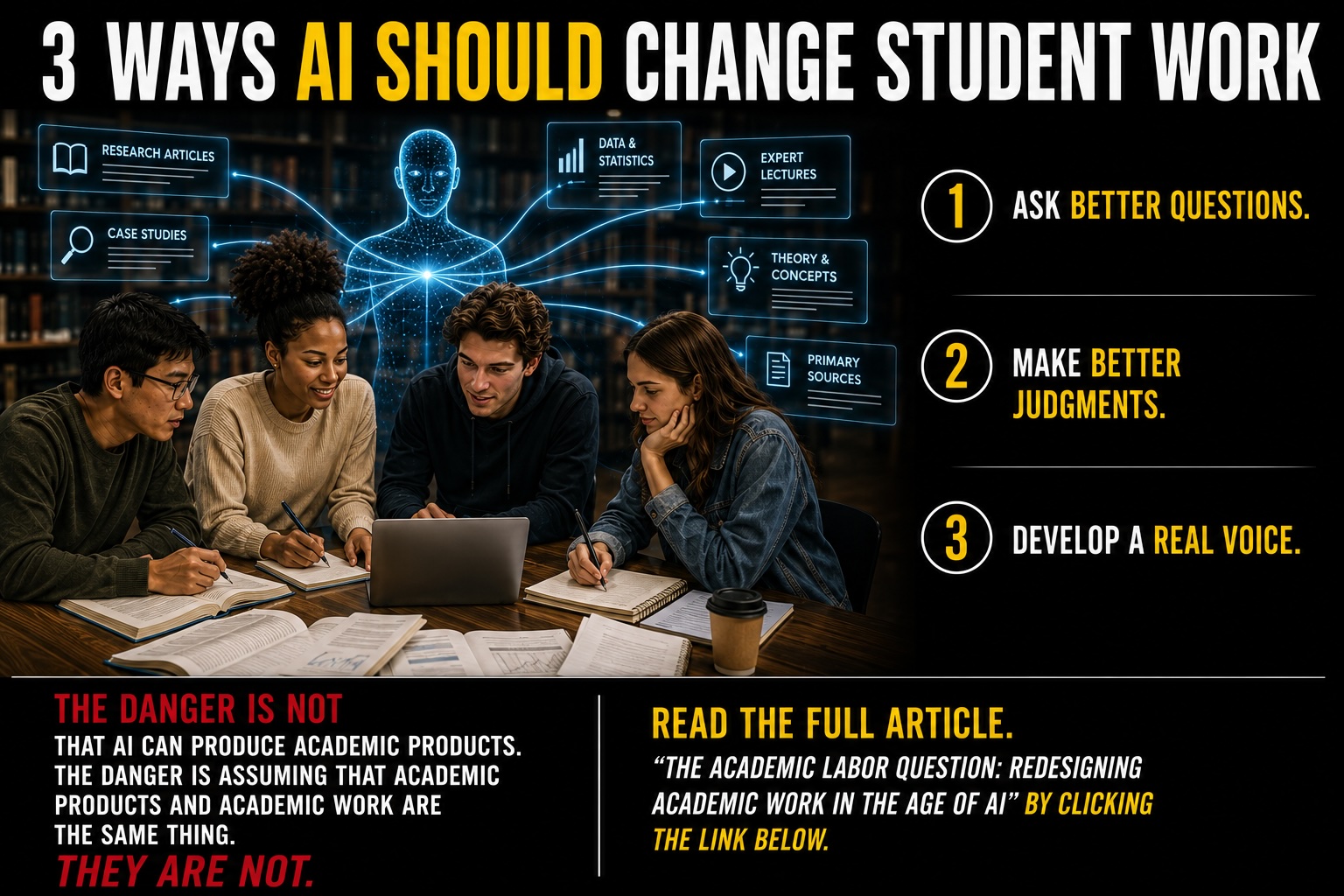
AI can now summarize readings, organize notes, generate outlines, solve routine problems, and produce first drafts.
So what should students do with the time and mental energy that technology frees up?
- Ask better questions.
Less time finding and organizing information; more time framing meaningful problems worth investigating. - Make better judgments.
Less time reproducing answers; more time evaluating evidence, challenging assumptions, interpreting results, and deciding what information means. - Develop a real voice.
Less time generating generic academic products; more time connecting disciplinary knowledge, lived experience, perspective, and purpose.
The future of academic rigor is not preserving every traditional task.
It is redesigning academic work so students spend more time doing the intellectual labor that matters most.
Part I asked how AI is changing the distribution of academic labor.
Part II explored how faculty, learning centers, and teaching-and-learning leaders can redesign assignments around deeper thinking, judgment, interpretation, and meaning-making.
How do you put them together?
How AI Contributed to This Article
I chronicled how I used generative AI as an assistant to write this article.
Substituted academic labor
I normally spend far too much time editing and rephrasing as I write. I can fixate on a single word for several minutes, only to delete the entire sentence later. It is not a great use of time. AI stepped in to handle much of the editing and rephrasing that I usually get stuck on.
I estimate that researching and writing this article would previously have taken 40 or more hours. With AI helping, the process took about 12 hours spread over four days. Much of that time was spent on higher-value thinking because AI handled much of the routine clean-up, such as smoothing sentences, tightening wording, and fixing minor inconsistencies.
Amplified academic labor
I had already written extensively about the deeper levels of academic work. Because AI reduced the time I spent on wording, editing, and second-guessing, I had more focus available for the core intellectual work. That included the overall judgment, the conceptual framework, the historical comparisons, the interpretation of the BCG model, and the application to academic work.
For me, those are the most cognitively engaging and personally rewarding parts of writing. In past projects, especially when I wrote my book in the pre-AI era, I sometimes lost motivation because I would fixate on details and lose my mental flow. AI helped me maintain that flow this time, and I genuinely enjoyed the process more.
In practice, AI did for my writing process what I argue it can do for students. It reduced lower-level drafting and organizing, so I could spend more energy on abstraction, transferring concepts, judgment, synthesis, meaning-making, and application. It also gave me insight into personal things that may make writing more cumbersome than it needs to be.
Metacognitive benefit
Reflecting on my use of AI has helped me better understand the specific roadblocks I run into when I write. I have started to name and track the time‑wasting habits that eat into my writing time. AI has also suggested small adjustments I can make to avoid these patterns in the future. This combination of awareness and concrete fixes should strengthen my writing over time and help me write both better and faster.
I have some concern that I could lose certain skills over time as I increasingly rely on AI, but I also believe that I will gain greater capacity for deeper work. Just as important, it helped me notice the personal habits that make writing harder than it needs to be and prompted the kind of metacognitive reflection that will improve how I work going forward. (This last part is not automatic; it takes a lifelong learning disposition. But I think we can all benefit by using the technology in this way.)
Looking ahead
I did not use agentic AI for this piece. Still, I can already imagine a near future in which those tools help me bring a much larger catalog of existing material into publishable form more quickly.
Ethical note
I am fully aware that AI relies on significant amounts of water and energy, and that many people are rightly concerned about its impact on future jobs and incomes. Those questions matter, but they are beyond my expertise and outside the scope of this piece. My focus here is much narrower: how education can use this technology to help students, faculty, and institutions thrive.


1 comment
Leonard Geddes
I’m interested in how others are thinking about the distinctions between academic products and academic labor. I think we will need to more clearly understand this distinction as AI usage spreads.