
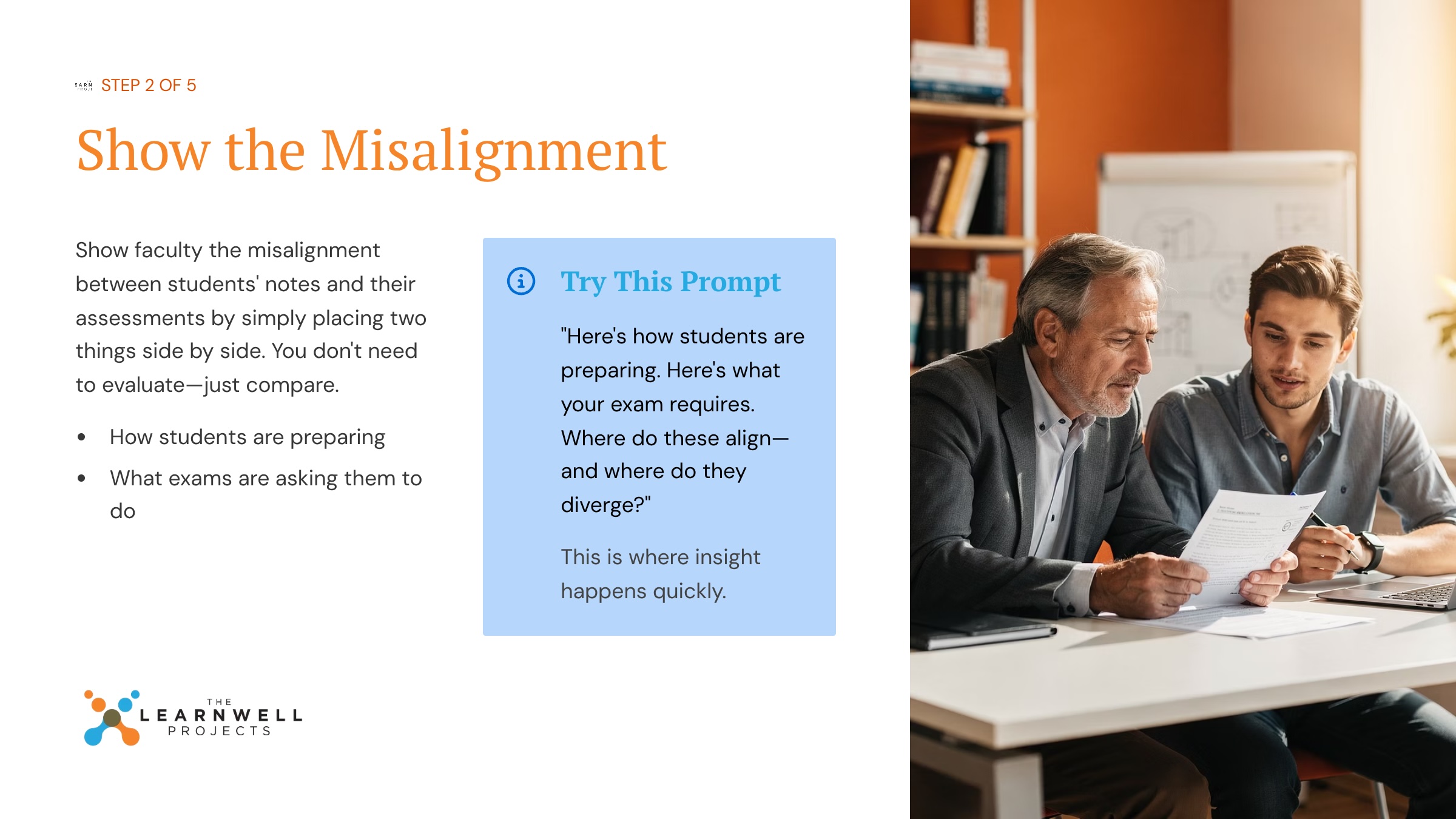
Put two things side by side.
Student notes.
The exam.
Then stop talking.
That’s where academic transformation begins.
I was invited to observe a class session at a university I’ll call North River College.
The instruction was strong. The professor moved through vivid examples on the board, checked for understanding throughout, and kept students engaged for the full 50 minutes. He paused, asked for feedback, waited patiently, and adjusted in real time. By all visible measures, it was a good class.
Everything seemed aligned.
But after class, I followed a few students and asked a simple question: “What did you take away from today?”
Their answers were thoughtful—but telling.
They could recall pieces. A definition. A step in a process. An example that stood out. But when I asked them to explain how those pieces connected—or how they might use them on an exam—their responses thinned. They had captured the class. They had not yet constructed the understanding.
A few days later, I looked at their notes.
Then I looked at the exam.
And there it was.
At the next faculty meeting, we didn’t start with a presentation. We placed two things side by side: how students were preparing and what the assessment required. No commentary. No critique. Just comparison.
The contrast was immediate.
Students were preparing in fragments—recording steps, terms, and examples as they appeared. The exam, however, required them to connect those elements, compare approaches, and apply ideas in unfamiliar ways. In other words, the exam asked for relationships. Their preparation captured pieces.
No one argued.
They didn’t need to.
This is the conversation many learning centers—and many faculty—are trying to have.
“How do we improve performance?”
“How do we get students to do better work?”
“How do we align what we teach with what they actually do?”
The instinct is to explain. To advocate. To propose solutions.
But in my experience, transformation doesn’t begin with persuasion.
It begins with visibility.
When we make the nature of student work visible, alignment—or misalignment—becomes something we can all see and work on together.
The posture that works
Across the campuses I’ve partnered with, the most productive shifts haven’t come from better arguments. They’ve come from a different posture—one that invites shared insight rather than defensiveness.
Here’s what that posture looks like in practice:
1. Stay in your lane—and expand it.
Your strength is not judging instruction; it’s illuminating how students experience it. You see what happens after class ends—how ideas are reduced, rehearsed, and sometimes misunderstood. When you bring that forward carefully, you’re not critiquing teaching; you’re completing the picture.
2. Bring comparison-ready data (not just activity).
Usage data tells us who showed up. It doesn’t tell us what they did with the work. What changes conversations is evidence of how students are interacting—what their notes emphasize, where their thinking stops, what types of thinking are missing. When placed next to assessment demands, the comparison becomes self-evident.
3. Lead as the bridge—not the support.
Learning centers and centers for teaching and learning occupy a critical space between expectation and preparation. You translate what faculty intend into what students actually do. That role is not peripheral; it is central to improving outcomes.
4. Resist the urge to fix—first make it visible.
It’s tempting to move quickly to strategies and interventions. But when misalignment isn’t clearly seen, solutions feel optional. When it is visible, solutions become shared priorities. Let the evidence create the urgency.
5. Translate, don’t tell.
Faculty don’t need to be told students are struggling. They need to see how students are interpreting their course. When you translate student work into patterns—what’s emphasized, what’s missing—you create clarity without assigning blame.
6. Anchor the conversation in artifacts.
The most productive discussions revolve around real student work: notes, practice problems, drafts, exam responses. Artifacts reduce abstraction and make alignment—or misalignment—something everyone can examine together.
At Grand Lakes University, after seeing this side-by-side comparison, one professor paused and said, “I’ve been teaching this the same way for years. I didn’t realize this is what students were doing with it.”
That wasn’t resistance.
It was recognition.
And recognition is where change begins.
Most institutions focus their transformation efforts on instruction, on what is taught and how it is delivered. But the real leverage point often lies in how students take up that instruction. The gap between delivery and use is where many breakdowns occur. It’s where meaningful improvement can begin.
A challenge for you
Whether you work in a learning center, a center for teaching and learning, a first-year program or teach in the classroom, you are in a position to lead this effort.
Try this:
- Collect a small sample of student preparation (notes, study guides, practice work) or have them share some of their AI inputs or outputs.
- Place it next to a recent assessment.
- Ask: Where do these align—and where do they diverge?
- Share what you see with one colleague and invite their perspective.
Then, report back—to your team, your department, or even just to yourself:
- What surprised you?
- Where was alignment stronger than you expected?
- Where did it break down?
- What is one small change you might test next?
You don’t need a new initiative to begin.
Start with two things, side by side.
And see what becomes visible.
Leave a thoughtful comment below to receive an expanded guide on how to start a transformation conversation on your campus.⬇️


2 comments
Gabriel Angrand
I appreciate how this article takes us back to frames, like Bloom’s Taxonomy, that we can use as a bridge between faculty expectations and student work!
I’m already thinking about how our office can adjust the session feedback our tutors provide, so we put student thinking next to assignment objectives!
Seeing our tutees leave sessions and semesters closer to what faculty assignments require cognitively would allow us to capture impact that provides one of many explanations behind GPA improvements or increased pass rates.
Leonard Geddes
Hi Gabriel,
Thank you for the comment. When students’ thinking and assignment outcomes are clear and placed next to each other, direction becomes clear and transformation is near.