
It’s beginning to sound a lot like exam prep time. Traffic in our learning centers is picking up, the quiet floors of the library are filling, and dorm lounges are turning into late-night study halls. To be honest, this is the time of year my staff and I find most encouraging and most worrying.
I like that students are showing up and putting in the hours. But two decades of this work have taught me that many of them are working hard toward the wrong target. In my focus groups, students describe revealing ways of judging their readiness. Some count how many pages of notes they’ve reviewed or how much they’ve highlighted. Others count the pages they’ve read or the questions they’ve answered, even when a tutor walked them to the answer or AI supplied it outright. Those measures feel like progress even when little learning is happening. There’s still time to change that. If we help students change what they measure in the next few weeks, we change what they learn and how they walk into finals.
Every year around this time, students ask me the same question: what is the best way to get ready for finals?
I am not a fan of cramming. It rarely works, and students know it rarely works, which is its own kind of misery. But there is a version of this question worth answering, because the few weeks before finals are not wasted time. They are the window where a student can still change the outcome.
Here is what I have learned watching students study for twenty years. Every student uses metrics. Every one. They are constantly asking themselves some version of am I ready yet? The problem is that most are using the wrong yardstick. They measure hours. They measure pages reviewed. They measure how familiar the material feels.
None of those tell a student whether they have learned anything.
Below are three mental metrics that do. They cost nothing, they work in the time a student actually has left, and they turn studying from an anxious slog into something closer to a puzzle worth solving.
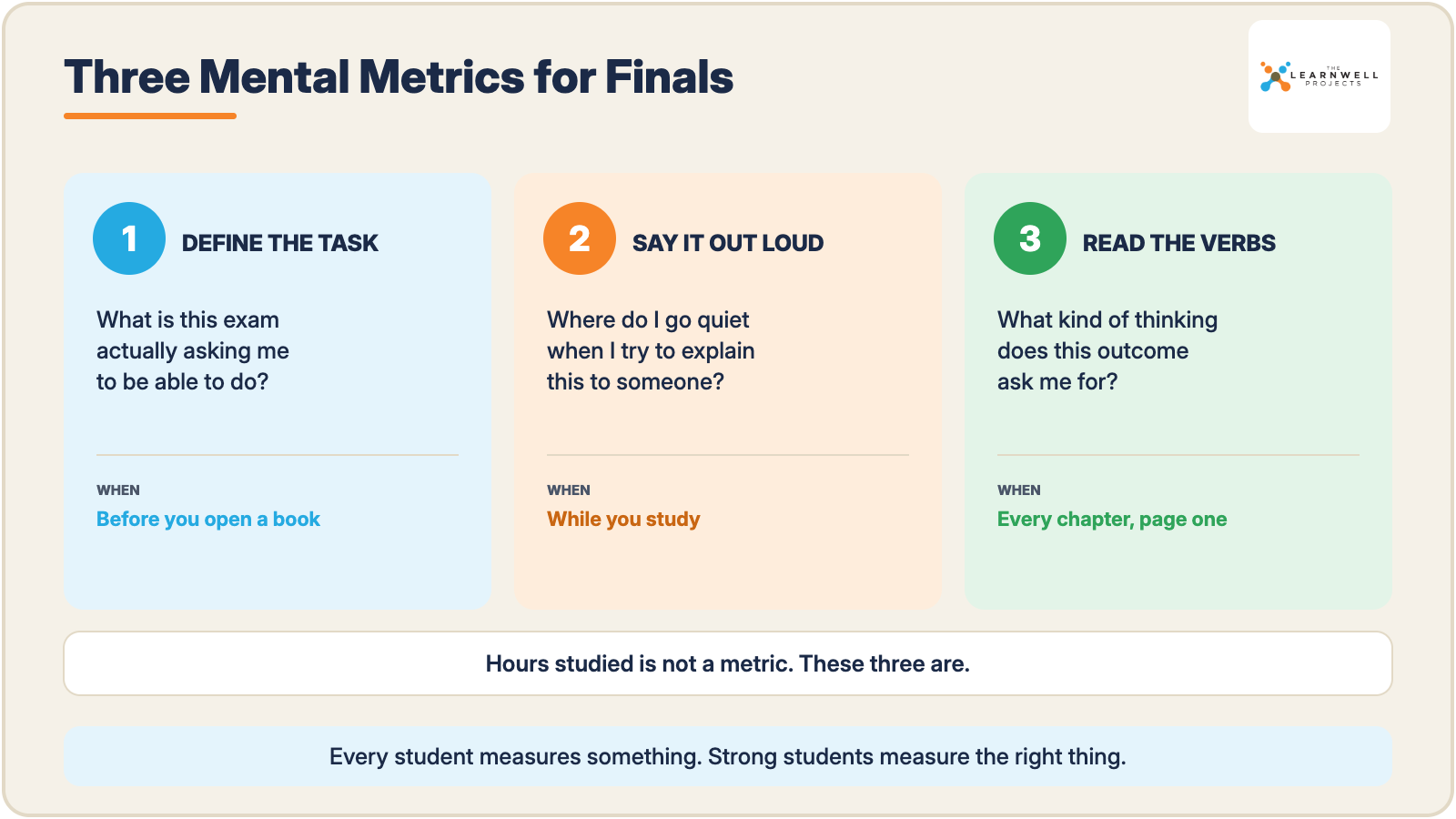
1. Define the task before you start
A task clearly defined is far easier to accomplish. Let me show you what I mean with two students.
Jack and Jill went up the hill to study for their test. Both were bright. Jill studied better. The difference had nothing to do with ability and everything to do with how each one read the assignment in front of them.
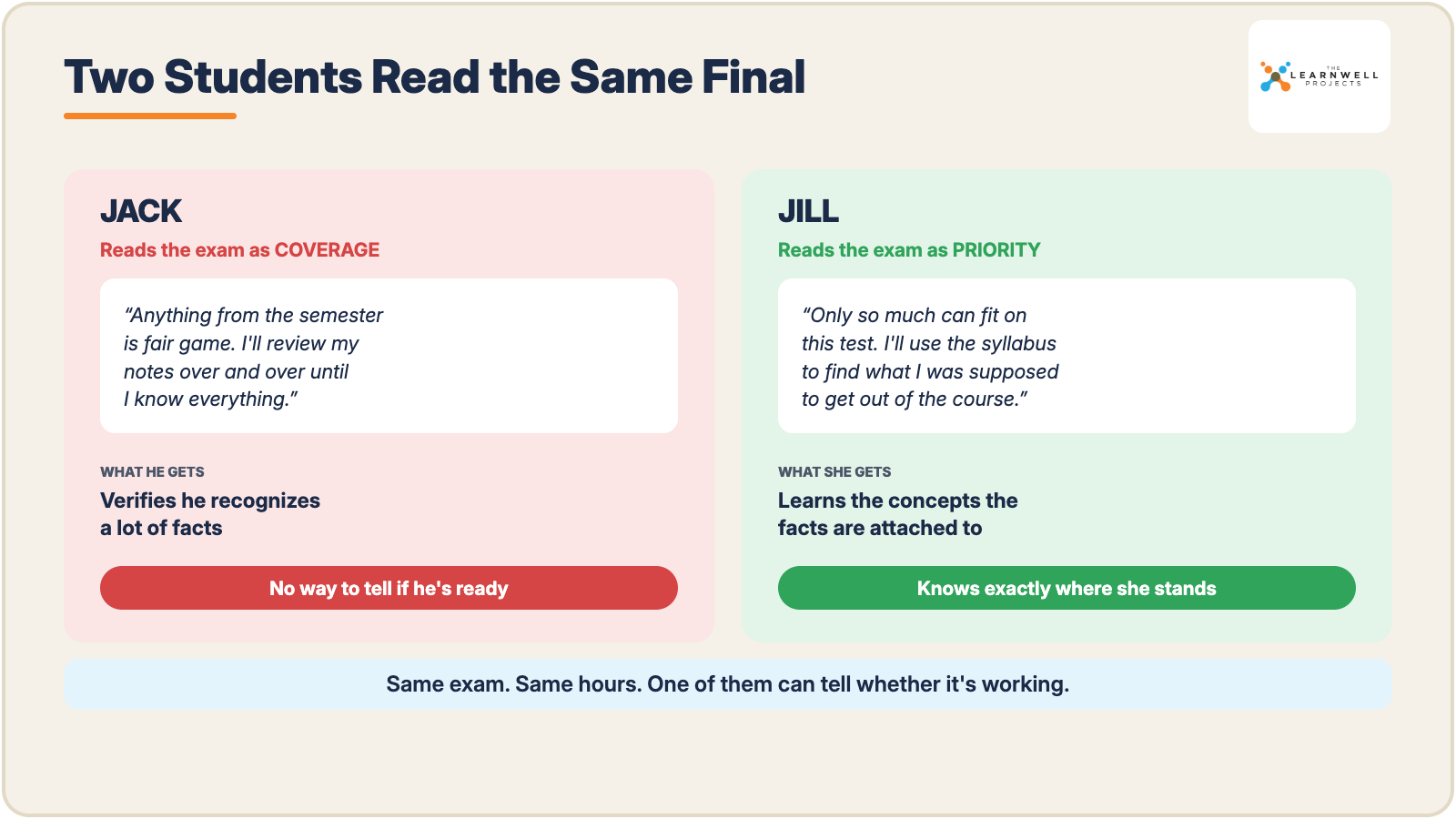
Jack will walk out of his review sessions confident that he knows a great deal of factual information. He will know less about the handful of concepts underneath those facts, which is exactly what the exam is built to assess.
Jill will actually learn rather than memorize. More importantly, she will know whether she has learned, because she gave herself something to measure against.
In the end, Jack falls down and breaks his crown. Jill does not make the mistake of tumbling after.
2. Say what you know before you need to know it
Students routinely overestimate what they know, and the reason is mechanical. They are measuring their knowledge by how familiar it feels, and familiarity is a liar. Rereading a page makes it feel known. Recognizing a term makes it feel mastered. Neither is the same as being able to produce it.
Psychologists call this the illusion of explanatory depth: we believe we understand things far better than we can actually explain them (Rozenblit & Keil, 2002). (I call it getting “lost in the sauce.”)It is one of the most reliable findings in cognitive science, and good academic assistance can surface it before it shows up on an exam.
The fix is simple and slightly uncomfortable.
- Write it out or say it out loud. If you come up blank, or cannot find the words, you have just found a gap. Better to find it now than Thursday morning.
- Talk it through with a friend. Not to quiz each other on definitions; you can do that alone. Use your friend as a sounding board while you explain the key concepts. Listen to how well you express what you think you know. Blanks and stumbles are signals, not failures.
- No friend available? Newborns, pets, houseplants and empty chairs are excellent listeners.
The metric here is not how much you can say. It is where you go quiet.
3. Use the textbook from the front, not the back
For many reasons, textbooks are now out of favor. However, the textbook is the most useful and most misused resource a student owns. Roughly 85 percent of college learning happens through out-of-class reading. So when a professor does not incorporate the book in their instruction, students take that as a signal the book is optional. The textbook is a tool for the person learning, not the person teaching.
Students who do open the book tend to go straight to the back of the chapter, to the review questions. They skip the part that would have saved them: the front.
Most contemporary textbooks open each chapter with five to ten learning outcomes. Those outcomes are gold. They condense an entire chapter into a handful of statements, and they tell a student what the chapter is for.
One detail makes all the difference. Read the verbs.
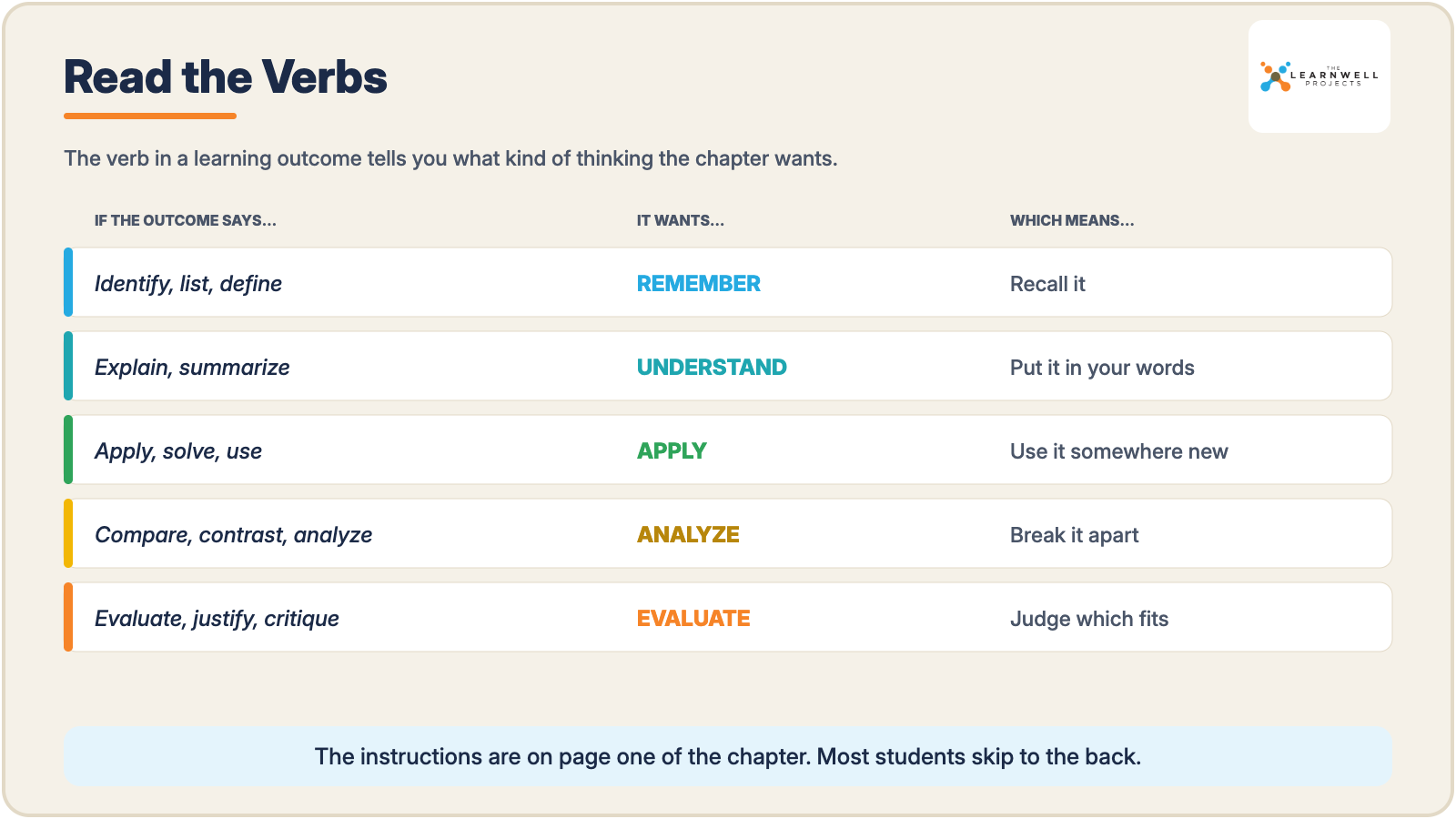
Identify asks you to remember. Compare and contrast asks you to analyze. Predict asks you to apply an analysis and evaluation while looking forward. Those verbs are instructions about what kind of thinking the chapter requires, and they are sitting in plain sight on page one.
That translation is where many students stall, and it is why I created the ThinkWell-LearnWell™ Diagram. It lays out the levels of thinking those verbs point to, so a student can read a learning outcome and know whether the chapter is asking them to recall, analyze or apply before they ever open their notes. It also turns into a readiness check: can I do what the verb asks? That is a far better question than have I read it? The diagram is free to download. Keep a copy beside the textbook during review sessions, and if you lead a learning center, put it in your staff’s hands too. It gives them and the students they serve a shared language for the kind of thinking the exam will demand.
What This Sounds Like in a Student’s Own Words
I ran a focus group with students who had turned their performance around. Listen to what changed. It was not effort. It was when and how they studied, and what they were listening for while they did it.
Keep exploring: if the three metrics are useful to you, the Learning Sufficiency Diagram is the tool I built to put them in a student’s hands. I walk through it in Improving Your Test Performance with the Learning Sufficiency Diagram on our YouTube channel — worth ten minutes before your next exam review session.
Using AI to Find Your Gaps
Most students heading into finals already have AI open in another tab. The question is what they are asking it to do.
If a student asks AI to summarize the chapter, they get a clean summary while learning almost nothing. The mental labor was performed, but not by them. There is good evidence this matters. In a study of nearly a thousand high school math students, those given an unrestricted chatbot scored 48 percent higher on practice problems and then 17 percent lower than their peers on the exam, once the tool was gone. A second group used a version built to give hints rather than answers. They gained in practice and lost nothing on the exam (Bastani et al., 2025).
The difference was not the technology. It was whether the student was still doing the mental labor.
Used the other way around, AI is excellent at exactly what metric two requires: showing a student where they go quiet.
- Students: Explain the concept in your own words first, then paste your explanation in and ask: “Tell me what’s accurate, what’s vague, and what’s missing. Don’t give me the answer. Ask me one question at a time until I can fix the gaps myself.” Then close the gaps yourself. That closing is the part that lasts, and it is the part that feels good.
- Faculty: Paste your course outcomes in and ask AI to identify the level of thinking each one demands and write one practice question at that level. Share the best of them. You will be modeling the verb-reading move from metric three without spending a class period on it.
- Learning center staff: When a student arrives with an AI summary, don’t review the summary. Ask what they can do now that they could not do before reading it, and how they would know if it were wrong. Their answer tells you whether anything landed.
One caution: AI will mirror your thinking back to you, and it can be confidently wrong. Your professor’s expectations are the final word. Use AI to sharpen your questions, then bring those questions to the learning center or to office hours.
The Part Worth Saying Out Loud
Finals get framed as something to survive. I would rather we framed them as the one moment in a semester when a student finds out what they actually built.
Paul Ramsden argued that good teaching invites students into the joys of learning (Ramsden, 2003), and there is a real joy available here: the moment a student explains something out loud and hears it come out whole. Not memorized. Understood. Students who feel that once go looking for it again.
Put these three metrics into a study routine and the change shows up quickly, in thinking first and in scores shortly after.
What are your go-to moves for helping students finish strong? I and those who read this post would like to hear them.
References and Further Reading
- Anderson, L. W., & Krathwohl, D. R. (Eds.). (2001). A taxonomy for learning, teaching, and assessing: A revision of Bloom’s taxonomy of educational objectives. Longman.
- Bastani, H., Bastani, O., Sungu, A., Ge, H., Kabakcı, Ö., & Mariman, R. (2025). Generative AI without guardrails can harm learning: Evidence from high school mathematics. Proceedings of the National Academy of Sciences, 122(26), e2422633122.
- Geddes, L. (2026). How to successfully transition students into college: From traps to triumph. Routledge.
- Ramsden, P. (2003). Learning to teach in higher education (2nd ed.). RoutledgeFalmer.
- Rozenblit, L., & Keil, F. (2002). The misunderstood limits of folk science: An illusion of explanatory depth. Cognitive Science, 26(5), 521–562.
Originally published 2014-05-06. Revised and expanded 2026-11-06.