
A first-year student came into my office in tears. I quickly learned that she was angrier than she was upset. She was earning Ds in a first-year seminar called Music through the Ages. She chose that course out of all the other options because she worked as a DJ. She pulled out her phone and showed me photographs of herself at event after event. She knew this material. She loved this material. And the course was burying her.
I had helped that university redesign its first-year seminar program in 2014, so I had a particular interest in how those courses were landing. The compromise that got faculty to teach them was that professors could build the course around something that genuinely interested them, and students could pick whichever one appealed.
That design has a name. In the standard typology it’s an academic seminar on various topics across sections: same credit, same expectations, different subject matter in every room, chosen by whoever is teaching it. I still think it was the right call, and I’d defend it now. It is also where this story goes wrong, which is the part I want to come back to at the end.
I’ll call her Molly.
What Her Notes Told Me
I asked to see her notes, which is almost always where I start, and the problem was visible inside a minute.
Her notes were meticulous. Every artist, every genre, every time period the professor had mentioned, captured accurately and organized beautifully. She had built a robust memory-and-retrieval system for the items discussed in class, and she had built it very well.
She had also misread what the course was for.
The professor spent most of each class covering popular artists and their work, so Molly concluded that her job was to hold an inventory of who produced what and when. Looking at how the class ran, I could see exactly how she got there. It was a reasonable inference from the evidence in front of her. It was also wrong, and no amount of additional effort was going to rescue her.
Studying Is a Feeling Process
Here’s the mechanism underneath, and it’s the part I hope you sit with.
Students are rarely certain that their preparation is adequate. There’s no gauge. So they rely on a feeling of readiness, and that feeling isn’t one thing: it’s assembled from three separate judgments a student is making continuously, mostly without noticing.
Each one answers a different question, and that’s the point. They aren’t three versions of the same signal. They cover different ground, and a student needs all three because no one of them can do the others’ job.
Judgment of learning asks: have I got this? It’s the prediction a student makes about material they can bring to mind right now. Read a section, look away, sense how well it stuck. This is the judgment that audits what has actually been covered (Zohar & Dori, 2012).
Feeling of knowing asks something stranger: is it in there somewhere? This one is about material the student cannot retrieve at this moment. It’s the tip-of-the-tongue sensation, the judgment that the answer exists in memory and would surface if something prompted it. Its job is to stop a student abandoning material prematurely, which is genuinely useful. It’s also the one that produces the click of recognition when you skim a page you can’t actually reproduce (Hart, 1965).
Judgment of learnability asks the question that runs the calendar: how much of this can I realistically get through before Thursday? This judgment allocates the hours. The research on it is unforgiving: under time pressure students drift toward the easier material and quit the hard material sooner, because they’re tracking how fast learning seems to be going rather than how much is left (Metcalfe & Kornell, 2005).
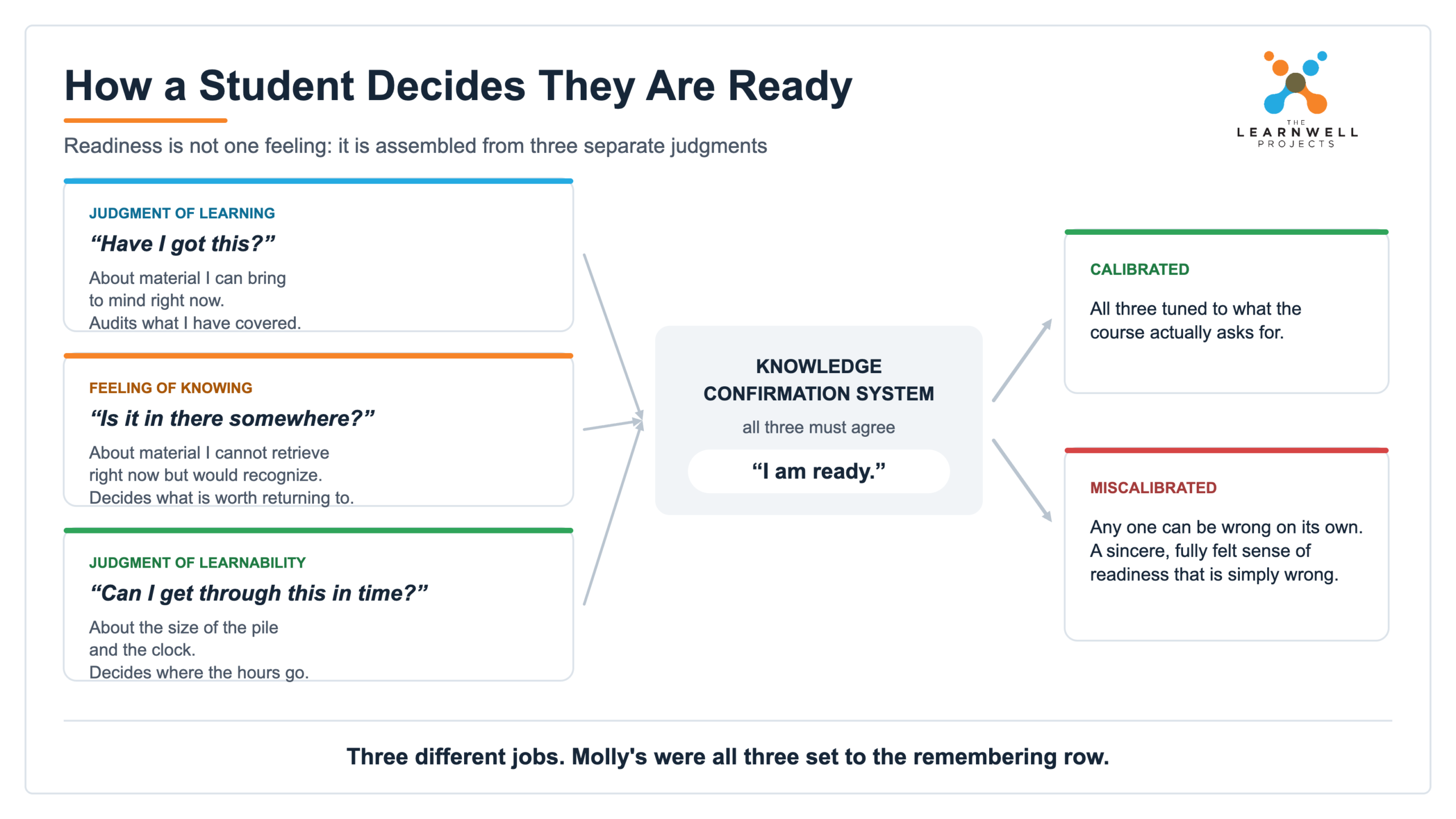
Together they answer the only question a student is really asking: am I ready yet? The first checks what’s covered, the second decides what’s worth returning to, and the third decides where the hours go. When all three agree, the student’s knowledge confirmation system trips and they feel prepared.
If the system is calibrated correctly, it carries them to success. If it’s calibrated to a different standard than the one their professor is using, it delivers a false confirmation: a genuine, sincere, fully-felt sense of readiness that is simply wrong.
And here’s what makes this hard to catch. The three can be miscalibrated independently. A student can have an accurate sense of what they’ve covered, a reliable instinct for what’s still retrievable, and a completely wrong idea of what the material requires, and still walk into the exam confident.
Molly’s were all three tuned to the same wrong setting. Every one of them was measuring the remembering row.
That’s why she couldn’t think her way out of it. Nothing in her experience was signaling a problem until the grade arrived, and by then she’d invested another two weeks.
Showing Her the Row She Was Standing On
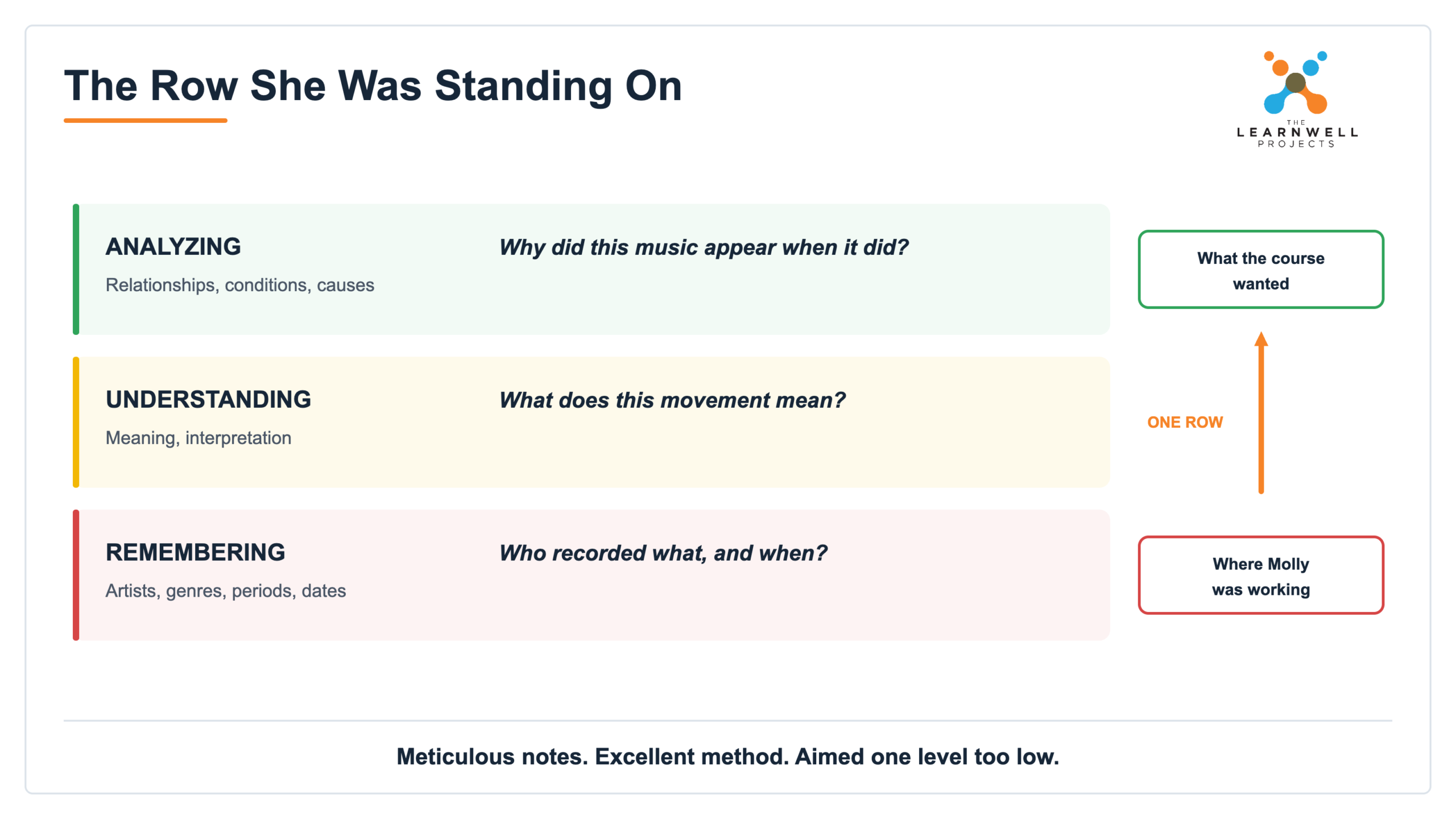
I needed Molly to see this rather than hear me describe it, so I put the Learning Sufficiency Diagram on the table between us.
%
%
All of Molly’s mental labor was going into capturing each artist, genre and period, then organizing those items for retrieval. That work was genuinely taxing. It just wasn’t producing the kind of outcome her professor was after.
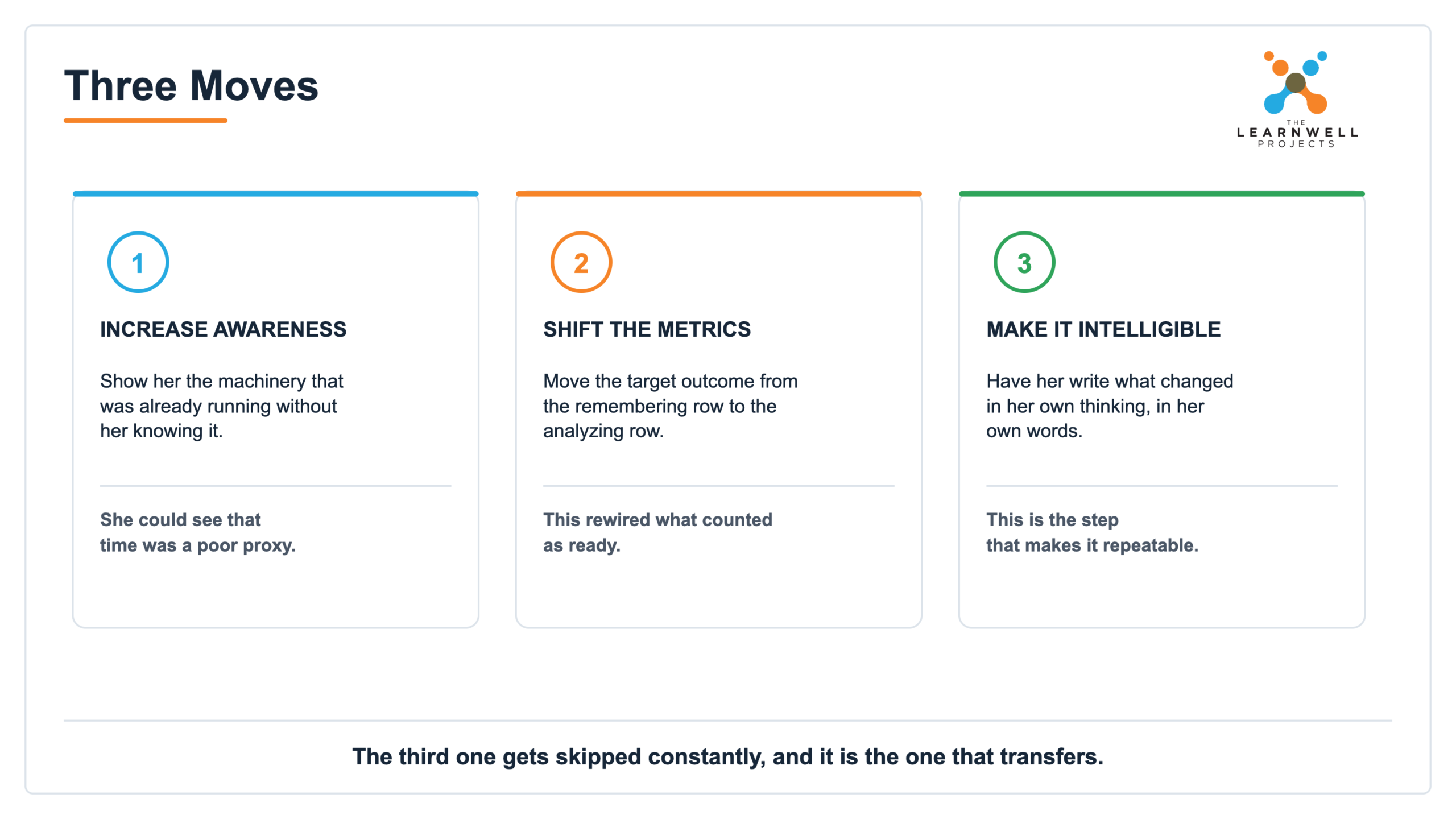
Three moves got her out:
%
%
Increase her awareness. Reading across the rows, I showed Molly the connections that were already happening in her mind without her knowing it. As she interacted with content, her mind was automatically generating outcomes. She had no visibility into that machinery, so she had focused on the one variable she believed she controlled: if she studied long enough, success would follow. Seeing the diagram, she could tell that time was a poor proxy for any of it.
Shift her metrics. Once she could see which knowledge products, metrics and confirmation signals were operating, she could set new ones. She moved her target outcomes from the remembering row to the analyzing row. That single shift changed the direction of her thinking and rewired what her confirmation system was willing to accept as ready.
Make the change intelligible. I had her write a short account of what had changed in her thinking. This step gets skipped constantly and it’s the one that makes the gain repeatable. If a student can’t articulate what they did differently, they can’t do it again on purpose in a different course.
The Learning Sufficiency Diagram is the tool this whole session runs on, and it’s free to download from the Tools page. I’d put it in front of any student who is working hard and getting nowhere.
What Happened to the Course
Her professor kept teaching exactly the same way. Nothing about the course changed. Molly’s analytical thinking changed what she pulled out of class and what she did with it afterward.
She started weighing the relationship between what artists produced and the conditions they produced it in. She noticed differences between songs that were popular in wartime and songs popular in peacetime, got interested in how societal shifts and musical shifts tracked each other, and began working on the question her professor had been circling all term: are artists shaping the culture, or is the culture producing the artists?
That turned out to be his lingering research question. She had found her way to it from the inside.
Her grade recovered, which is the least interesting part of this. What I find more telling is that she came out with a deeper relationship to music than she went in with. She was no longer satisfied writing accurate papers about artists and their hits. She was writing about the interplay between a society and its music, and she carried that way of working into her other courses.
She graduated near the top of her class. When we crossed paths years later she told me the Learning Sufficiency Diagram had been her study companion all the way through graduate school, from which she’d graduated magna cum laude.
Using AI to Test a Confirmation System
This is one of the few places where AI can reach something we’ve never had good access to: the moment a student decides they’re ready.
- Students: Use it to check your calibration before the exam checks it for you. Try: “I believe I’m prepared for this assessment. Here’s the learning outcome and here’s a summary of what I did to prepare. Tell me which cognitive level my preparation actually reaches, and write me three questions at the level the outcome is asking for.” If you can’t answer those three, your confirmation system is miscalibrated and now you know a week early.
- Faculty: Use it on the gap between how you teach and what you assess. Try: “Here’s a transcript or outline of a typical class session, and here’s an exam question. What would a diligent student reasonably conclude this course is asking them to do, based only on the session? Where does that conclusion fail them on the exam?” Molly’s professor had no idea this gap existed in his course.
- Learning center staff: Use it to read the notes the way I read Molly’s. Try: “Here’s a page of a student’s class notes and here’s the course outcome. What cognitive level are these notes operating at? Give me one question I could ask that would let the student notice the mismatch themselves.”
One caution: a confirmation system can only be recalibrated by the student who owns it. If AI supplies the analysis Molly needed to produce, she gets a correct answer about Music through the Ages and keeps the faulty system intact into her next course, which is where the real damage was always going to happen. The point of that session was never the music paper. Let AI expose the miscalibration. The student has to do the recalibrating.
The Course Design Was Right. It Still Missed.
Now the part I promised at the start, because I don’t want this read as a story about one confused student.
The seminar Molly took is, on paper, exactly what we say we want. First-year seminars are one of the recognized high-impact practices, and the strongest versions of them put small groups of students in regular contact with faculty and pull them into real scholarly questions rather than a survey of settled facts (Kuh, 2008). Molly’s professor did that. His course was built around a question he was actually chasing: are artists shaping the culture, or is the culture producing the artists? That’s not a warm-up exercise. That’s the work.
And the interest blend is a genuine asset, not a gimmick. A student who chose the room is a student who shows up. For a first-year course whose real job is moving students into college-level academic work, starting from something they already care about is a reasonable way to buy their attention while you change what they do with it.
So this design should be one of our best vehicles for transition. In my experience it is also one of the most reliable places to lose a student, and for a specific reason.
The interest blend hides the academic demand. When a student picks a course because they love the subject, they arrive with a fully formed idea of what that subject is about, and that idea is almost always made of content. Molly knew an enormous amount about music. She reasonably concluded that the course wanted what she already had, in greater quantity. Nothing in the room contradicted her until the first grade, because her professor was teaching his question and she was hearing his examples.
A course taught from genuine curiosity is full of signal about what the instructor finds interesting and nearly silent about what kind of thinking the student is supposed to do with it. The passion that makes the design work is the same thing that makes the task invisible.
Which is fixable, and cheaply. Not by flattening these courses into uniform content, which would throw away the thing that makes them good. By saying the quiet part out loud in week one: this course will ask you to analyze, not to catalogue, and here is what that looks like in this subject. Ten minutes of that, repeated a few times a term, is the difference between Molly’s first semester and the one she actually had.
I’ve spent a lot of years on the transition into college specifically, and wrote it up at length in How to Successfully Transition Students into College: From Traps to Triumph. This is one of the traps in it, and it’s among the quietest, because every visible indicator says the course is working.
Why I Still Tell This One
Because Molly was not struggling with a subject she disliked, and she was not short on effort or interest. She was a specialist in the content, working hard, using an excellent method, aimed one row too low.
We advise students to study X hours for every hour of class. I understand why, and I’d ask us to stop. Time is a container. It tells a student nothing about what went into it, and it hands them a metric that can be fully satisfied while nothing is learned. It sets them up to feel betrayed by their own diligence.
Ramsden argued that the real aim is to make learning possible, and that there’s deep satisfaction available when it happens (Ramsden, 2003). Molly’s satisfaction didn’t come from the grade. It came from the week she realized her own mind was something she could aim.
What are your students using to decide they’re ready? And have you ever asked one out loud?
References and Further Reading
- Bjork, R. A., Dunlosky, J., & Kornell, N. (2013). Self-regulated learning: Beliefs, techniques, and illusions. Annual Review of Psychology, 64, 417–444.
- Geddes, L. (2026b, June 16). Part II: The academic labor question – Redesigning academic work in the age of AI. The LearnWell Projects. https://thelearnwellprojects.com/redesigning-academic-work-age-of-ai/
- Hart, J. T. (1965). Memory and the feeling-of-knowing experience. Journal of Educational Psychology, 56(4), 208–216.
- Koriat, A. (1997). Monitoring one’s own knowledge during study. Journal of Experimental Psychology: General, 126(4), 349–370.
- Kuh, G. D. (2008). High-impact educational practices: What they are, who has access to them, and why they matter. Association of American Colleges and Universities.
- Metcalfe, J., & Kornell, N. (2005). A region of proximal learning model of study time allocation. Journal of Memory and Language, 52(4), 463–477.
- Ramsden, P. (2003). Learning to teach in higher education (2nd ed.). RoutledgeFalmer.
- Zohar, A., & Dori, Y. J. (2012). Metacognition in science education. Springer.
Originally published September 20, 2022. Revised and expanded November 13, 2026.