
Part II of the Metacognition Is Academic Athleticism series
In Part I, we looked at the sophistication of learning taking place inside athletics. But saying that athletes learn complex systems still leaves an important question unanswered: What changes between the player who memorizes the playbook and the player who can actually use it intelligently?
Football calls it vision. Academics rarely give it a name.
For decades, commentators, fans, and even athletes have downplayed the role of intellect on the gridiron. The prevailing assumption was simple: quarterbacks needed to be smart, but everyone else just needed to be tough.
I’ve always pushed back against that narrative.
Consider a directive barked on practice fields everywhere: “Play fast!” At first glance, a coach seems to be demanding raw foot speed. But “playing fast” isn’t about sprinting harder; it is about diagnosing what unfolds in front of you rapidly enough to trigger an immediate, decisive reaction. Diagnosis is a cognitive skill. How quickly you do it dictates your physical response time.
I had unexpected help getting this point across to a team in 2011. While leading a workshop, I had the players work in groups to unpack the hidden meaning behind familiar sideline maxims like “read the defense,” “play fast,” and “play with anticipation.”
After the session, Brandon Lynch—a Super Bowl champion with the 2007 Indianapolis Colts—pulled me aside.
“What you’re describing,” he told me, “is the exact separator I saw in the League. I didn’t know exactly what it was until now.” Everyone at that level has world-class athletic talent, he explained, or they wouldn’t have made the roster. What distinguishes the elite isn’t sheer physical superiority; it’s how their minds work. It’s how they see the game. They spot patterns others miss and react faster because their minds operate differently.
Lynch was articulating what cognitive scientists call the metacognitive edge: athletic dominance quietly powered by underlying mental architecture.
Two years later, many of those same players helped Lenoir-Rhyne reach the 2013 NCAA Division II National Championship game, finishing the season 13–2. I remember being struck by comments from opposing coaches about how fast the team played. I don’t offer that as evidence that one workshop produced a championship team—far from it. What stays with me is the language. It echoed the distinction Lynch had helped me see two years earlier: sometimes what looks like physical speed begins with how quickly a player can see, interpret, and understand the game.
Yet this gap between mechanical execution and deep, rapid analysis is hardly unique to elite sports. It mirrors almost identically the struggle students face when moving from memorization to mastery in academic coursework.
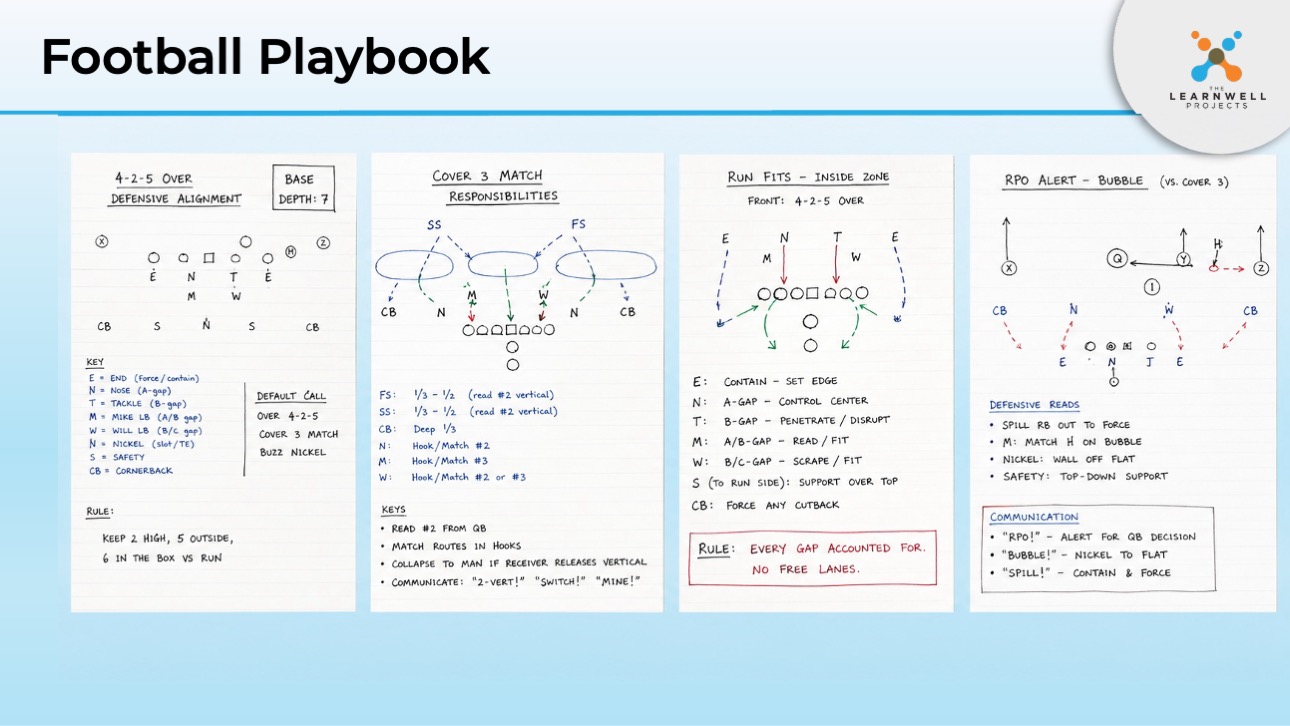
One way to understand this is to compare the information students study with what we ask them to do on an exam or in practice. Consider an organic chemistry course.
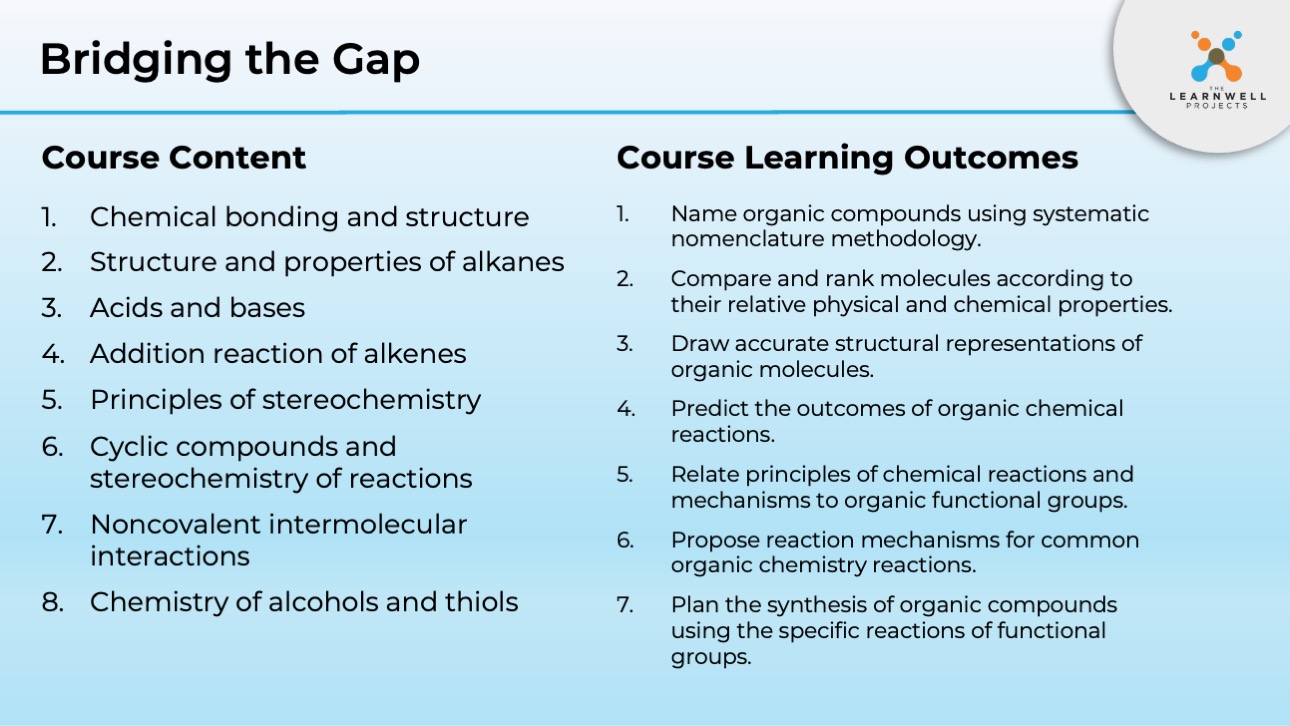
The left side identifies what students encounter. The right side reveals what they must eventually be able to do with it.
Notice the language on the left: chemical bonding, alkanes, acids and bases, stereochemistry, reactions. These are the subjects around which the course is organized. Now notice the verbs on the right: name, compare, draw, predict, relate, propose, plan.
Those verbs make something visible that students can easily miss. The course is not ultimately asking them merely to possess information about organic chemistry. It is asking them to perform intellectual work with that information.
Football has the same architecture.
A defensive player may learn terms such as A-gap, B-gap, C-gap, backside responsibility, and cutback lane. Those pieces matter, but Saturday’s performance is not a vocabulary quiz asking the player to define B-gap. He may instead have to diagnose a developing run, preserve his responsibility within the defense, and adjust as the offensive picture changes.
Between the individual terms and the successful performance sits something important: conceptual structure.
Content → Concepts → Performance
Take the football example:
A-gap, B-gap, backside responsibility, cutback lane → gap integrity → diagnose the run and maintain defensive structure.
The pieces of content become usable because they are organized around a concept. Gap integrity helps a player understand not merely where he is supposed to go, but why his position matters in relation to the other ten defenders.
Now consider organic chemistry:
particular molecules, reaction types, intermediates, and terminology → principles such as stereochemistry and reaction mechanisms → predict or explain the outcome of an unfamiliar reaction.
Again, isolated content matters. But the larger goal is not merely recall. Concepts allow learners to organize those pieces so that they can use them when the surface features of the problem change.
This matches what researcher Patricia Alexander observed about how people learn. Real expertise isn’t just collecting more facts; it’s organizing knowledge so you know when and how to use it.
The labor between the two sides
The problem becomes even clearer when we make the relationships themselves visible.
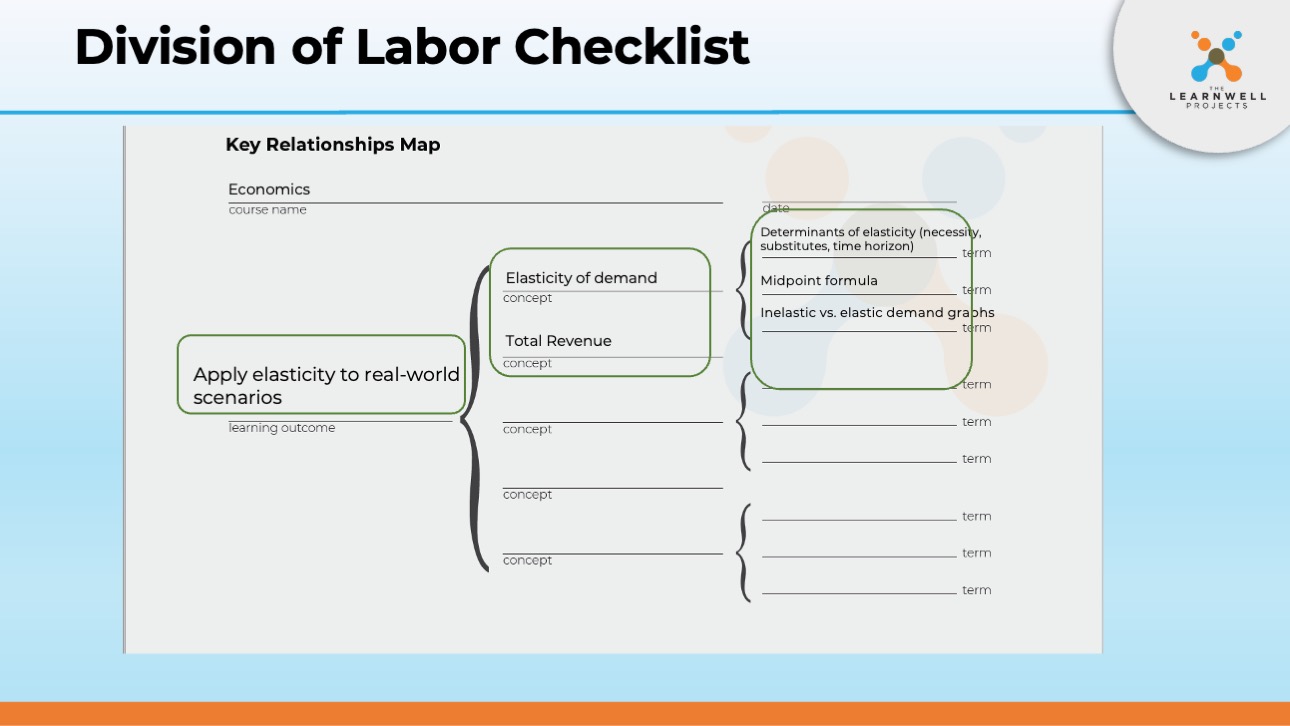
Outcomes sit on one side and specific terms on the other. The learner has to build the conceptual bridges in between.
Imagine looking at the tasks on the left side of this map without thinking about your own learning process: Predict chemical reaction outcomes. Propose reaction steps. Connect principles to functional groups. Then look at the terms on the right: halogen addition, intermediates, cyclohexene, 2-butene.
A student who actively manages their own thinking sees how these pieces fit together. Without that self-awareness, the student sees only a list of separate facts. The real challenge is moving from just receiving information to actively organizing it.
Which terms belong together? What concept organizes them? Which details matter in this problem? When does one principle apply rather than another? Is this new example genuinely new, or is it another version of something I already understand?
That is rich cognitive labor — the hidden part of academic work that is often unseen and therefore overlooked.
Cognitive labor and metacognitive labor
Cognitive labor is the actual intellectual work of recognizing, recalling, comparing, interpreting, connecting, predicting, deciding, and executing. A linebacker identifying a blocking pattern and a chemistry student interpreting a reaction are working with different content, but both are doing something with information rather than merely possessing it.
Metacognitive labor sits around and within that work. What am I trying to accomplish? At what level do I know the content? Do the examples simply look familiar? Is my approach working? What should I change if it isn’t?
Researchers Marcel Veenman and his colleagues define metacognition simply as knowing about and managing your own thinking. That distinction shows why metacognition isn’t just extra content to memorize—it is the mental control system learners use to handle the content.
The distinction also helps explain an experience familiar to coaches and professors alike. Two learners may have been exposed to the same information, yet one sees meaningful relationships where the other sees many disconnected details. The difference may not be how many pages they read or how many times they ran through plays, but how their knowledge has been organized and how effectively they can regulate its use.
Athletic and Academic Vision
That difference in mental organization is what creates vision, which enables athletes and students to look past surface distractions and perceive underlying conceptual structures.
I have used the term academic vision for years to describe this capacity. In How to Successfully Transition Students into College: From Traps to Triumph, I devoted Chapter 7, “The Power of Academic Vision,” to the idea that successful students learn to look beyond the surface features of academic work and perceive the deeper relationships that organize it. Football gives us an unusually visible example of the same phenomenon.
Consider how athletic vision operates before a football snap. A defender who lacks it sees only scattered information—receivers, linemen, a quarterback, and motion—leaving them overwhelmed by competing details. In contrast, a player who has it sees clear patterns, anticipates concepts, filters out distractions, and instantly focuses on key visual cues.
The field itself hasn’t changed, but athletic vision allows the player to process the game with clear, structured focus rather than confusion.
Academic vision follows the same pattern in the classroom. Without it, studying feels like memorizing an endless list of isolated facts and formulas or terms and techniques. But a student with academic vision connects those separate pieces into coherent concepts, transforming overwhelming material into manageable understanding.
That brings us back to What → Why → How. At first, learners often need the what: tell me where to line up; tell me which formula to use; tell me what will be on the test. Greater understanding introduces the why, and greater metacognitive skill permits a more flexible how: how should I adapt when the conditions are no longer identical to the example I practiced?
This conceptual structure explains why deep understanding makes a player appear to react faster or a student solve problems more effortlessly. As Mihaly Csikszentmihalyi noted in his work on Flow State, they are not bypassing thinking; rather, their cognitive processing becomes so fluid and automatic that time seems to slow down.
The connection—and the complication
Put the two worlds beside one another and the analogy becomes clearer. Successful football performance requires players to connect content to concepts and concepts to action. Academic performance asks learners to do much the same thing with different kinds of knowledge.
The complication is that recognizing this architecture in one domain does not mean we automatically recognize it in another. A player may understand perfectly that dozens of defensive terms are organized around a few central concepts, yet walk into biology and treat every highlighted sentence as an equally isolated piece of information.
That does not necessarily mean the learning capacity vanished.
It may mean the learner has not yet recognized that the new environment contains a familiar kind of problem.
And that brings us directly to transfer, which will be the focus of the next article.

Start the Conversation
With a student-athlete: Pick one concept from your sport—something like spacing, leverage, timing, or gap integrity. What pieces of information sit underneath it, and what does understanding that concept allow you to do that memorizing the pieces would not?
With someone supporting student-athletes: If we took one of the student’s courses and tried to map content → concepts → performance, how much of that structure would be visible to the student without our help?
With yourself: As a former linebacker, I like to test my own athletic vision when watching games by trying to diagnose the play before the players on the field do. The next time you watch a game, pay attention to the players who move first, act with purpose, and play with anticipation—you are watching their mental vision in action.
Bibliography
Csikszentmihalyi, M. (1990). Flow: The psychology of optimal experience. Harper & Row. Amazon
Alexander, P. A. (2003). The development of expertise: The journey from acclimation to proficiency. Educational Researcher, 32(8), 10–14. https://doi.org/10.3102/0013189X032008010
Veenman, M. V. J., Van Hout-Wolters, B. H. A. M., & Afflerbach, P. (2006). Metacognition and learning: Conceptual and methodological considerations. Metacognition and Learning, 1(1), 3–14. https://doi.org/10.1007/s11409-006-6893-0.
Hancock, P. A., Kaplan, A. D., Cruit, J. K., Hancock, G. M., MacArthur, K. R., & Szalma, J. L. (2019). A meta-analysis of flow effects and the perception of time. Acta Psychologica, 198, 102836. https://doi.org/10.1016/j.actpsy.2019.04.007
Geddes, L. (2023). How to successfully transition students into college: From traps to triumph. Routledge. https://doi.org/10.4324/9781003447252