

The Far Transfer Matrix: Why Students Fail to Transfer Learning—and How to Diagnose It
Malik graduated from an electrical program with a strong transcript and a lot of confidence. Six months into his first job, he was troubleshooting a three-phase industrial motor control circuit on his own. He reached for the Ohm’s-law reasoning that had worked perfectly on the simple series DC circuits from his coursework. The vocabulary matched: voltage, current, circuit. The underlying physics did not. Malik produced a confident, wrong diagnosis, and nobody caught it until the equipment misbehaved.
That moment has a name, and naming it is the whole point of this guide.
What Far Transfer Actually Means
Transfer of learning is what happens when something a student learned in one setting has to work in a different one: a different course, a different tool, a different job, or a different timeframe than where it was first learned. Near transfer means the new setting is close to the original, similar tools, similar vocabulary, soon after. Far transfer means the new setting is genuinely different: a different domain, a different context, months or years later, with no one there to say “this is the same kind of problem.”
Cross that distance question with a second question, whether the old learning helped or hurt in the new setting, and four outcomes emerge instead of the one outcome most programs actually watch for.
Two Questions, Four Outcomes
Most academic support systems only ever look for one thing: did the student finish the assignment in front of them? That single question collapses a much richer picture down to its easiest cell to satisfy, positive near transfer, a skill repeated correctly in a familiar setting soon after it was taught.
The other three cells are where the real signal about long-term learning lives.
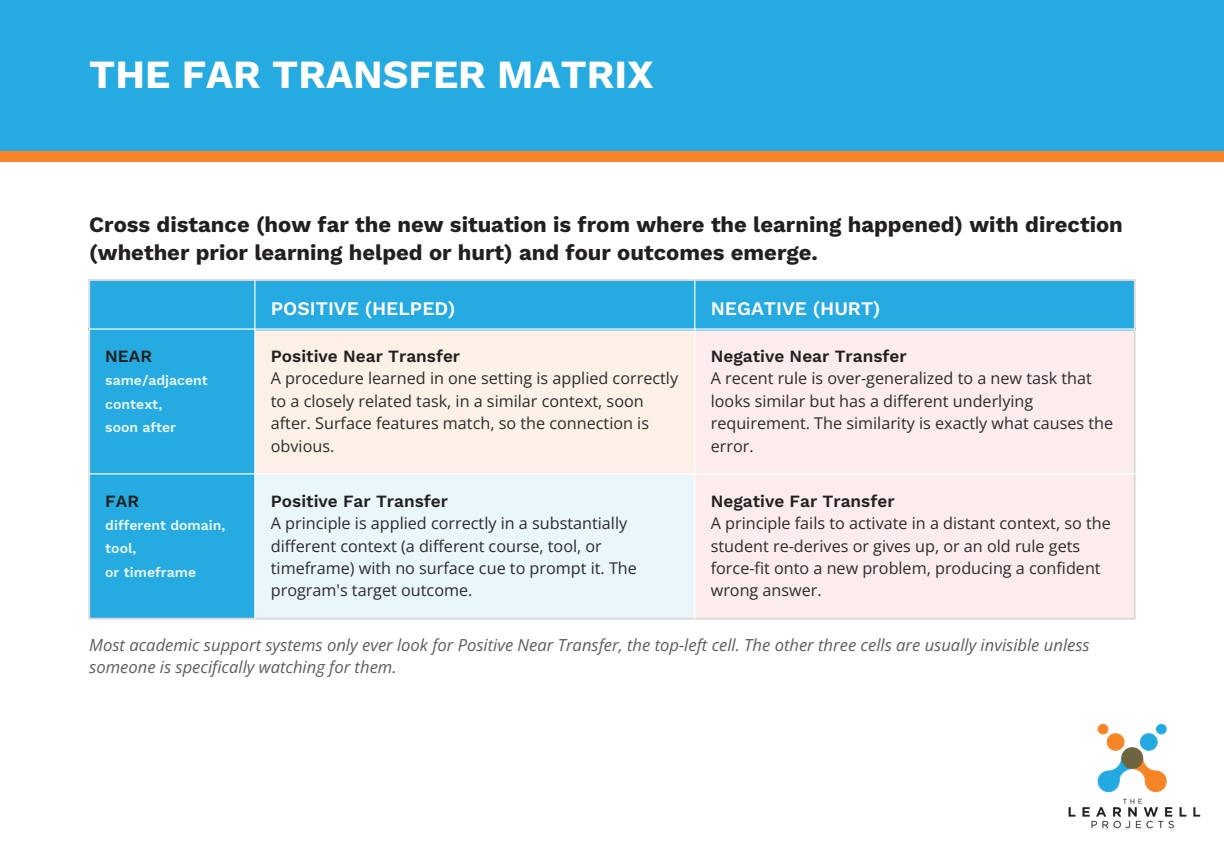
Positive Near Transfer. A student correctly applies something learned in one setting to a new but closely related task, usually within the same course or the very next one in sequence. Maria learns to calculate shaft tolerances using a plus/minus formula in one lab, then applies that same formula, unprompted, to compute an allowable clearance in the very next lab. This is the easiest transfer to produce, and the easiest to mistake for mastery. It tells an instructor a student can repeat a procedure, not that she understands why it works, which is what the far-transfer cells actually require.
Negative Near Transfer. A student applies a rule from a recent, closely related task to a new task that looks similar but has a different underlying requirement, and the similarity itself is what causes the error. Derek spends two weeks in a duct-sizing unit where rounding up to the next standard size is the safe convention. A week later, in a static-pressure calculation for a different configuration, he rounds up again out of habit. Here, rounding up produces an under-sized estimate that would leave the system unsafe. Derek’s memory, effort, and habit-forming all worked exactly as designed. Only the boundary around the habit was missing.
Positive Far Transfer. A student correctly applies a principle learned in one course to a problem in a completely different domain, tool, or timeframe, often months or years later, with no one telling her “this is the same kind of problem.” Two years after a gen-ed math course, Renee is on a job site troubleshooting an HVAC system she has never worked on before. She notices the airflow problem tracks with the ratio between duct diameter and run length, and recognizes, unprompted, that it is the same proportional-reasoning principle from that math course. Nothing about the job site resembles a classroom. That is what makes it far transfer, and it is the outcome that defines “workplace-ready” rather than “exam-ready.”
Negative Far Transfer. Either prior learning that should apply to a distant new problem fails to activate, so the student re-derives it from scratch or gives up on something she already knows, or a principle from an old, unrelated context gets force-fit onto a new problem where it does not hold, producing a confident but wrong answer. This is Malik’s cell, and it is the costliest one in a technical field, because it produces confident errors, not visible confusion. A student who does not know what to do will ask for help. A student who wrongly transfers an old rule often will not. He thinks he has already solved it.
Why the Matrix, Not Just the Story
An instructor who says “that student just isn’t trying” and a peer coach who says “she clearly gets it, she just froze” can be describing the exact same moment: a student who has the right knowledge, but it did not activate when the surface context changed enough to hide it. Without a shared vocabulary, that moment gets explained away by personality, effort, or luck, and the same misdiagnosis repeats month after month, cohort after cohort, because nobody names it.
“Which cell was that?” is a faster, more precise question than “what happened?” It points straight at what to do next, and it travels well beyond a single conversation. A department chair reviewing capstone results, a curriculum committee mapping course sequences, or an institutional-effectiveness team analyzing retention data can use the same four cells to ask a sharper question about where prior learning did or did not survive contact with a new demand, not just whether outcomes improved.
None of this means positive near transfer is unimportant. It is the foundation everything else builds on. The point is only to notice it, name it correctly, and not mistake it for the harder work still ahead: building toward Cell 3 on purpose, and catching Cell 4 before it reaches a live circuit, an operating room, or a client meeting.
Barnett and Ceci’s review of the transfer literature found that far transfer becomes less likely as the gap widens between where a skill was learned and where it needs to be used (Barnett & Ceci, 2002). That gap will not close on its own. Programs that want graduates to reach positive far transfer have to design for it directly, which is what Perkins and Salomon’s classic “hugging and bridging” framework was built to do: hugging instruction closer to the transfer performance a program actually wants, and bridging explicitly between the classroom and the far context where the skill will next be needed (Perkins & Salomon, 1988).
Running the Diagnostic Live
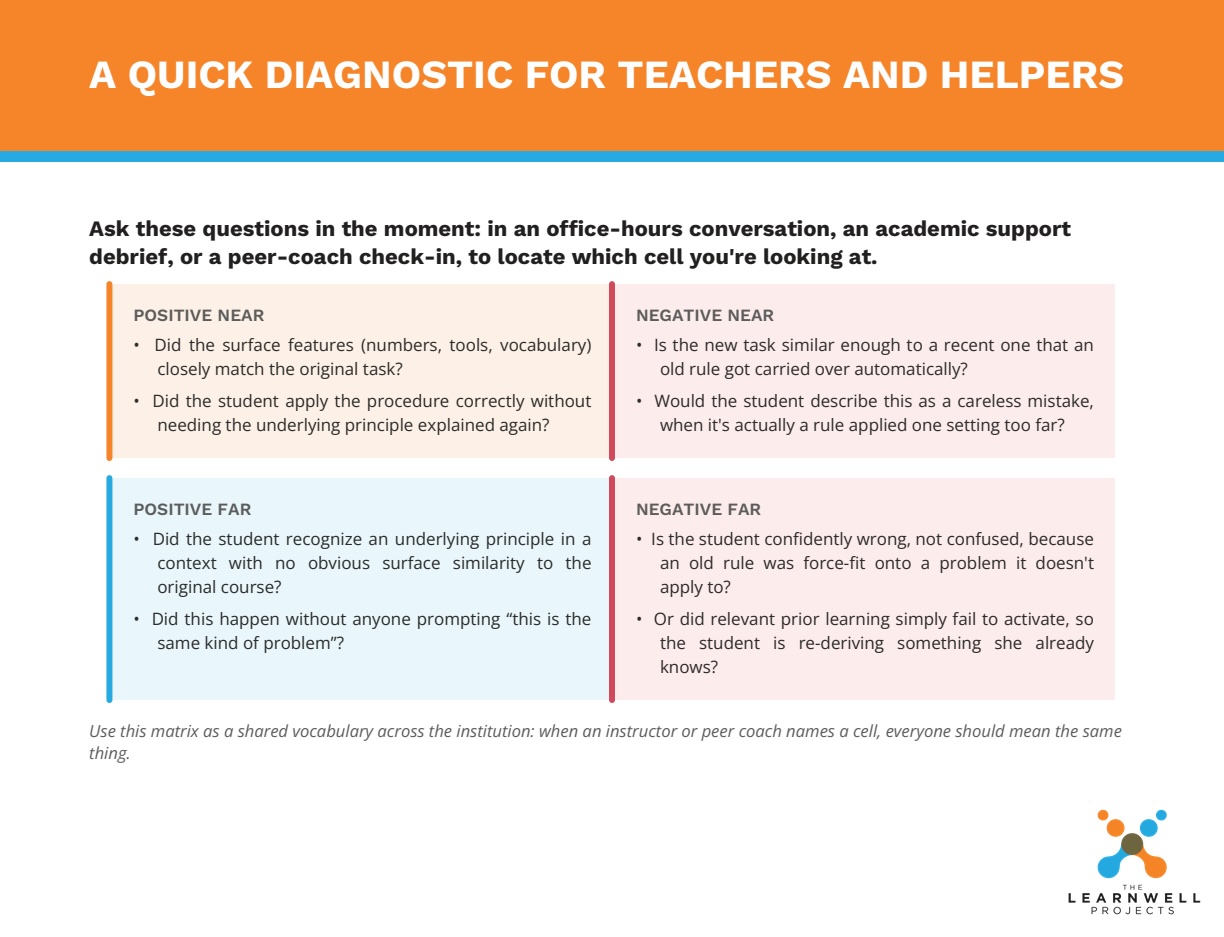
The matrix works because it gives instructors, peer coaches, and students the same four words for four very different problems. A diagnosis takes seconds, not a debate.
Derek’s negative near transfer moment shows how fast this runs in practice. His coach did not open with a lecture on decimals. She asked one question: is this task similar enough to a recent one that an old rule got carried over automatically? Derek said yes before he finished the sentence. He had been rounding to the nearest whole number all semester and never noticed the new problem required two decimal places.
That is the whole diagnostic: one shared question, one honest answer, and a coaching conversation that starts in the right place instead of a generic reminder to “be more careful.” The coach logged it as “Cell 2, decimal-place habit carried over,” turning an anecdote into data a program can track across a semester or a cohort. A cluster of Cell 2 tags in one course sequence is a curriculum signal. A cluster of Cell 4 tags in one capstone is a safety signal, and it is the cell traditional academic support is least equipped to catch, because it shows up on the job or in a capstone, far outside the original course.
Grow, lead, and achieve with tools, tips, and insights delivered straight to your inbox by The LearnWell Projects.
By submitting this form, you are consenting to receive marketing emails from: . You can revoke your consent to receive emails at any time by using the SafeUnsubscribe® link, found at the bottom of every email. Emails are serviced by Constant Contact
Try This
- Pull one assignment you graded or observed this week. Which of the four cells does it actually demonstrate, not just “finished” or “not finished”?
- Ask one student this week to explain, in their own words, why a procedure they used correctly actually works. If they can only repeat the steps, you are probably looking at Cell 1, not Cell 3.
- In your next academic support debrief or peer-coach training, replace “how did that go?” with “which cell was that?” and see how much faster the conversation gets specific.
- Identify one course or capstone in your program where a confident wrong answer would carry real consequences. Build a habit of asking about Cell 4 there before a student ever reaches that moment alone.
References
Barnett, S. M., & Ceci, S. J. (2002). When and where do we apply what we learn? A taxonomy for far transfer. Psychological Bulletin, 128(4), 612-637. https://doi.org/10.1037/0033-2909.128.4.612
Perkins, D. N., & Salomon, G. (1988). Teaching for transfer. Educational Leadership, 46(1), 22-32. https://files.ascd.org/staticfiles/ascd/pdf/journals/ed_lead/el_198809_perkins.pdf
Thorndike, E. L., & Woodworth, R. S. (1901). The influence of improvement in one mental function upon the efficiency of other functions (I). Psychological Review, 8(3), 247-261. https://psychclassics.yorku.ca/Thorndike/Transfer/transfer1.htm
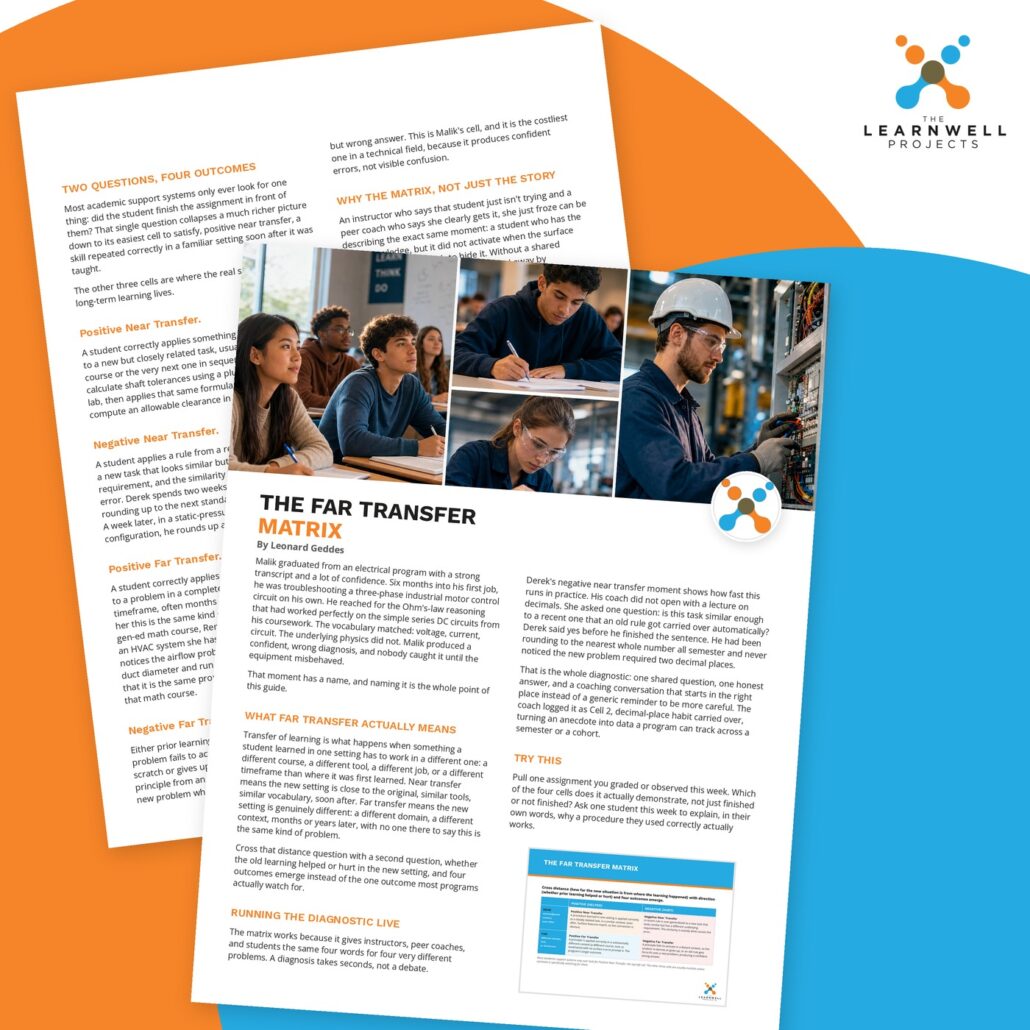
Get your FREE PDF version.
Leave a thoughtful comment below to get the extended PDF version with scenarios and questions for all stakeholders!
6 comments
Susan Wolcott
Thank you for the great resources, which can help educations address major educational issues including:
1. The challenges and support within courses often fail to encourage self-management and application beyond memorization and the current assignment.
2.We need to help students think beyond the current course and develop long-term knowledge and realistic skills for effectively applying their knowledge in new settings (and acquiring new knowledge as needed).
Leonard Geddes
Hi Susan.
Thanks for your contribution. I really like your reference to self-management. I think empowering students to manage how their learning transfers should be a key outcome for all. Check your inbox for the PDF.
Stacey
This is a nice framing of a challenge that is often difficult to discuss in ways that lead to actionable steps. Thank you for sharing!
Leonard Geddes
Hi Stacey. It’s always nice to have thoughts from a close colleague. I know you and your staff does outstanding metacognitive work at Rutgers, so your comments are even more meaningful. Check your inbox for the PDF. Let’s connect soon.👋🏿
Ro
Thank you for sharing this important information
Looking forward to digging in deeper to see how I can better support my learners
Ben K
This framework, along with the matrix tools, is pertinent to my academic coaching practice. It will help me be more granular in my approach, giving students more specific feedback and helping them identify what they can do to improve their learning.