
As she works through the midterm, Emma recognizes terminology on nearly every question. That is precisely what makes the experience so unsettling.
The first problem looks like something from last week’s homework, yet she stalls, unable to decide which method to use. She starts one, crosses it out, and tries another. A few questions later, two ideas she understood in separate chapters appear together. She knows what each means. She is less certain about how they relate.
Emma ponders, Am I getting lost in the sauce?
As she walks away from the exam, she tries to reconcile two experiences: the student who could do the work throughout the semester and the student who struggled to do it for ninety minutes.
Her homework grades were in the nineties. Her quizzes suggested she was learning effectively, which made the uncertainty she experienced on the exam even more confusing. When the exam grades post, she’s shocked to see her score was much lower than she expected.
In that moment of defeat, Emma doesn’t ask whether the weekly coursework and the midterm demanded different kinds of mental labor. Instead, she internalizes the gap and asks a destructive question:
Am I just not cut out for this?
That question can escalate a common, solvable learning challenge into a permanent transition trap that follows a student throughout their academic career and beyond.
To fix it, we need to replace Emma’s self-doubt with a more productive question: Are comprehensive exams testing something fundamentally different from what students practice during the term?
When we examine uneven performance like Emma’s, we find the issue is rarely capability, motivation, or effort. It boils down to how students interact with three core elements: what I call the Three Cs of Academic Work.
The Three Cs of Academic Work
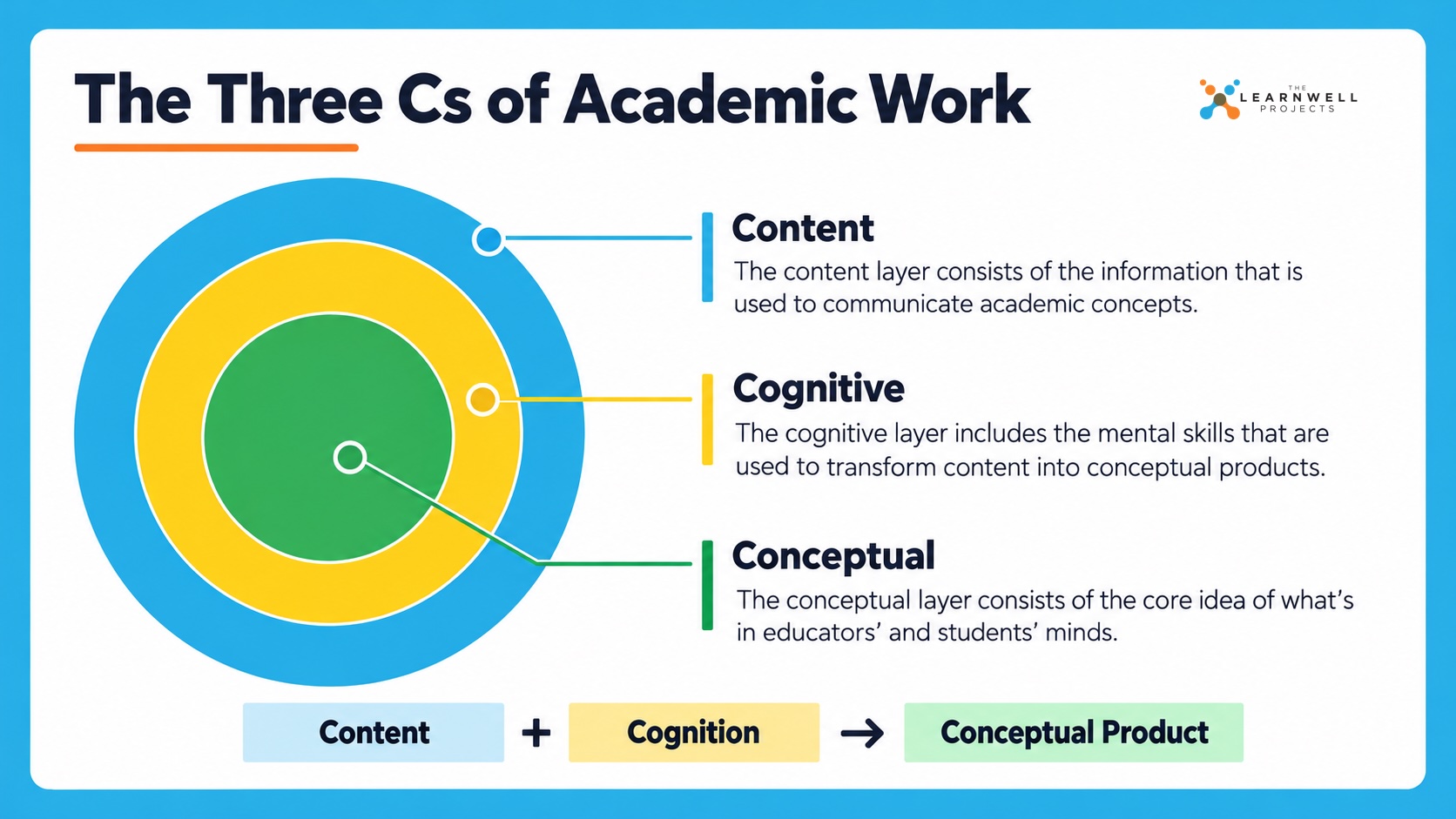
The disconnect between homework and comprehensive exams comes down to this formula: content and cognition combining to create conceptual understanding.
Just as mixing blue and yellow makes green, students must combine course content (blue) with active cognition (yellow) to build true conceptual understanding (green).
- Content provides the raw information, such as definitions, formulas, facts, and rules.
- Cognition supplies the deliberate mental labor required to process and evaluate that material.
- Conceptual Understanding is the resulting product: an integrated mental schema where ideas connect, compare, and transfer to new contexts.
The green inner circle—the conceptual product—is what comprehensive exams actually evaluate. The test isn’t merely assessing what a student has accumulated, but how fluidly they can navigate the relationships among ideas.
Instructors and students often misunderstand this dynamic. In student focus groups, they earnestly believe their teachers deliberately try to trick them by putting material on exams that they didn’t cover in class. In faculty focus groups, professors adamantly counter that everything on the exam was taught.
Who’s telling the truth? Both are, from their vantage point. The gap isn’t about what was taught; it is about what each side actually sees.
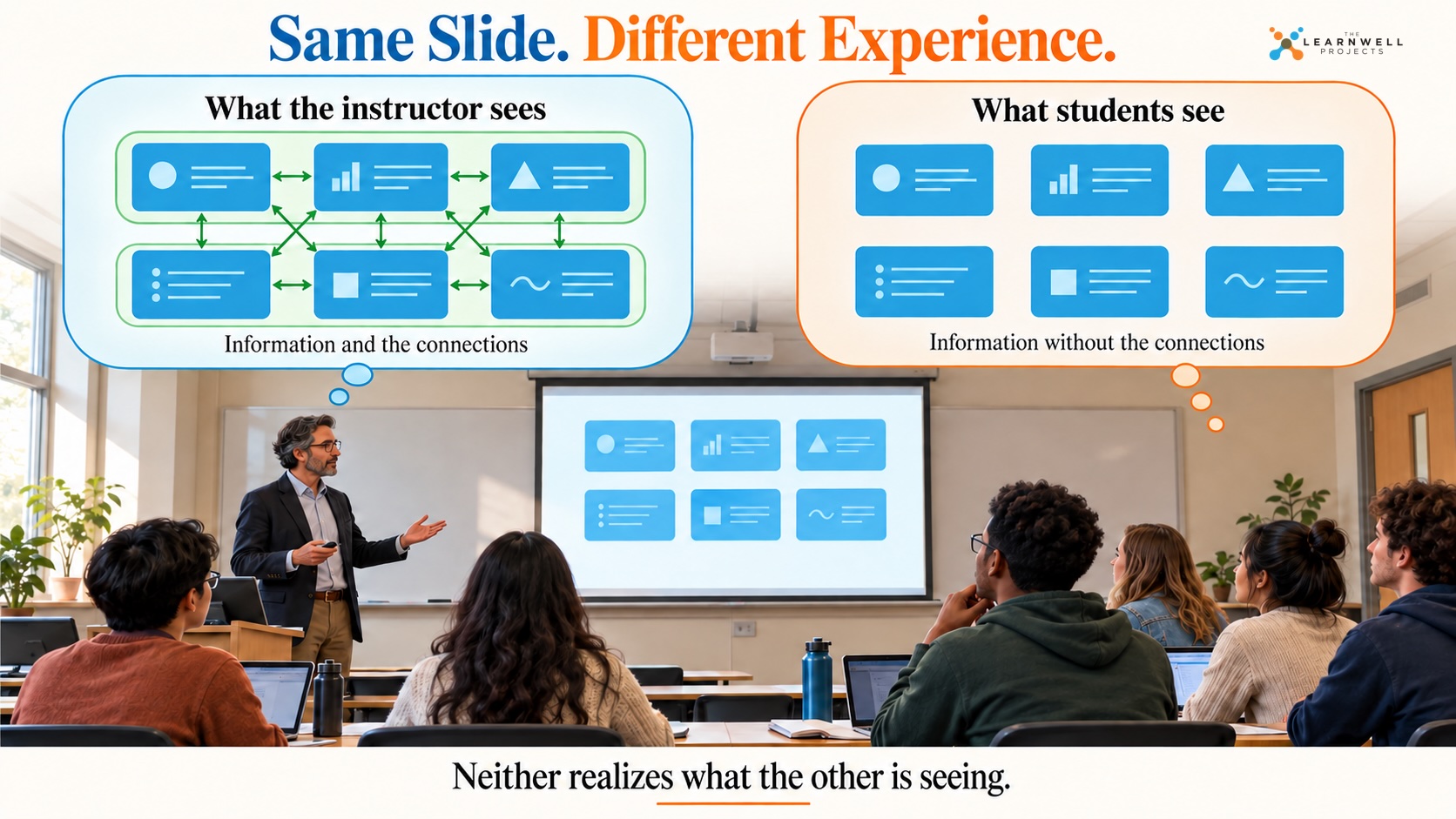
Instructors benefit from an invisible network of relationships forged over years of immersion in their disciplines. When they glance at a slide, they see the connective tissue linking principles across chapters and semesters. What they rarely realize is that this architecture remains largely invisible to students during lectures.
Consequently, comprehensive exams might use familiar terms from class, homework, and weekly quizzes, but they demand an entirely new way of interacting with the Three C elements. Students are suddenly asked to recognize patterns without any familiar prompting, choose among multiple competing approaches, and integrate concepts on the spot—mental labor they may be doing for the first time under timed pressure.
Making Metacognitive Leaps
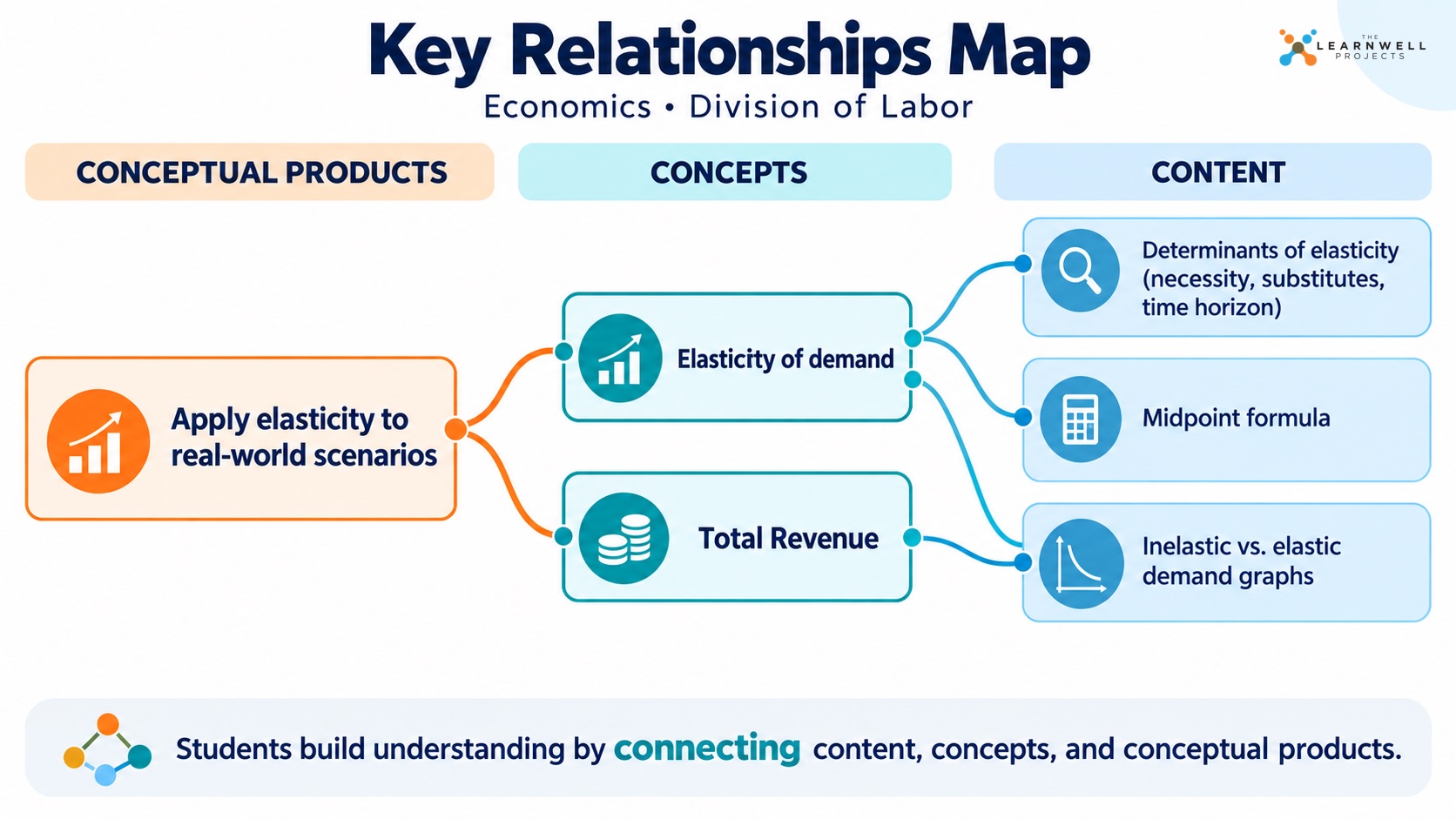
Closing this divide requires empowering students to make deliberate metacognitive leaps—building explicit bridges across content, cognition, and conceptual products before test day.
Three proactive strategies make this possible:
- Guiding (Framing Foreknowledge): Ensure students identify the intended conceptual products before diving into discrete details. This organizational scaffolding gives raw content immediate context, helping the brain map relationships naturally during lectures and study sessions.
- Gauging (Continuous Connection): Prompt students to regularly step back and anchor individual facts and problem sets to their broader conceptual parents. Instead of asking, “Did I solve this problem?” they should ask, “What category of problem is this, and why does this principle govern it?”
- Transforming (Cognitive Calibration): Ensure students deploy the specific cognitive skills that the final conceptual product demands. If an exam tests synthesis, evaluation, or real-world application, practicing simple recall or isolated formula execution will never suffice.
When bright students like Stephanie struggle on high-stakes exams, they may question their capabilities. Educators may question their work ethic or their academic viability.
But they don’t lack the aptitude; they simply brought content-level preparation to a conceptual-level arena.
Imagine Emma approaching that same midterm with this metacognitive framework in place. When she opens the exam, she isn’t hunting for familiar keywords or trying to recall an identical homework problem. Because she practiced Guiding, she immediately spots which overarching principle governs Question 1. Because she practiced Gauging, the pairing of two separate chapters in Question 4 doesn’t catch her off guard—she spent the previous three weeks tracing how those ideas intersect. And because she engaged in Cognitive Calibration, her brain has already practiced the exact synthesis the exam demands under timed conditions.
The test hasn’t changed, but Emma’s mental architecture has.
“When bright students struggle on high-stakes exams, they haven’t lost their aptitude. They simply brought content-level preparation to a conceptual-level arena.”
Once students learn to diagnose the distinct mental labor comprehensive assessments require, they no longer get lost in the sauce; they use it to cook.
Helping students make this shift doesn’t require more study hours; it requires teaching staff and faculty how to reveal this hidden architecture.
Equip your academic support staff to diagnose cognitive bottlenecks before midterm season arrives.
Help your academic support staff diagnose cognitive bottlenecks.