
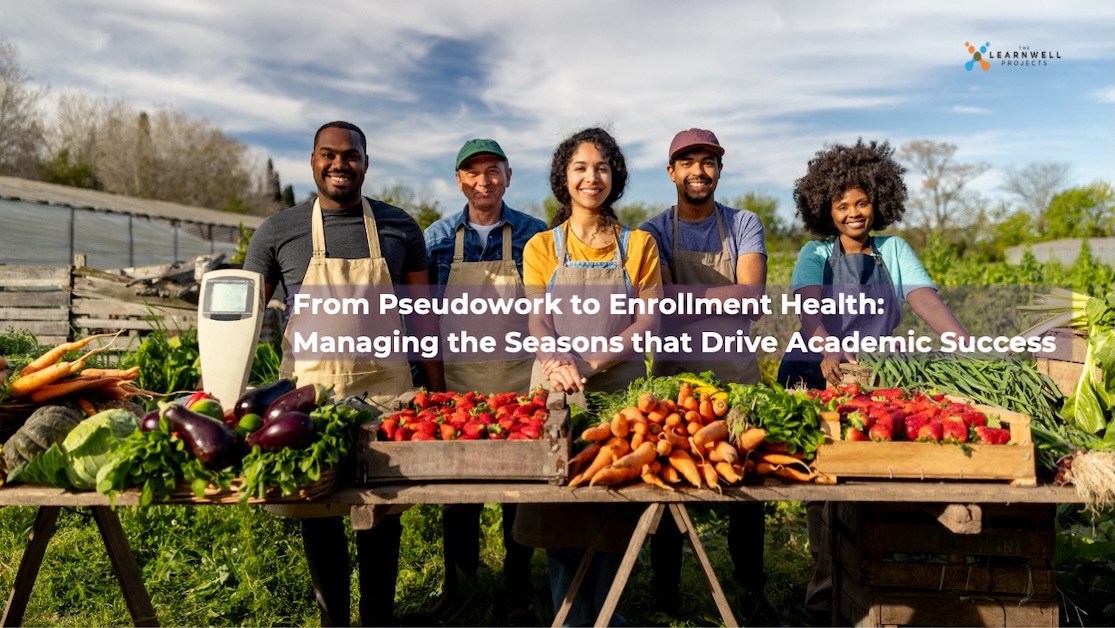
It’s a new semester. But will it be a new season of academic success, or the same mixed harvest of mid-range retention numbers, uneven program persistence, and stagnant enrollment outcomes?
This pattern has become so familiar that we accept it as normal. Students ramp up their studying near the end of the term. Late-night review sessions. Cramming marathons. Snacks, caffeine, urgency, and adrenaline. The campus buzzes with activity. Everyone is working hard.
But here’s the uncomfortable truth we rarely confront:
Many of these end-of-semester rituals aren’t signs of productivity; they are symptoms of what I identify in How to Successfully Transition Students into College: From Traps to Triumph: pseudowork.
The work looks good. It feels intense. But effort alone does not guarantee yield. In the early years of my learning center, I fell into this seductive trap. I watched students exhaust themselves toward the end of the semester without realizing they were carrying weak foundations from the beginning. The institutional harvest reflected this mirage of success in some recognizable ways.
- Inconsistent outcomes. The students who performed well were likely going to do well anyway. We were not making a measurable difference. We were simply making students—and ourselves—feel productive.
- Unenduring impact. Students passed classes, but they were not transformed in ways that extended beyond a particular course or carried forward into the workforce.
- Limited institutional gains. The college continued moving, but it wasn’t humming. Instead of advancing confidently toward bold strategic goals, we created the appearance of success near the back end of the academic year.
So we made a cultural shift.
Instead of pouring resources into last-minute studying, we refocused our attention on the early and middle seasons of learning, when understanding takes root, thinking deepens, and conditions for growth are intentionally created.
That shift changed everything.
Retention rose.
Program persistence strengthened.
Enrollment stabilized and then grew.
Not because students worked harder at the end of the semester, but because they worked differently from the beginning.
Farmers already know this lesson well:
The harvest is not won during the harvest season.
It is secured weeks and months earlier in soil preparation, tending, and growth conditions.
A successful farmer does not sprint into overdrive the week before harvest. They benefit from the quiet, structured, incremental work that came before.
I’m sharing simple ways you can thrive in each season!
Join me — and the educators I am collaborating with — as we cultivate a new harvest of academic excellence and institutional growth in 2026.
Let’s walk through the Seasons of Academic Success together.
Here’s an overview of what we will be covering.
Season 1 — Planting (Weeks 1–3)
Farming parallel: Seeds are planted, soil is prepared, rows are mapped.
Academic parallel:
This is when conceptual seeds enter the mind.
-
New ideas are introduced
-
Early assignments begin
-
Students are still forming habits and developing their mental representations
Key insight:
Planting is not the harvest — it is only potential.
Common student mistake:
Students treat exposure to content as learning. They believe hearing it, copying notes, or “feeling familiar” means it has taken root.
But seeds lying on top of soil don’t grow.
Season 2 — Rooting & Conditions for Growth (Weeks 3–7)
Farming parallel: Roots spread underground; farmers cultivate soil, water, fertilize, and protect seedlings.
Academic parallel:
This is when learning infrastructure is built.
-
Students connect concepts across lectures
-
They clarify misunderstandings
- They make meaningful relationships
This stage is invisible but essential.
Growth that matters happens under the surface.
Without strong roots, nothing survives midterms.
Season 3 — Tending & Strengthening the Crop (Weeks 7–12)
Farming parallel: Ongoing care — pruning, weeding, thinning, pest control, irrigation.
Academic parallel:
-
Misconceptions are corrected
-
Gaps in understanding are closed
-
Students refine strategies and deepen reasoning
Here students stop asking:
“Did I do the assignment?”
and start asking:
“Did this work improve my understanding?”
This is where students either cultivate mastery
—or let distractions & procrastination choke growth.
Season 4 — Harvest (Weeks 12–16)
Farming parallel: When conditions were right, the harvest emerges naturally.
Academic parallel:
Assessments reveal what has been cultivated.
-
Sound thinking → reliable performance
-
Deep understanding → flexible problem-solving
-
Durable knowledge → confidence under pressure
At this point, it is too late to grow what wasn’t nurtured.
A farmer cannot cram growth into a crop the night before harvest.
Students cannot cram understanding the night before finals.
Sign up for the lesson of a lifetime.