Have you ever seen a story about someone finding a priceless antique at a garage sale or in a junk pile—something others walked past or threw away, not realizing its worth?
That’s exactly what happened during my time at Lenoir-Rhyne University. Only the “junk” wasn’t a dusty heirloom or a rare painting. It was student notes. Tossed-out folders. Crumpled papers. The very things that fill dumpsters at the end of every semester.
And yet, buried in that academic debris were the hidden answers to some of the institution’s most persistent challenges: underperformance in gateway courses, student retention struggles, enrollment volatility, and instructional impact.
This is the story of how my team turned that trash into treasure, and how your institution can do the same.
The Discovery: What Students Threw Away, We Picked Up
While leading the learning center at Lenoir-Rhyne, my team and I noticed a troubling pattern. Despite well-meaning support efforts, academic outcomes remained inconsistent. Enrollment numbers wobbled. Faculty were frustrated. Students were trying but still falling short.
In a moment of curiosity (and, yes, desperation), we decided to look for answers where no one else was looking: the trash. At the end of the semester, we paid students for their discarded course materials. And what we found was stunning.
These “worthless” notes held clues to how students processed information, where they got stuck, and how they attempted to overcome academic hurdles. We had stumbled upon a rich, raw form of insight that I came to call metacognitive notes analysis.
This wasn’t just anecdotal evidence. This was trench-level data, academic intelligence from the frontlines of learning.
From Data Debris to Institutional Insights
The insights weren’t just helpful. They were transformational.
-
Academic Treasure: We (the learning center and faculty leaders) used the findings to close performance gaps, reduce failure rates, and support vulnerable populations like first-year students and student-athletes. Instruction improved because faculty finally had visibility into how students were truly engaging with course material. This wasn’t theoretical data. It was the lived academic experience.
-
Financial Treasure: As academic outcomes improved, so did enrollment metrics. Students persisted. They passed critical courses. And perhaps most importantly, they felt supported in meaningful, targeted ways. Over time, this improved not just retention rates but the institution’s enrollment health. The institution enjoyed nearly a decade of enrollment health.
-
Cultural Treasure: With an institutional focus on student-athletes, we amazingly saw student-athletes’ GPAs surpass the overall student GPA — a previously unimaginable milestone, as faculty loathed teaching some of the student-athletes and were not going to lower their academic standards.
The solution had been hiding in plain sight. We had just never thought to dig through the academic rubble.
From Usage Reports to Strategic Assets
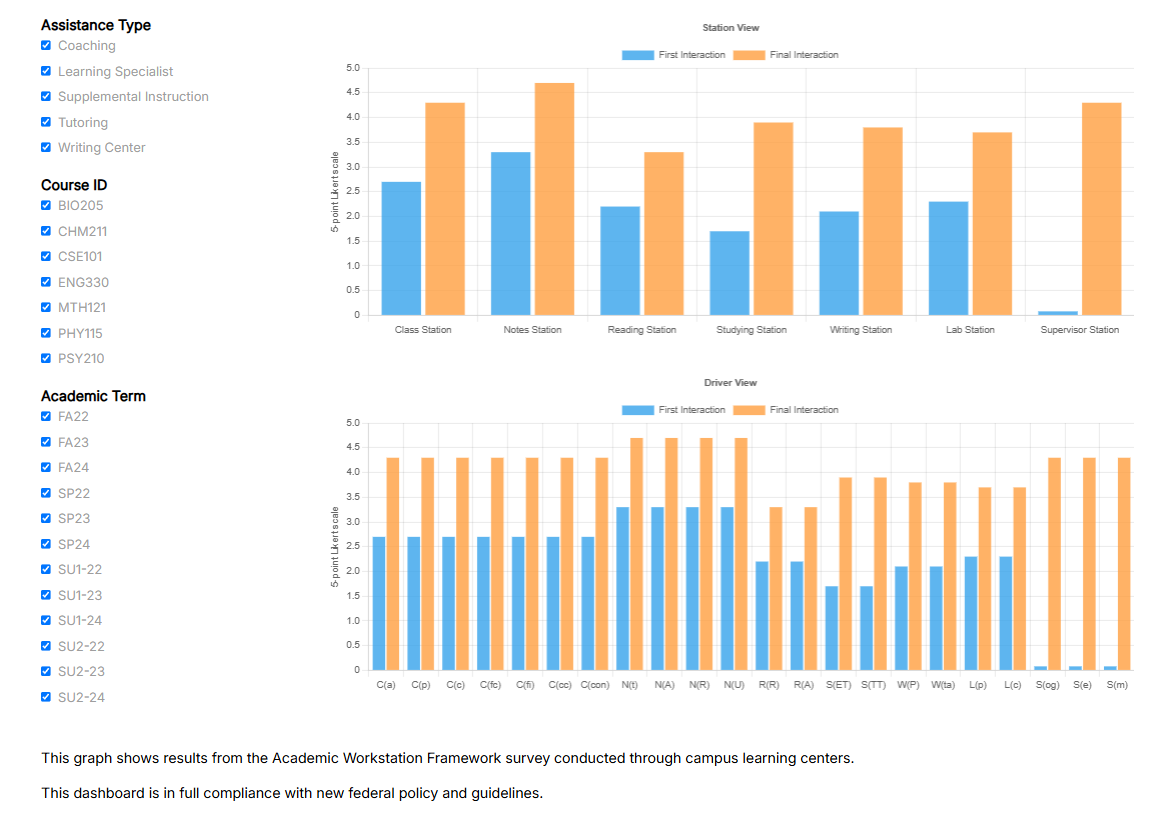
Check out the new dashboard here.
Too often, learning centers rely on usage dashboards to prove their value. “How many students came in? How long did they stay? What courses did they come for?” But these numbers, while tidy, don’t capture our real impact. They leave us stuck in a defensive posture, trying to justify our existence.
That’s why I developed the Trench Data Dashboard and the Academic Workstation Framework (AFW), a new way of thinking, working, and leading enrollment health from the learning trenches.
Instead of counting visits, the Trench Data Dashboard captures the substance of academic work. It tells the story of what students actually do to learn, and where those efforts break down. It gives us and our institutions the data that drives strategy, not just spreadsheets.
We moved from usage data to institutional intelligence.
From Isolated Fixes to Institutional Culture
Since leaving Lenoir-Rhyne, I have had the pleasure of taking the show on the road and have seen other schools experience enrollment health as well.
At one regional college, Trench Data uncovered that students in a high-failure biology course were over-indexing on rote memorization and underdeveloping conceptual synthesis. Their notes showed beautiful diagrams but weak explanations. With targeted workshops and course-integrated support, students were taught how to move from memorization to meaning.
“I used to think if I knew every slide and all my notes, I’d be fine,” said Maya, a sophomore biology major. “But the learning center helped me understand how to connect the pieces and actually think like a biologist.”
The biology faculty began to collaborate directly with the center to integrate metacognitive prompts into assignments.
“Partnering with the learning center changed how I teach,” said Dr. Elena Ramirez, Associate Professor of Biology. “I now see how students are processing what I say—and more importantly, what they’re missing.”
At another institution, business faculty were struggling with students who could solve textbook problems but failed to apply those skills in case studies or real-world simulations. Through analysis of students’ discarded assignments and note-taking habits, the learning center discovered that students were trying to apply concepts without first analyzing them. Using the ThinkWell-LearnWell Diagram and Learning Sufficiency Diagrams, peer mentors modeled how to sequence their thinking skills properly.
Download these FREE tools here: Tools.
Subscribe to my YouTube channel for guidance. The LearnWell Projects YouTube Channel.
The learning center created simulation labs to build cognitive flexibility and trained peer mentors in real-time effective metacognitive thinking techniques.
“The first time I walked into the simulation session, I felt lost,” admitted Jamal, a junior in the business program. “Now I get excited to solve messy problems because I know how to break them down.”
Even seasoned instructors noticed the shift.
“You can feel the difference,” said Professor Andrew Lin. “My students don’t just know the content. They can think with it.”
At a leading technical institute, instructors in a high-intensity automotive systems program were facing a different kind of bottleneck. Students with strong mechanical aptitude were hitting a wall during certification testing, despite performing well in lab settings.
The Trench Data Dashboard revealed a subtle but crucial gap. Students were proficient with hands-on diagnostics but struggled to translate their process into written and verbal explanations—skills essential for passing industry-standard exams and thriving in supervisory roles.
The learning center collaborated with instructors to embed metacognitive strategies directly into technical modules. Students practiced articulating their decision-making, predicting system failures, and mapping out diagnostic sequences using visual thinking tools and verbal walk-throughs.
“It wasn’t a knowledge issue—it was a translation issue,” said Prof. Monroe, Lead Instructor in Automotive Technology. “They knew what to do but didn’t know how to explain it. The learning center helped us bridge that gap.”
As a result, certification pass rates rose by 22 percent, and more students began qualifying for advanced co-op placements.
“The learning center gave our students a competitive edge without adding extra coursework,” said Prof. Patel, Associate Dean of Applied Sciences. “It helped us deliver on the promise of career readiness.”
The Institutional Shift: Enrollment Health
This work repositions learning centers not as academic sidecars but as central drivers of institutional health. We’re no longer reactive defenders of student support. We’re proactive strategists improving both academic culture and enrollment viability.
That is enrollment health. It is a shift from chasing numbers to building sustainable success. And it is cheaper, smarter, and more impactful to grow this way. It is good for students. It is good for faculty. And yes, it is good business.

What’s in Your Trash?
Your institution may be unknowingly discarding the very data it needs to thrive. But if you dig into the trenches, if you capture the academic reality of your students, you’ll find solutions hiding in plain sight.
The Trench Data Dashboard helped us do it. It turned overlooked messes into institutional messages. It turned discarded pages into academic power. It turned trash into treasure.
Now the question is: What institutional treasure is hiding in your trash?
For more insights into how “trash” can produce institutional treasures, explore my groundbreaking book.
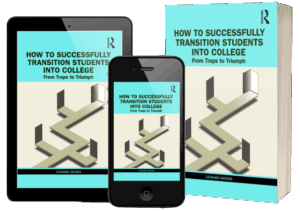
It’s a guide designed to support both educators and students in making the shift from high performance to deep, lasting learning.
You’ve come this far. Let’s connect in the comments section. Share your reaction below.👇🏿
As always, follow The LearnWell Projects on all your social media platforms and subscribe to my growing YouTube community!