
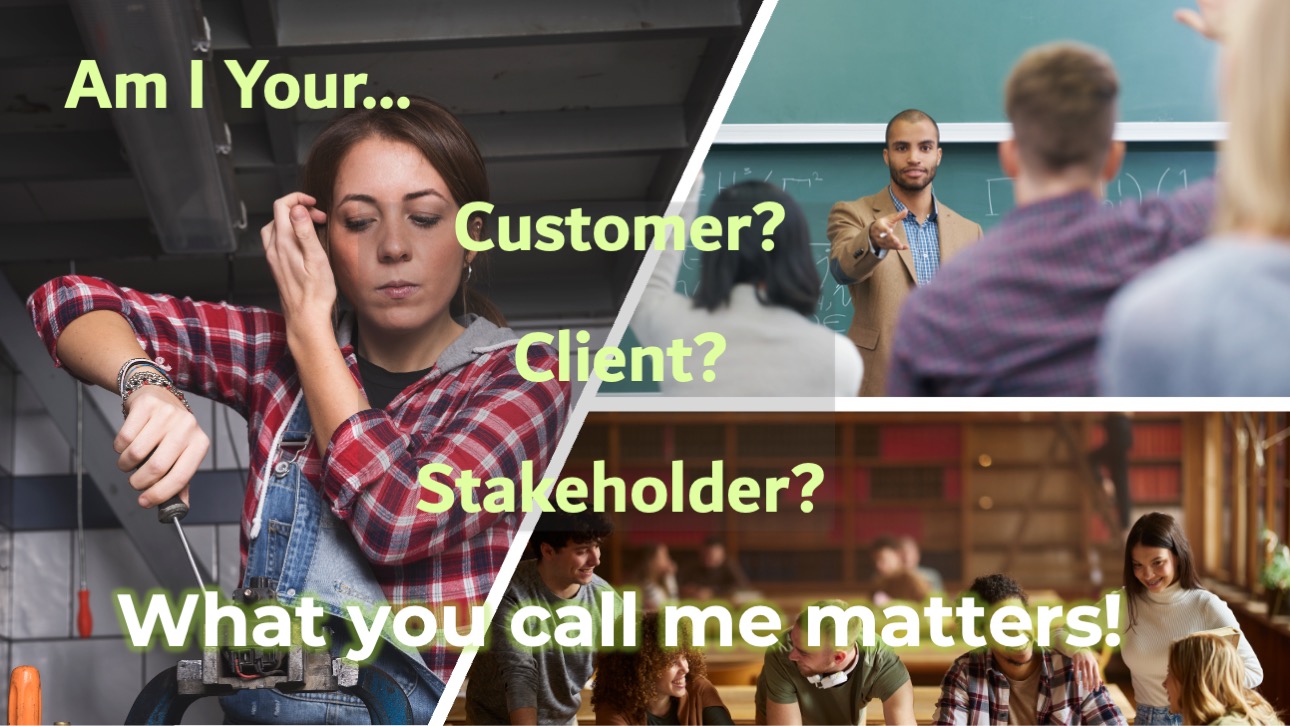
Some of the most significant changes in higher education haven’t come from sweeping policies or groundbreaking technologies, but from something far more subtle: the words we use to describe the people we serve.
During the 1990s and early 2000s, the shift from referring to students as students to referring to them as customers or clients has quietly reshaped the very nature of the student-institution relationship—and not always for the better. These linguistic shifts, often perceived as harmless or merely strategic, have had profound and lasting consequences on how we interact with students and how they interact with us.
Words Signal Relationship
The nouns we choose to describe others matter because they define the kind of relationship we believe we’re in. You act differently toward a colleague than a coworker, a friend than a family member, a spouse than a roommate. Language doesn’t just reflect reality—it shapes it.
Try introducing your spouse as a “friend” at a public event and see how well that lands. Friend doesn’t encapsulate the nature of the relationship. The same principle applies in education: what we call students conveys the type of relationship between us.
Students as Customers: The Transactional Approach
During the 1990s and early 2000s, higher education was infiltrated by businesspeople who misunderstood our mission. They began referring to students as customers, and we imported an incongruous business mindset into academic spaces. Under this model, institutions became service providers, education became a product, and students became consumers.
This framework encourages efficiency over effectiveness and favors superficialness over depth. Faculty and staff are expected to minimize “friction,” and students, in turn, expect satisfaction. The implicit contract? “I pay, you deliver.” Within this mindset, rigor feels like bad customer service, and challenge is seen as an inconvenience. Rather than empower students to succeed in difficult courses and thus feel more rewarded in the end, we “advise” them around difficulty so that they get a degree — but without being transformed.
The result? A weakening of the intellectual partnership and a rise in disengagement, entitlement, and passivity.
Paradoxically, the customer approach is sold as a way to improve institutional metrics, yet they don’t.
Retention, persistence, and graduation rates become harder to influence when students—and institutions—view the relationship as short-term and transactional.
Students as Clients: The Professional Approach
Referring to students as clients may elevate the professional tone, but the underlying dynamic still lacks co-ownership. Clients are recipients of services—experts deliver, clients receive. In this frame, education is something done to students or for them, but not with them. Agency remains with the institution.
It’s a subtle improvement, but still far from transformational.
Students as Stakeholders: Educational Approach
What if we thought of students not as consumers or recipients, but as stakeholders—individuals with a long-term, vested interest in the health, success, and trajectory of the institution?
This redefinition changes everything.
I’ve long believed students are—and should be seen as—stakeholders. They hold a multigenerational investment in the success of the institution. Today’s students are tomorrow’s alumni, potential donors, and parents of future students. Their relationship with the institution doesn’t end at graduation—it evolves and should deepen.
When we view students as stakeholders, we begin to serve them differently. We design tools and systems that support their long-term growth. We provide data, insights, and solutions that not only reflect the demographics of their past but also help elevate them toward a better future. We don’t just track performance—we empower lifelong learning..
They, in turn, see us differently—not as service providers, but as partners in their journey.
This very belief inspired the creation of the Academic Workstation Framework and the Trench Data Dashboard—a platform built not for customers or clients, but for stakeholders. It’s a tool designed to deepen relationships, support student agency, and transform institutional outcomes.
👉 Click here to explore a demo version of the Trench Data Dashboard and see how it’s reshaping student engagement and long-term success.
Stakeholder language invites shared ownership. And that shift could be the key to solving some of our most persistent challenges in higher education.
Why This Matters Now More Than Ever
We often talk about retention strategies, student engagement initiatives, and graduation rate improvements. But perhaps we’ve been trying to solve long-term problems with short-term mindsets—because we’ve defined the relationship wrong from the start.
Words shape expectations. Expectations shape behavior. Behavior shapes outcomes.
If we continue to treat students as customers, we will keep getting the results that transactional relationships deliver: disconnection, dissatisfaction, and disengagement.
But if we embrace students as stakeholders, we open the door to lasting partnership, deeper investment, and mutual growth.
So ask yourself—not just as an educator, administrator, or policymaker, but as a participant in shaping the future of higher ed: What do you call the people you serve? Because that one word might just explain everything.
Share your thoughts with the community in the comments. I’ll meet you there.


2 comments
Ron Andrade
Thank you for this thoughtful discussion on the language we use to describe our students. The terms we choose—customer, client, stakeholder—carry real consequences for how we structure our institutions and how we interpret our obligations to students. I’d like to offer a complementary perspective that I believe, is worth considering: framing the student as the college’s product.
To be clear, this analogy is not meant to imply that students are passive objects or that learning is a manufacturing process. Rather, it highlights a persistent challenge with the “student-as-customer” model. If we treat students as customers, then courses, credentials, and services become the “products,” and institutional priorities tend to drift toward satisfaction and convenience rather than learning and development. However, when we regard the student as the product, our institutional mission becomes much more explicit: the outcome we are responsible for is an educated, capable, resilient graduate prepared to contribute meaningfully to their community, workplace, and society.
Seen through this lens:
Faculty function as expert builders of intellectual and personal capacity, not content distributors.
Student services operate as quality enhancement systems, ensuring that students have equitable access to the conditions required for success.
Administrators become stewards of the learning environment, responsible for the policies, structures, and climate that shape the educational process.
Communities and employers become recipients of our output, validating whether our graduates meet real-world expectations.
This reframing also sharpens our approach to equity. If students are the “product,” then gaps in completion, transfer, or learning outcomes cannot be written off as individual shortcomings—they point to breakdowns in the educational ecosystem that require systemic improvement. Just as importantly, this perspective reinforces that quality must be measured not only by how satisfied students felt during a semester, but by what they learned, who they became, and what opportunities they can access afterward.
Of course, no metaphor is perfect, and I’m not suggesting this framing as a replacement for the stakeholder model. Rather, it is an additional conceptual tool—one that centers educational quality, accountability, and equity in ways the customer paradigm often obscures.
Thank you for engaging in this ongoing conversation about how our language shapes our practice. I am grateful for the opportunity to think together about what, exactly, we aim to produce and how we can organize ourselves to do it well.
Leonard Geddes
Ron,
Thanks for the contribution. I like your product framing as well. Higher education is a process that students go through and are the end-products. I particularly like the point you made that “quality must be measured not only by how satisfied students felt during a semester, but by what they learned, who they became, and what opportunities they can access afterward.” I see this through the lens of a former student-athlete. There are experiences that I did not appreciate in the moment that undoutbedly become immensely valuable throughout my latter years. Unfortunately, athletic coaches are praised for challenging their players and getting them to pull more out of themselves than they otherwise could. However, many of my faculty colleagues feel pressure to make things easier for students, which devalues education.
So, using your metaphor, we must conceptualize what we want the product to be in the end. I believe this product should be focused around academic competencies. I think many colleges era when academics are not properly prioritized.
Here a few ways I believe we get the product wrong:
1) “The end product is students who know how to work hard.” While hard work is noble, it should never be the primary goal of higher education.
2) “The end product is students who contribute to society.” While making valuable contributions to society is noble, it is not higher education’s core business.
3) “The end product is students who have happy marriages.” Great relationships are wonderful and fulfilling, but this is not the purpose of higher education.
There are other societal systems that major in these areas. However, academic work is where higher education should always excel.