Academic Rigor & Complexity Series | Infrastructure of Academic Work™



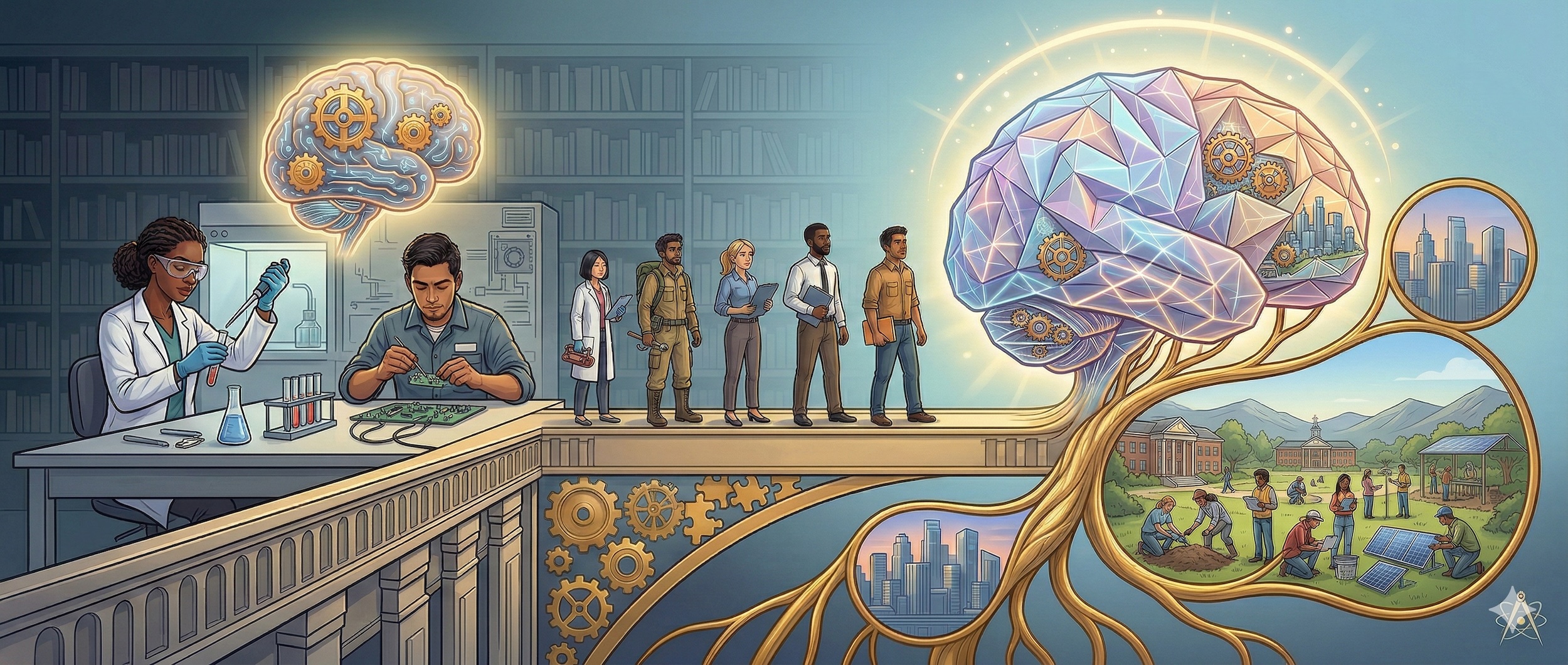
Why Cognitive Complexity Is the Real Career Readiness Skill
Across industries, employers are converging on a strikingly consistent message:
The most valuable professionals are those who can regulate their thinking.
Leadership experts and business thinkers have long emphasized the power of reflection, self-awareness, and strategic adjustment. Peter Drucker described effective leadership as a cycle of action followed by disciplined reflection. Daniel Goleman connected decision-making and emotional intelligence to metacognitive awareness. Adam Grant argues that the ability to rethink and unlearn is a defining skill in modern environments. Productivity researchers such as David Allen and Charles Duhigg emphasize clarity, prioritization, and cognitive regulation over mere busyness.
Different industries.
Different language.
Same architecture.
Metacognition — the ability to monitor, regulate, and adjust one’s thinking — has become a defining workforce competency.
And here is the implication for higher education:
The very capacity employers are demanding is the same capacity embedded in authentic academic rigor.
Academic skills and career skills are not separate domains.
They are converging.
When Technology Changes the Metric
Whenever a transformative technology emerges, there is a predictable reaction.
We assume the future will require entirely new skills.
We imagine that long-standing intellectual capacities are now obsolete.
Artificial intelligence has triggered exactly that response.
But history tells a different story.
When routine execution becomes automated, foundational cognitive capacities become more valuable — not less.
AI does not eliminate judgment.
It intensifies the need for it.
AI does not remove ambiguity.
It multiplies it.
When automation handles repetition, what remains for humans is coordination:
Framing better questions
Evaluating outputs
Identifying blind spots
Integrating across systems
Making decisions under uncertainty
These are not only analytical skills. They are entrepreneurial skills that promote the capacity to identify opportunities amid ambiguity, evaluate risk with incomplete data, and act while conditions continue to evolve.
The future demands that students own their cognitive processes more than ever before.
This is not a rejection of academic rigor.
It is a validation of it.
A Workforce Reality Check
This alignment is not theoretical.
On Monday, November 23, 2015, at the Sheraton Conference Center in Birmingham, Alabama, I had the opportunity to serve as keynote speaker for leaders across the Alabama Community College System.
The state faced a pressing challenge. The automobile industry was evolving rapidly. Technological advances were reshaping production systems. Workers who had mastered established procedures were now required to learn new systems quickly, adapt to updated technologies, and operate within increasingly complex environments.
The central question confronting the system was not simply:
How do we train workers for the next task?
It was:
How do we prepare workers to learn new tasks quickly as technology continues to evolve?
That distinction is critical.
Upskilling is not only about immediate technical instruction. It is about cultivating the capacity to recalibrate — to diagnose new demands, coordinate unfamiliar inputs, and regulate learning under shifting conditions.
In other words, the challenge was not merely a skills gap.
It was a cognitive complexity gap.
And that same gap appears in college classrooms every semester.
From Conveyor Belt to Complexity Economy
Many students arrive in higher education shaped by environments that function like a conveyor belt.
Material moves in organized segments.
Coverage aligns with assessment.
Teachers regulate pace.
Success depends on staying aligned with the flow.
That system is not flawed.
It is efficient for predictable conditions.
But both college and the modern workforce operate in environments defined by escalating complexity.
And complexity changes the metric.
What Academic Rigor Actually Develops
College-level rigor is often misinterpreted as workload.
In reality, it is defined by escalating cognitive complexity.
Cognitive complexity is the increasing range, depth, and coordination of thinking skills required to navigate abstract, ambiguous work.
In academic settings, this means students must:
Integrate ideas across units and disciplines
Evaluate incomplete or competing interpretations
Apply principles to unfamiliar scenarios
Construct defensible reasoning in the absence of explicit direction
The structure of assessment changes.
The locus of responsibility shifts.
Students are no longer evaluated primarily on what was covered.
They are evaluated on how effectively they coordinate what was learned.
That shift increases the level of mental labor required.
Mental Labor Is Career Preparation
Mental labor refers to the depth and coordination of cognitive effort required to perform a task.
Not all studying requires the same mental labor.
Re-reading notes demands less cognitive coordination than synthesizing concepts across themes.
Memorizing definitions requires less evaluative reasoning than applying principles to ambiguous cases.
When students increase time without increasing coordination, they increase effort but not alignment.
Cognitive complexity responds to alignment.
The modern workforce operates the same way.
Employers do not reward repetition.
They reward regulated thinking:
Diagnosing ambiguity
Coordinating multiple constraints
Evaluating tradeoffs
Adapting strategy as conditions evolve
Academic rigor, when properly understood, is not detached from workforce preparation.
It is rehearsal for it.
The False Divide Between Academic and Career Skills
Public discourse often frames academic rigor and career readiness as competing priorities.
Theory versus practice.
Content versus employability.
Grades versus job placement.
But this framing misses the underlying convergence.
The core transferable advantage in a complexity-driven economy is not content recall.
It is cognitive regulation.
The same metacognitive skills that allow a student to navigate a complex biology assessment are the skills required to manage evolving production technologies, interpret business analytics dashboards, or evaluate AI-generated outputs.
Higher education is not choosing between rigor and relevance.
It is clarifying their connection.
Practical Alignment: Turning Rigor into Career Readiness
If academic rigor is rehearsal for complexity, institutions must operationalize that alignment.
1. Make Cognitive Complexity Explicit
Faculty should articulate not only what content is covered, but what coordination is required.
Instead of:
“Read Chapters 3–5.”
Clarify:
“This assessment requires integration across thermodynamic principles and application to unfamiliar scenarios.”
Naming the complexity calibrates preparation.
2. Teach Mental Labor Upgrades
Learning centers and first-year programs should explicitly differentiate between:
Time invested
Cognitive coordination invested
Workshops should model how to:
Synthesize rather than summarize
Evaluate rather than repeat
Apply rather than review
3. Align Career Language with Cognitive Complexity
Career services, internship programs, capstones, and employer partnerships should explicitly connect professional competencies to cognitive complexity.
When students see that:
Interview case questions require integration
Workplace problem-solving requires evaluation
Leadership requires reflection and recalibration
Academic rigor becomes clearly instrumental.
Institutional Implications
If institutions misunderstand rigor as volume, they risk exhausting students without upgrading cognition.
If they clarify rigor as cognitive complexity, they align academic preparation with workforce reality.
Students who learn to regulate their mental labor persist longer in demanding majors.
They remain in STEM pathways.
They graduate not merely with credentials, but with portable cognitive control.
Retention improves not because standards are lowered.
But because standards are clarified.
Enrollment health strengthens when cognitive preparation aligns with complexity demands.
Retention is not only structural.
It is cognitive.
Reflection for Higher Education Leaders
For Faculty:
Are your assignments cultivating coordination under ambiguity?
For Learning Center Leaders:
Are students being coached to extend effort — or to elevate mental labor?
For First-Year Leaders:
Do students understand that academic rigor is rehearsal for complexity?
For Administrators:
Does your institutional definition of career readiness explicitly include cognitive complexity?
For State Systems and Workforce Boards:
Are you training for today’s tasks — or tomorrow’s adaptability?
Artificial intelligence has accelerated the shift.
But it did not create it.
The economy is not asking graduates to know more information.
It is asking them to manage complexity more effectively.
Academic rigor in the age of AI is not an obstacle to workforce readiness.
It is its foundation.
When higher education clarifies that rigor develops regulated thinking under complexity, the divide between academic and career skills dissolves.
They converge.
And institutions that recognize that convergence do more than prepare students for their first job.
They prepare them not only to enter existing industries, but to shape emerging ones.
References
Allen, David. Getting Things Done: The Art of Stress-Free Productivity. Viking, 2001.
Bezos, Jeff. Interview with Business Insider, 2014.
Clear, James. Atomic Habits: An Easy & Proven Way to Build Good Habits & Break Bad Ones. Avery, 2018.
Drucker, Peter F. The Effective Executive. Harper & Row, 1967.
Duckworth, Angela. Grit: The Power of Passion and Perseverance. Scribner, 2016.
Duhigg, Charles. Smarter Faster Better: The Secrets of Being Productive in Life and Business. Random House, 2016.
Dweck, Carol S. Mindset: The New Psychology of Success. Random House, 2006.
Goleman, Daniel. Emotional Intelligence: Why It Can Matter More Than IQ. Bantam Books, 1995.
Grant, Adam. Think Again: The Power of Knowing What You Don’t Know. Viking, 2021.
Schultz, Howard. Onward: How Starbucks Fought for Its Life Without Losing Its Soul. Rodale Books, 2011.
Stick Around
Don’t be shy — leave a thoughtful comment ⬇️ before you say goodbye. 👋🏿