From Factories to AI: Why the World Still Needs Thinkers, Not Just Workers
By Leonard Geddes
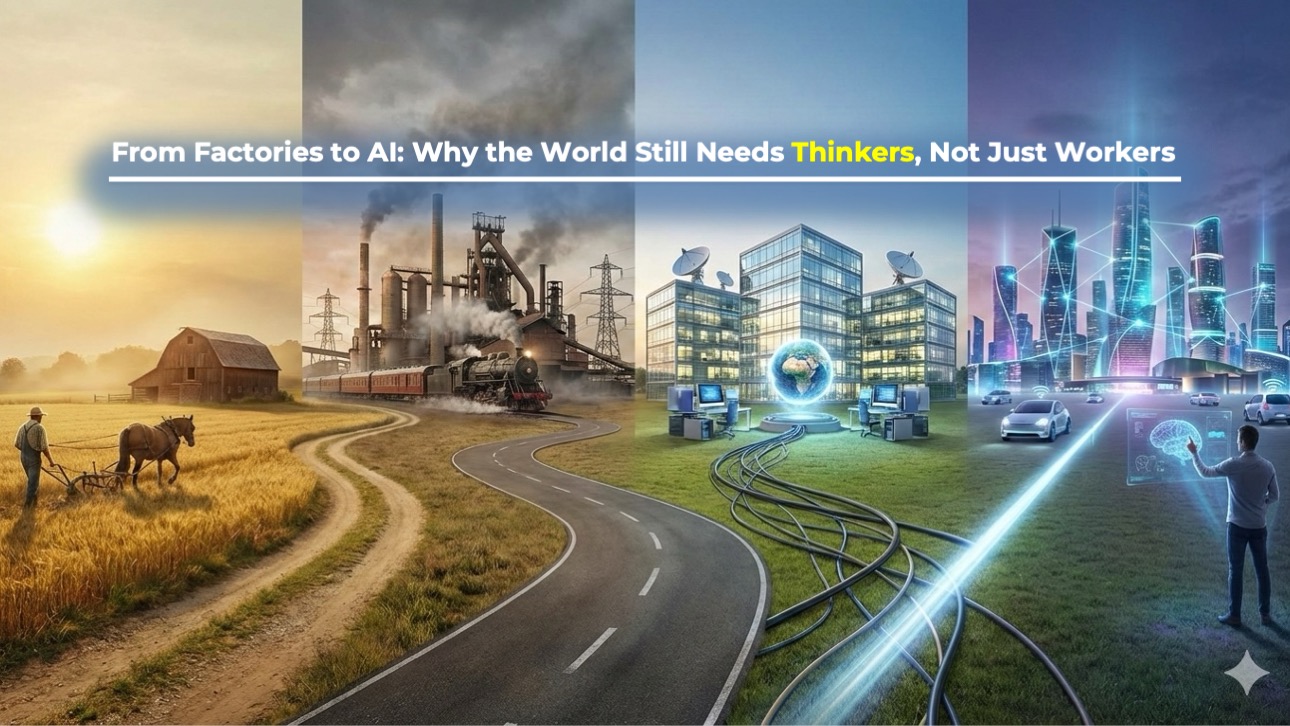
Image generated by Gemini
Is the world about to make a cataclysmic error?
Across dinner tables, in boardrooms, and throughout media headlines, a familiar question continues to echo: Is higher education still worth it? While the demand for college remains strong, a growing number of voices in the U.S. and Canada are advocating for a dramatic shift. They are deprioritizing traditional higher education with what some have bluntly called “lower education”: short-term, skills-only pathways designed for immediate employability.
It’s not hard to see why this perspective has gained traction. Rising tuition costs, the explosion of interest in tech programs, and the disruptive potential of AI have led many to favor fast, targeted training over comprehensive or liberal arts education. On the surface, this approach seems pragmatic—a return to something simpler, perhaps more efficient. But this article argues the opposite: we’re not returning to the past, we’re misremembering the past while risking the future.
I have been presenting on this topic for the last fifteen years or so. But I was moved to update this article after a conversation with a long-time corporate executive. When she remarked, almost in passing, that “work is learning,” the phrase stuck with me. It revealed what this debate often misses: employable skills absolutely matter, but they are secondary to something far more fundamental.
What keeps people employable over a lifetime is not a fixed toolkit of current technologies, but the capacity to learn new ones—to represent the unseen, adapt mental models, and “think about thinking” in the face of change (Dunlosky & Metcalfe, 2009; Flavell, 1979). Those are metacognitive and abstract reasoning skills, and historically, higher education has been the most robust system for cultivating them (Ambrose et al., 2010; Tanner, 2012).
The Constant of Metacognitive Progress
Metacognition, first named by developmental psychologist John Flavell, is the awareness and regulation of one’s own cognitive processes: knowing how we learn, plan, monitor, and adjust our understanding (Flavell, 1979). Far from an ivory-tower concept, it has quietly powered humanity’s great leaps in productivity and innovation (Dunlosky & Metcalfe, 2009).
Research in education and workforce development shows that metacognitive self-regulation underpins expertise in engineering, medicine, leadership, and communication (Zimmerman & Schunk, 2011). When learners can plan their approach, monitor their understanding, and change strategies when stuck, they become more accurate problem-solvers and more adaptable professionals (Dunlosky & Metcalfe, 2009; Zimmerman & Schunk, 2011). Higher education’s distinct role, historically and today, is to cultivate this reflective capacity—to make learners architects of their own understanding rather than passive recipients of content (Ambrose et al., 2010; Tanner, 2012).
From Agrarian Fields to Industrial Minds
In the shift from agrarian to industrial economies, success depended less on inherited routines and more on abstract reasoning (Pink, 2005). Workers moved from following the rhythms of the seasons to understanding the invisible forces driving steam engines, mechanical power, and production lines (Dunlosky & Metcalfe, 2009). Early polytechnic institutes and technical colleges helped learners build mental models of these unseen systems, developing habits of planning, monitoring, and rethinking that are the essence of metacognitive work (Ambrose et al., 2010).
Industrial innovators like Frederick Taylor, often called the father of scientific management, relied on the ability to represent workflows mentally to optimize them (Dunlosky & Metcalfe, 2009). The worker became both doer and thinker, and the factory became a site where cognitive and technical skills intertwined (Pink, 2005). Even then, it was not just what workers knew, but how they could conceptualize and reconfigure processes, that created advantage (Zimmerman & Schunk, 2011).
The Information Age: Thinking About Code
As the world entered the digital era, learning shifted again. However, this time from manipulating machinery to manipulating data and information systems (Ambrose et al., 2010). Knowledge workers had to understand not just how to write code, but how their own reasoning shaped algorithms, architectures, and digital processes (Dunlosky & Metcalfe, 2009). Employable skills now include programming languages and database tools—but those skills were constantly changing (Pink, 2005).
Universities responded by expanding computer science and information programs that emphasized abstraction, systems thinking, and logical self-monitoring. Students learned to trace their reasoning through complex systems, debug their thinking as well as their code, and transfer foundational principles across platforms and languages (Dunlosky & Metcalfe, 2009). This made explicit what experience had already suggested: progress depends on learners who can continually reflect on their problem-solving strategies and adjust them in real time (Pintrich, 2002). A narrow focus on today’s tools without this deeper capacity would have left graduates obsolete within a few upgrade cycles (Jarche, 2012).
Metacognition in the Conceptual and AI Ages
In today’s conceptual and AI-driven age, those unseen skills are even more central. Pink (2005) describes a landscape where synthesis, creativity, and adaptive expertise matter as much as technical proficiency. Workers must not only manage tools and data but also manage their own learning amid rapid, often disruptive change (Jarche, 2012).
Metacognitive thinkers ask, How do I best learn this new system? What assumptions am I making? Where might I be wrong? These questions turn workplace change into an opportunity to reconfigure understanding rather than a threat to job security (Dunlosky & Metcalfe, 2009). Studies in higher education and cognitive science show that explicit metacognitive training improves critical thinking, problem-solving, and transfer of learning to unfamiliar contexts—capacities that make short-cycle retraining and on-the-job learning more effective and impactful (Ambrose et al., 2010; Tanner, 2012).
Even the pioneers of AI relied on metacognition in a deep sense. Early AI researchers had to model how human cognition works well enough to represent aspects of it in algorithms and systems (Dunlosky & Metcalfe, 2009). They were not merely coding; they were reflecting on human and machine learning simultaneously, revising their own mental models as the field evolved (Zimmerman & Schunk, 2011). The AI revolution itself is a story of metacognitive thinking at scale (Dunlosky & Metcalfe, 2009).
Higher Education: The Crucible of Cognitive Growth, Not Just Content
If the only question is, Which discrete skills lead directly to the first job? then colleges will always be forced into a reactive posture—chasing each new tool or platform (Harvard Business Review Analytic Services, 2023). But if the deeper question is, What makes people ready to learn, relearn, and lead in unpredictable conditions? then higher education’s distinctive contribution becomes clear (Frontiers in Education, 2024).
Campuses are one of the few structured spaces where learners systematically practice managing their own thinking (How a Course Design Experience, 2010). Consider the student who enters college focused mainly on memorizing content but gradually learns to plan study strategies, monitor understanding, and reflect on mistakes (Tanner, 2012). Over time, this student learns to diagnose why a method is not working, seek alternative explanations, and construct personal strategies for tackling complexity (Ambrose et al., 2010). By graduation, they are not just a repository of domain knowledge; they are self-directed learners capable of taking on novel, ill-structured problems (Zimmerman & Schunk, 2011).
Research on university teaching and learning shows that when instructors make metacognition explicit—by prompting students to reflect, plan, and self-assess—students demonstrate improved performance and greater adaptability in their learning approaches (Tanner, 2012; How a Course Design Experience, 2010). This metacognitive capacity is one of the most durable outcomes of higher education, persisting long after specific facts or techniques have been forgotten (Ambrose et al., 2010). It is also the capacity that makes it easier to improve existing skills or learn new skills later.
“Work Is Learning”: Metacognition Across a Career
Seen through this lens, the “Is college worth it?” question changes. The first job matters—but the capacity to keep learning across many jobs matters more (Jarche, 2012).
Early career: New employees with strong metacognitive skills plan how they will learn systems, monitor understanding, and adjust when something is not working, which helps them ramp up faster and with less overwhelm (Pintrich, 2002; Metacognition and Learning, 2017).
Mid-career: As roles expand and technologies like AI reshape workflows, metacognition allows professionals to diagnose their own learning needs, select strategies, and remain agile rather than stuck in outdated approaches (Elliott, 2024; Zimmerman & Schunk, 2011).
Leadership: Those who understand how they and others learn create cultures of reflection and experimentation, supporting resilient, adaptive teams in uncertain environments (Earley & Mosakowski, 2004; Lipkin, 2021).
In an AI-enabled workplace, the most valuable workers are less those who know the most at any single moment and more those who can learn the fastest, unlearn the obsolete, and help others do the same (Harvard Business Review Analytic Services, 2023). That is metacognition at scale—and it is a direct throughline from what higher education can intentionally cultivate (Frontiers in Education, 2024).
Universities do not only produce discrete discoveries; they cultivate people who can productively manage their cognitive experiences, thinking about their thinking under conditions of urgency and uncertainty (Frontiers in Education, 2024). When the world has needed not just skills but conceptual agility, that foundation in abstract work training made a significant difference. And it will be needed in the future, regardless of the job or professional field students enter or how AI reshapes the world.
Beyond the Academy: How Non-Academic Voices Describe Metacognition
I’m convinced that business leaders crave traditional higher education skills. Yet, they communicate them completely differently. We must do a better job of translating our value proposition.
Leaders outside academia are increasingly expressing the role that metacognition has had in their own professional and personal successes, even if they don’t use the term itself (Lipkin, 2021). Their language can help higher education leaders connect campus conversations to public and professional discourse.
Clarity, focus, and reflection. Productivity writer David Allen argues that clarity and focus come from knowing what to do and what not to do, linking this to a calm awareness of one’s own thinking and priorities (Allen, 2001). Management thinker Peter Drucker urges leaders to “follow effective action with quiet reflection,” framing reflective cycles as the source of increasingly effective action (Drucker, 1967).
Self-awareness in leadership. Former Starbucks CEO Howard Schultz emphasizes that self-awareness—listening to one’s “inner voice”—is central to navigating complex leadership decisions in business (Schultz, 2011). Daniel Goleman, writing on emotional intelligence, explicitly frames “thinking about thinking” as a core aspect of emotionally intelligent leadership, enabling leaders to notice and regulate their own mental states (Goleman, 1995).
Innovation and rethinking. Jeff Bezos has described innovation as a process that often requires questioning one’s own assumptions and mentally “inventing” a way out of constraints, a stance rooted in reflective thinking about one’s own reasoning (Business Insider, 2014; Business Insider, 2019). Organizational psychologist Adam Grant argues that the ability to rethink and unlearn is now a critical professional skill, one that depends on recognizing and interrogating one’s own beliefs and mental models (Grant, 2021).
Learning, habits, and grit. Carol Dweck’s work on growth mindset stresses that successful people continually stretch themselves to learn new things and adapt their strategies, an inherently metacognitive process (Dweck, 2006). Charles Duhigg, Angela Duckworth, and James Clear each, in their own way, describe productivity, grit, and habit change as processes that depend on reflecting on how one behaves and learns, then deliberately adjusting course (Clear, 2018; Duckworth, 2016; Duhigg, 2016).
In different languages and from different vantage points, these non-academic voices converge on a shared idea: sustained success in modern life and work rests on the ability to observe, evaluate, and deliberately reshape one’s own thinking (Lipkin, 2021; Rollo, 2024). That is precisely the capability higher education is uniquely positioned to cultivate at scale (Frontiers in Education, 2024).
Check out my Playlist for a visual experience on the connection between academic and work skills.
Looking Ahead: What Future Metacognitive Skills May Look Like
If history is any guide, the next wave of “employable skills” will again depend on deeper metacognitive and abstract-reasoning capacities (Pink, 2005). Looking forward, these are likely to include:
Human–AI co-mentoring. Graduates will need to monitor not only their own thinking but also the behavior of AI tools—asking, When should I trust this model? Where might it be biased? How do I integrate its output with my own judgment? Metacognition will include reflecting on and calibrating shared cognition with machines.
Cross-context transfer as a default skill. Work will increasingly ask people to apply ideas across domains, using insights from biology in computing or from psychology in design (Science Reports, 2025). The core skill will be the ability to abstract, reframe, and reapply knowledge, not just memorize domain-specific facts (Dunlosky & Metcalfe, 2009).
Collective metacognition in teams. As work becomes more collaborative and distributed, groups will need to reflect on how they think together: How do we make decisions? Where do we get stuck? What patterns keep repeating? (Elliott, 2024; Earley & Mosakowski, 2004). Higher education can prepare students to participate in and lead these “thinking-about-thinking” conversations at team and organizational levels (Frontiers in Education, 2024).
Ethical self-interrogation. In an era where technology can scale impact quickly, professionals will need the habit of interrogating their own assumptions, blind spots, and value judgments before deploying powerful tools (Hoffman, 2019; Metacognitive Tools and Growth, 2023). That is metacognition with an ethical dimension, rooted in reflection on how and why we think as we do (Metacognitive Tools and Growth, 2023).
These emerging skills go beyond any single trade skill, coding language, platform, or credential. They are the mental infrastructure that will allow graduates to navigate tools and roles that do not yet exist (Frontiers in Education, 2024).
The Enduring Mandate of Higher Education
The public conversation about higher education’s value tends to focus narrowly on starting salaries and immediate job skills (Harvard Business Review Analytic Services, 2023). Those metrics matter, but they are the visible tip of a much larger iceberg. Beneath them lie metacognition, abstract reasoning, and mental representation—the capacities that make all later learning possible.
From fields to factories, from data centers to digital clouds, progress has always begun in the mind of someone who understood how they learn. As AI reshapes our economy and society, higher education’s mandate is unchanged but amplified: to cultivate reflective thinkers who can make meaning within complexity, learn with and alongside machines, and continually reinvent their own skillsets (Frontiers in Education, 2024).
So, before we dismantle the institutions designed to help us think, adapt, and grow over a lifetime, we should pause. Are we sure we want to make this move? The real cost may not be just educational—it could be societal, economic, and deeply personal.
In a world where “work is learning,” institutions that intentionally form learners who can think about their thinking are not optional—they are the infrastructure of the future.
So let’s rise to meet this moment—not by shrinking education down, but by lifting it up. The future is waiting. Let’s give it thinkers it can depend on!
References
Allen, D. (2001). Getting things done: The art of stress-free productivity. Viking.
Ambrose, S. A., Bridges, M. W., DiPietro, M., Lovett, M. C., & Norman, M. K. (2010). How learning works: Seven research-based principles for smart teaching. Jossey-Bass.
Business Insider. (2014). Amazon’s Jeff Bezos: The Business Insider interview. Business Insider.
Business Insider. (2019). Jeff Bezos explains how to be right a lot of the time. Business Insider.
Clear, J. (2018). Atomic habits: An easy & proven way to build good habits & break bad ones. Avery.
Drucker, P. F. (1967). The effective executive. Harper & Row.
Duckworth, A. (2016). Grit: The power of passion and perseverance. Scribner.
Duhigg, C. (2016). Smarter faster better: The secrets of being productive in life and business. Random House.
Dunlosky, J., & Metcalfe, J. (2009). Metacognition. SAGE.
Dweck, C. S. (2006). Mindset: The new psychology of success. Random House.
Earley, P. C., & Mosakowski, E. (2004). Metacognition: The skill every global leader needs. Harvard Business Review, 82(10), 107–113.
Elliott, J. M. (2022). Block quotes and pull quotes. J. M. Elliott Substack.
Flavell, J. H. (1979). Metacognition and cognitive monitoring: A new area of cognitive–developmental inquiry. American Psychologist, 34(10), 906–911.
Frontiers in Education. (2024). Development of a metacognition co-curriculum for a university. Frontiers in Education, 9, 1402599.
Goleman, D. (1995). Emotional intelligence: Why it can matter more than IQ. Bantam Books.
Grant, A. (2021). Think again: The power of knowing what you don’t know. Viking.
Harvard Business Review Analytic Services. (2023). Building a real culture of learning will move your company forward. Harvard Business Review.
Hoffman, J. (2019). Using pull quotes, display quotes, block quotes, and epigraphs in your writing. BookEditor-JessiHoffman.com.
How a Course Design Experience Can Increase Metacognition in Students. (2010). To Improve the Academy, 29, 61–74.
Jarche, H. (2012, June 16). Work is learning and learning is the work. Harold Jarche Blog.
Lipkin, N. (2021, April 26). What is metacognition and why it can help or hinder your success. Forbes.
Metacognitive Strategies and Development of Critical Thinking. (2022). Frontiers in Psychology, 13, 9242397.
Metacognitive Tools and Growth. (2023). Using metacognitive tools to facilitate professional growth. PA Times.
Pink, D. H. (2005). A whole new mind: Why right-brainers will rule the future. Riverhead Books.
Pintrich, P. R. (2002). The role of metacognitive knowledge in learning, teaching, and assessing. Theory into Practice, 41(4), 219–225.
Schultz, H. (2011). Onward: How Starbucks fought for its life without losing its soul. Rodale Books.
Much appreciated, Leonard! Your article presents a positive and timely perspective on learning and metacognitive skills as enduring outcomes of higher education. Over the course of my career, I have seen many technical skills come and go, while the metacognitive capabilities you describe have remained essential. Your work offers valuable insight for higher education and industry alike as we navigate the evolving relationship between humans and machines and prepare learners for a rapidly changing world.
Thanks for your contribution. The students we worked with a Florida Poly got a tremendous advantage. They have excelled in the classrooms and in their careers. This speaks to the transferability of metacognitive skills!
Thanks so much, Leonard, for your usual insightful perspective. Yes, we certainly need metacognitive critical thinkers now more than ever. And the need will exponentially increase as the world moves forward. As you correctly point out there is a trend toward “deprioritizing traditional higher education with what some have bluntly called “lower education”: short-term, skills-only pathways designed for immediate employability.”
I think that there is now a blurring of the roles of higher education and skills-based programs in teaching metacognitive skills. Many college faculty tell me that it is almost impossible for them to teach critical thinking skills to their woefully underprepared students, and many instructors in technical programs are teaching students how to think metacognitively. One solution might be to continue to emphasize the importance of higher education in fostering creative thinkers while at the same time teaching metacognitive skills to students in technical programs, beginning with Career and Technical Education (CTE) students in high school.
It is unfortunate that college is becoming less affordable for low-income students. Recent plans by the Department of Education to reclassify certain programs as “non-professional” (e.g., nursing, physician assistant (PA), physical therapy (PT), audiology, social work, public health, and even architecture!) will put higher ed affordability even further out of reach for many students.
While I certainly strongly agree that the knowledge, skills, critical thinking, and creativity (that should be) learned in college are invaluable for continuing societal advances in the current AI environment and beyond, I also hope that skills-based programs will see the necessity of teaching metacognitive skills to their students. I feel strongly that when all employees embrace the maxim that “work is learning” and have the tools to continuously improve their own learning, we’ll have what the world needs for continuing advancement.
Please keep these articles coming; I learn so much from your perspective on current issues in higher ed!
Thanks for your valuable contribution! You and I have shared numerous conversation about this topic over the years. Of course, the college affordability issue is a deep iceberg, with divestments of state and federal funds at the bottom. When the contributions of higher education were more manifestly known and appreciated, state and federal governments viewed higher ed as a worthy investment. We are indeed in a different era today.
Being career-ready and workforce-prepared are not in contradiction to higher education’s goals. In fact, living in North Carolina, I have spoken with many leaders of blue-collar businesses who want sound thinkers because they realize that employees with low cognitive abilities hit the same performance ceiling that students with low cognitive abilities hit in classes. While sharing the metacognitive work that I do with the owner of a local electrical company. He said, employees who can’t do the type of thinking that we describe and promote will only be assistants. They will not advance in his field and will always be replaced by those who think better.
My career arc has taken an interesting turn recently. Originally, I focused on making the abstract parts of academic work visible. Now, I also spend lots of time doing the opposite: making the hidden parts of visible work (manual labor) known and accessible. Both are very rewarding!
Regardless of the type of work we do, “work is learning”!
Leonard, this is an insightful and timely article with a lot to unpack! I appreciate how you reframe the value of higher education around metacognition and the ability to learn, relearn, and adapt. Teaching students how to think and solve problems goes beyond preparation for a specific job and is essential for navigating work as learning and ever-changing technology.
Your background in academic assistance, advising and career planning gives you a unique insight into how academic skills truly are professional skills. Thanks for your contribution.
Thanks Leonard! I totally agree that universities cultivate readiness for learning and relearning by teaching students how to think critically and adapt knowledge across disciplines rather than just master fixed content. They also prepare students to lead in unpredictable conditions by immersing them in diverse communities, complex problems, and collaborative settings that develop judgment, ethical reasoning, and the capacity to act amid uncertainty.
Saul,
Thanks for your contribution. Leading through unpredictable conditions is a requirement of today’s workers and leaders. They will need the practice of navigating cognitively complex material, working through abstract mental terrain and enhancing mental representation skills that comes from a higher education.
As always, I’m grateful for Leonard’s practical and timely insights. This article is a thoughtful reminder that as digital tools continue to advance, what truly matters is our ability to think, question, and adapt. Rather than chasing the technologies of the moment, Leonard makes a compelling case for an education that helps people learn how to learn, empowering them to face change with curiosity and creativity.
Katie,
Thanks for you contribution. When world leaders and society at large remember that a significant aspect of work is learning, then they will again value the invaluable contribution that higher education has made — and continues to make — to business, culture, politics. religion and life!
Let’s Talk About Your Institution’s Next Breakthrough.
Schedule your free consultation with The LearnWell Projects today. Together, we’ll identify your most pressing challenges and explore proven strategies to boost student success, improve retention, and strengthen faculty development. Let’s take the first step toward measurable, lasting academic excellence.
Leonard Geddes Founder & Higher Education Strategist
Let’s Talk About Your Institution’s Next Breakthrough.
Schedule your free consultation with The LearnWell Projects today. Together, we’ll identify your most pressing challenges and explore proven strategies to boost student success, improve retention, and strengthen faculty development. Let’s take the first step toward measurable, lasting academic excellence.
Leonard Geddes Founder & Higher Education Strategist
Newsletter Signup
Grow, lead, and achieve with tools, tips, and insights delivered straight to your inbox by The LearnWell Projects.



10 comments
Mary
Much appreciated, Leonard! Your article presents a positive and timely perspective on learning and metacognitive skills as enduring outcomes of higher education. Over the course of my career, I have seen many technical skills come and go, while the metacognitive capabilities you describe have remained essential. Your work offers valuable insight for higher education and industry alike as we navigate the evolving relationship between humans and machines and prepare learners for a rapidly changing world.
Leonard Geddes
Mary,
Thanks for your contribution. The students we worked with a Florida Poly got a tremendous advantage. They have excelled in the classrooms and in their careers. This speaks to the transferability of metacognitive skills!
Saundra McGuire
Thanks so much, Leonard, for your usual insightful perspective. Yes, we certainly need metacognitive critical thinkers now more than ever. And the need will exponentially increase as the world moves forward. As you correctly point out there is a trend toward “deprioritizing traditional higher education with what some have bluntly called “lower education”: short-term, skills-only pathways designed for immediate employability.”
I think that there is now a blurring of the roles of higher education and skills-based programs in teaching metacognitive skills. Many college faculty tell me that it is almost impossible for them to teach critical thinking skills to their woefully underprepared students, and many instructors in technical programs are teaching students how to think metacognitively. One solution might be to continue to emphasize the importance of higher education in fostering creative thinkers while at the same time teaching metacognitive skills to students in technical programs, beginning with Career and Technical Education (CTE) students in high school.
It is unfortunate that college is becoming less affordable for low-income students. Recent plans by the Department of Education to reclassify certain programs as “non-professional” (e.g., nursing, physician assistant (PA), physical therapy (PT), audiology, social work, public health, and even architecture!) will put higher ed affordability even further out of reach for many students.
While I certainly strongly agree that the knowledge, skills, critical thinking, and creativity (that should be) learned in college are invaluable for continuing societal advances in the current AI environment and beyond, I also hope that skills-based programs will see the necessity of teaching metacognitive skills to their students. I feel strongly that when all employees embrace the maxim that “work is learning” and have the tools to continuously improve their own learning, we’ll have what the world needs for continuing advancement.
Please keep these articles coming; I learn so much from your perspective on current issues in higher ed!
Leonard Geddes
Saundra,
Thanks for your valuable contribution! You and I have shared numerous conversation about this topic over the years. Of course, the college affordability issue is a deep iceberg, with divestments of state and federal funds at the bottom. When the contributions of higher education were more manifestly known and appreciated, state and federal governments viewed higher ed as a worthy investment. We are indeed in a different era today.
Being career-ready and workforce-prepared are not in contradiction to higher education’s goals. In fact, living in North Carolina, I have spoken with many leaders of blue-collar businesses who want sound thinkers because they realize that employees with low cognitive abilities hit the same performance ceiling that students with low cognitive abilities hit in classes. While sharing the metacognitive work that I do with the owner of a local electrical company. He said, employees who can’t do the type of thinking that we describe and promote will only be assistants. They will not advance in his field and will always be replaced by those who think better.
My career arc has taken an interesting turn recently. Originally, I focused on making the abstract parts of academic work visible. Now, I also spend lots of time doing the opposite: making the hidden parts of visible work (manual labor) known and accessible. Both are very rewarding!
Regardless of the type of work we do, “work is learning”!
Angie
Leonard, this is an insightful and timely article with a lot to unpack! I appreciate how you reframe the value of higher education around metacognition and the ability to learn, relearn, and adapt. Teaching students how to think and solve problems goes beyond preparation for a specific job and is essential for navigating work as learning and ever-changing technology.
Leonard Geddes
Angie,
Your background in academic assistance, advising and career planning gives you a unique insight into how academic skills truly are professional skills. Thanks for your contribution.
Saul
Thanks Leonard! I totally agree that universities cultivate readiness for learning and relearning by teaching students how to think critically and adapt knowledge across disciplines rather than just master fixed content. They also prepare students to lead in unpredictable conditions by immersing them in diverse communities, complex problems, and collaborative settings that develop judgment, ethical reasoning, and the capacity to act amid uncertainty.
Leonard Geddes
Saul,
Thanks for your contribution. Leading through unpredictable conditions is a requirement of today’s workers and leaders. They will need the practice of navigating cognitively complex material, working through abstract mental terrain and enhancing mental representation skills that comes from a higher education.
Katie
As always, I’m grateful for Leonard’s practical and timely insights. This article is a thoughtful reminder that as digital tools continue to advance, what truly matters is our ability to think, question, and adapt. Rather than chasing the technologies of the moment, Leonard makes a compelling case for an education that helps people learn how to learn, empowering them to face change with curiosity and creativity.
Leonard Geddes
Katie,
Thanks for you contribution. When world leaders and society at large remember that a significant aspect of work is learning, then they will again value the invaluable contribution that higher education has made — and continues to make — to business, culture, politics. religion and life!