

As she works through the midterm, Emma recognizes terminology on nearly every question. That is precisely what makes the experience so unsettling.
The first problem looks like something from last week’s homework, yet she stalls, unable to decide which method to use. She starts one, crosses it out, and tries another. A few questions later, two ideas she understood in separate chapters appear together. She knows what each means. She is less certain about how they relate.
Emma ponders, Am I getting lost in the sauce?
As she walks away from the exam, she tries to reconcile two experiences: the student who could do the work throughout the semester and the student who struggled to do it for ninety minutes.
Her homework grades were in the nineties. Her quizzes suggested she was learning effectively, which made the uncertainty she experienced on the exam even more confusing. When the exam grades post, she’s shocked to see her score was much lower than she expected.
In that moment of defeat, Emma doesn’t ask whether the weekly coursework and the midterm demanded different kinds of mental labor. Instead, she internalizes the gap and asks a destructive question:
Am I just not cut out for this?
That question can escalate a common, solvable learning challenge into a permanent transition trap that follows a student throughout their academic career and beyond.
To fix it, we need to replace Emma’s self-doubt with a more productive question: Are comprehensive exams testing something fundamentally different from what students practice during the term?
When we examine uneven performance like Emma’s, we find the issue is rarely capability, motivation, or effort. It boils down to how students interact with three core elements: what I call the Three Cs of Academic Work.
The Three Cs of Academic Work
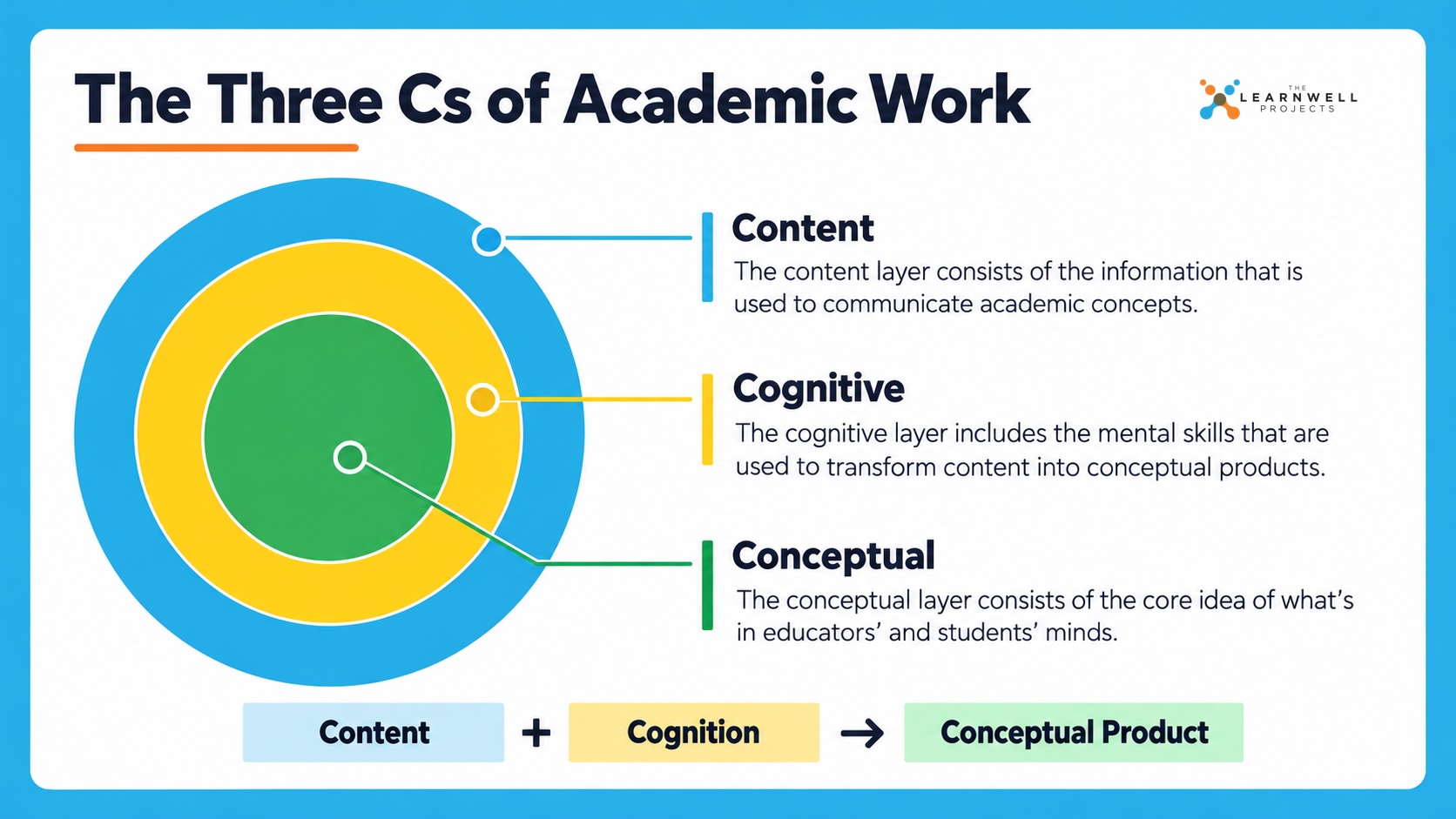
The disconnect between homework and comprehensive exams comes down to this formula: content and cognition combining to create conceptual understanding.
Just as mixing blue and yellow makes green, students must combine course content (blue) with active cognition (yellow) to build true conceptual understanding (green).
- Content provides the raw information, such as definitions, formulas, facts, and rules.
- Cognition supplies the deliberate mental labor required to process and evaluate that material.
- Conceptual Understanding is the resulting product: an integrated mental schema where ideas connect, compare, and transfer to new contexts.
The green inner circle—the conceptual product—is what comprehensive exams actually evaluate. The test isn’t merely assessing what a student has accumulated, but how fluidly they can navigate the relationships among ideas.
Instructors and students often misunderstand this dynamic. In student focus groups, they earnestly believe their teachers deliberately try to trick them by putting material on exams that they didn’t cover in class. In faculty focus groups, professors adamantly counter that everything on the exam was taught.
Who’s telling the truth? Both are, from their vantage point. The gap isn’t about what was taught; it is about what each side actually sees.
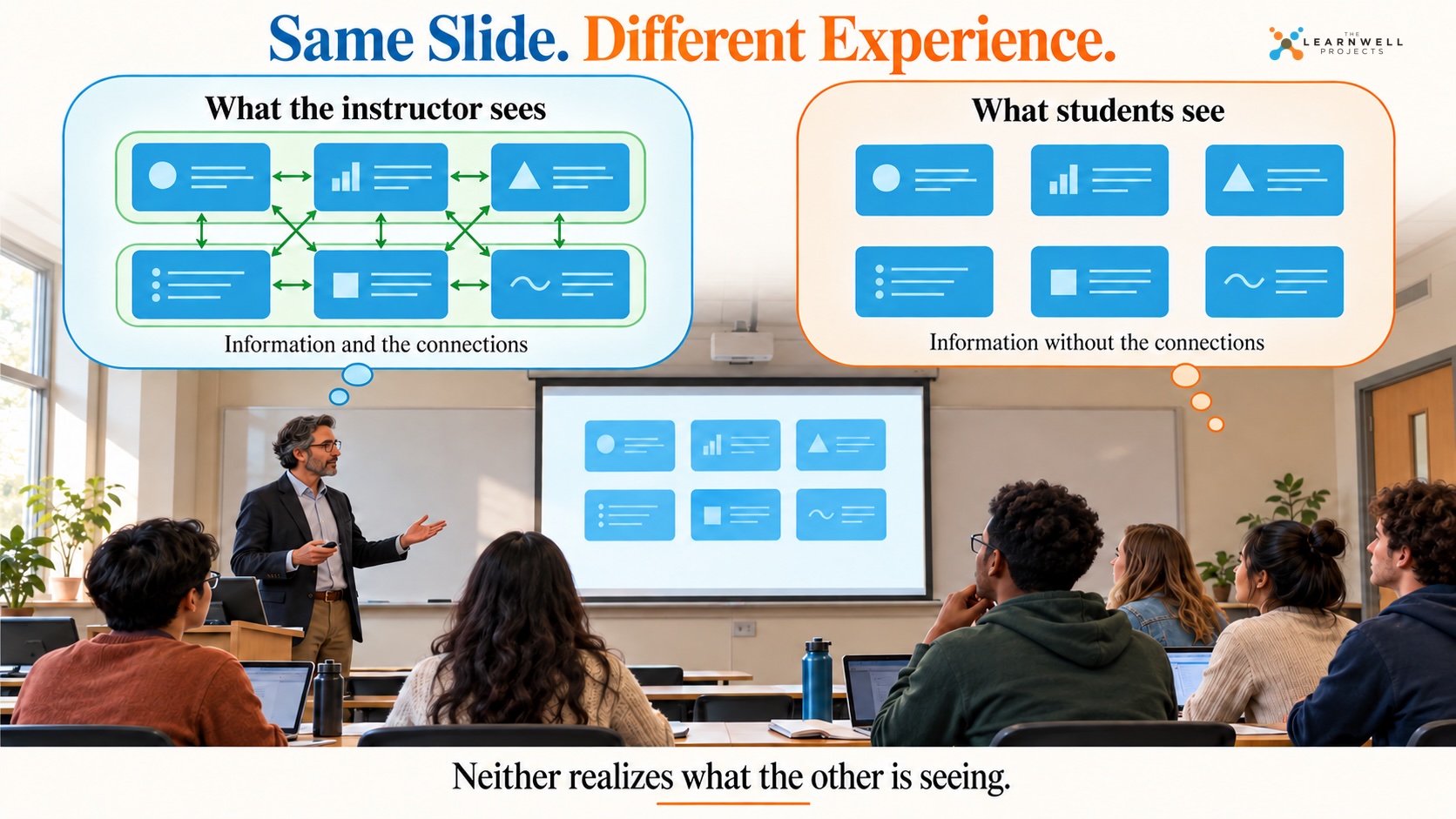
Instructors benefit from an invisible network of relationships forged over years of immersion in their disciplines. When they glance at a slide, they see the connective tissue linking principles across chapters and semesters. What they rarely realize is that this architecture remains largely invisible to students during lectures.
Consequently, comprehensive exams might use familiar terms from class, homework, and weekly quizzes, but they demand an entirely new way of interacting with the Three C elements. Students are suddenly asked to recognize patterns without any familiar prompting, choose among multiple competing approaches, and integrate concepts on the spot—mental labor they may be doing for the first time under timed pressure.
Telling Them Apart When a Student Is Sitting in Front of You
Naming the three is the easy part. The useful part is being able to tell which one broke, in a session, from what the student can show you. Each has a tell, and they are worth taking in this order, because ruling the first one out is fast and the other two get harder to see the longer you wait.
Content: the information isn’t there. It was taught in class or it sat in an assigned resource, and the student never took it in. They skipped it, missed it, or wrote it down wrong and used the wrong version faithfully all term. The tell is that they cannot begin. A student who has the material and is handling it with the wrong thinking skill starts and goes astray. A student who doesn’t have the material stalls at the first move, and a student who took it down wrong is consistently wrong in the same direction.
Cognition: the information is there, but the wrong thinking skill is running. A student can define gravity accurately and still be unable to explain it, and the exam question is assessing explaining. Or they can explain it perfectly well, and the lab is assessing whether they can use it in an experiment, which asks for applying or creating instead. The tell is an answer that is accurate and off-task. They are not wrong. They are answering a different question than the one in front of them, which is why this gets filed as carelessness more often than it gets diagnosed.
Conceptual understanding: the concept isn’t named, and they can’t find it. The student has the content and the formula. What they cannot do is pick the concept out of a context that doesn’t announce it. If gravitational force has to be deduced from the situation, or told apart from a similar force sitting next to it, they stall, because knowing the idea and recognizing it in the wild are not the same accomplishment. The tell is the gap between labeled and unlabeled work: fine on the chapter quiz, lost on the comprehensive; fine on the problem set that announced its method, lost on the exam that didn’t.
Two of these look identical from across a desk. A student who chose the wrong method and a student who ran the wrong thinking skill both produce a confident, carefully worked, incorrect answer. The question that separates them is whether the task named the concept. If it did and they still missed, look at cognition. If it didn’t, look at conceptual understanding first.
Try it yourself
Diagnose the Bomb
Same symptom every time: solid weekly work, then an exam that goes badly. Each set below holds one content failure, one cognition failure and one conceptual failure, in that order. Read each one, make your call, then open it to compare.
Six times, with a few sentences to go on, you weighed a situation and named where it broke. That is the whole move. Your staff makes it in a session with the student sitting across the table, the details arriving out of order and the clock running, which is considerably harder. The rest of this article is about making that move earlier, before an exam has to make it for us.
Making Metacognitive Leaps
Diagnosing after the fact is useful. Preventing the mismatch is better. The gap this article opened with, where the instructor sees a web of relationships and the student sees a list of items, closes when students make deliberate metacognitive leaps: building explicit bridges across content, cognition and conceptual products before test day.
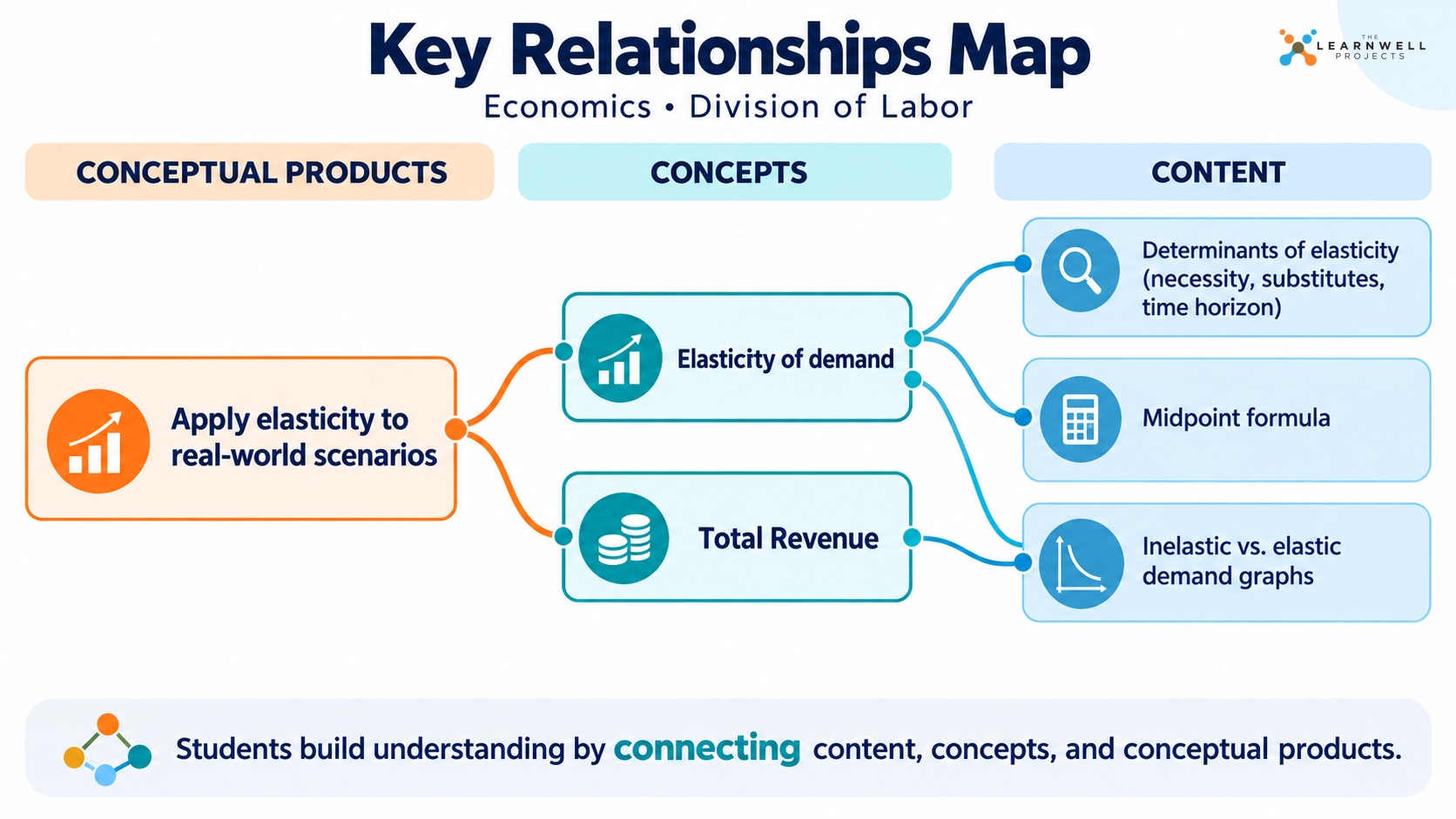
One note before the strategies. Content failures are the easy ones, and you rule them out in the first two minutes. Most academic helpers are already adept at addressing them: a student who cannot begin needs the missing information, and a capable tutor supplies it inside a single session. These three strategies handle what is left, which is where the hard cases live.
Three proactive strategies make this possible:
- Guiding (Framing Foreknowledge): Ensure students identify the intended conceptual products before diving into discrete details. This organizational scaffolding gives raw content immediate context, helping the brain map relationships naturally during lectures and study sessions.
- Gauging (Continuous Connection): Prompt students to regularly step back and anchor individual facts and problem sets to their broader conceptual parents. Instead of asking, “Did I solve this problem?” they should ask, “What category of problem is this, and why does this principle govern it?”
- Transforming (Cognitive Calibration): Ensure students deploy the specific cognitive skills that the final conceptual product demands. If an exam assesses synthesis, evaluation or real-world application, practicing simple recall or isolated formula execution will never suffice. This is the strategy that catches Sofia and Liam above: both had the material, and both rehearsed a thinking skill their assessment was not asking for.
When bright students like Emma struggle on high-stakes exams, they may question their capabilities. Educators may question their work ethic or their academic viability.
But they don’t lack the aptitude; they simply brought content-level preparation to a conceptual-level arena.
Imagine Emma approaching that same midterm with this metacognitive framework in place. When she opens the exam, she isn’t hunting for familiar keywords or trying to recall an identical homework problem. Because she practiced Guiding, she immediately spots which overarching principle governs Question 1. Because she practiced Gauging, the pairing of two separate chapters in Question 4 doesn’t catch her off guard—she spent the previous three weeks tracing how those ideas intersect. And because she engaged in Cognitive Calibration, her brain has already practiced the exact synthesis the exam demands under timed conditions.
The test hasn’t changed, but Emma’s mental architecture has.
“Students rarely need more effort. They need someone who can name which part of the work broke.”
Once students learn to diagnose the distinct mental labor comprehensive assessments require, they no longer get lost in the sauce; they use it to cook.
Helping students make this shift requires more than urging them to study longer; it requires teaching faculty and academic helpers how to reveal this hidden architecture.
Equip your community to find the break before the exam does.
Download — Post-Exam One-Pager
Downloadable Post-Exam One-Pager from The LearnWell Projects. PDF resource accompanying the related blog post.
"*" indicates required fields
Bibliography
- Chi, Feltovich, & Glaser (1981) — Categorization and representation of physics problems by experts and novices.
- Geddes (2023) — How to successfully transition students into college: From traps to triumph. Routledge.
- Rohrer, Dedrick, Hartwig, & Cheung (2020) — A randomized controlled trial of interleaved mathematics practice.
- Simón-Grábalos and colleagues (2025) — Systematic review of the literature on interventions to improve self-regulation of learning in first-year university students.
Share your reaction below. Your thoughtful comments encourage me to keep providing free resources, and they help others who read this article.


3 comments
Leonard Geddes
Hi Diane, I keep coming back to your point about syllabi and the Relationship Map. Have you or your SI leaders tried the new post-midterm conversation guide alongside them? I’d love to hear how they fit together. And would you be open to me quoting your comment in an upcoming note to subscribers?
Diane Eisenberg
From your previous work I have been instructing students, my Tutors and Supplemental Instruction Leaders to look to the course Syllabi to understand how the course contents connect to the course concepts and course learning objects. They have been encouraged to use the Relationship Map to identify the key relationships. Three Cs of Academic Work described in this latest edition will be so helpful in helping students visually understand the relationships. (I love the analogy of mixing the yellow and blue to get green).
Thank you for all your work!
Leonard Geddes
Hi Diane,
Thanks for your contribution. It’s so rewarding to hear that other educators and students are benefiting from these articles and tools. Keep learning and leading!